PACCAR MX-13 Turbocharger Guide: Kenworth T680 & Peterbilt 579 Applications
If you run a PACCAR MX-13 turbocharger in a Kenworth T680 or Peterbilt 579, you already know these engines live and die by boost control. The MX-13 is a 12.9L inline-six that puts out anywhere from 405 to 510 horsepower and up to 1,850 lb-ft of torque, and every bit of that performance leans on a variable geometry turbocharger (VGT) that has to survive EGR heat, hard duty cycles, and 800,000-plus mile expectations. When that turbo starts acting up, downtime gets expensive fast. This guide breaks down the MX-13 turbo system, the failure symptoms worth catching early, part number guidance, and how to decide between new, remanufactured, and rebuild.
PACCAR MX-13 Turbocharger: What You’re Working With
The MX-13 uses a Holset variable geometry turbocharger: the HE531VE on EPA10 and some 2014-2017 engines, with HE500VG units on many EPA13 and later engines. Mechanics who have worked on the Holset VGT units of the Cummins ISX and X15 will find the MX-13 turbo familiar in both operation and diagnosis.
The variable geometry section uses a sliding nozzle ring moved by an electric smart actuator, with actuator part numbers that differ by emissions year. The ECM commands nozzle position to control exhaust backpressure for the EGR system and the aftertreatment regeneration cycle. That means the turbo on an MX-13 is doing double duty: it makes boost and it drives emissions functions. When the nozzle sticks, you don’t just lose power, you throw fault codes and can trigger derates.
- Engine: PACCAR MX-13 (EPA10, EPA13, EPA17, EPA21)
- Displacement: 12.9L inline-six
- Turbo type: Single variable geometry (VGT) with sliding nozzle ring
- Actuator: Electric smart actuator, ECM controlled
- Applications: Kenworth T680, T880, Peterbilt 579, 567, 389 (spec dependent)
Emissions year matters. An EPA10 MX-13 turbo is not always a drop-in for an EPA17 truck. Actuator calibration, vane geometry, and mounting can differ across model years even when the housing looks identical. Always verify against your engine serial number before ordering.
Common MX-13 Turbo Part Numbers and Cross-Reference
PACCAR service part numbers and the underlying Holset/Cummins numbers both float around the parts world, which causes confusion. Below are commonly referenced numbers for the MX-13 turbo and its installation kit. Treat these as a starting point, then confirm by engine serial with your dealer or with PT Turbo before you buy.
| Component | Reference Numbers | Notes |
|---|---|---|
| MX-13 EPA10 turbo | Holset HE531VE, PACCAR 2117933 (remanufactured 2117933PRX) | Variable geometry; verify by engine serial number |
| Installation kit for the HE500VG fitted to later MX-13 engines | 172-784-0457 | Always replace gaskets on install |
One important note on actuators: the MX-13 smart actuator is calibrated to the specific turbo cartridge. You cannot reliably swap a used actuator onto a different turbo and expect correct vane travel. If you buy a remanufactured unit, it should come with the actuator matched and calibrated. This is one of the biggest advantages of buying a properly built reman over piecing parts together.
Symptoms of a Failing MX-13 Turbocharger
The MX-13 turbo rarely fails all at once. It gives you warning signs, and catching them early is the difference between a straightforward turbo replacement and a stranded truck with a fried DPF. Here is how symptoms break down by severity.
| Severity | Symptoms | Likely Cause |
|---|---|---|
| Early | Slight power loss, sluggish throttle response, occasional soot | Vanes beginning to carbon up, minor sticking |
| Moderate | Active regen frequency climbing, boost pressure faults, intermittent derate | Nozzle ring sticking, actuator working harder than commanded |
| Severe | Hard derate, no boost, actuator fault codes, whistle or grinding | Seized vanes, actuator failure, bearing or shaft damage |
| Catastrophic | Oil in charge pipe, blue smoke, metallic contact noise, blade contact | Bearing failure, oil seal failure, foreign object damage |
Watch for these fault codes on the MX-13: SPN 641 (VGT actuator), SPN 102 (boost pressure), and SPN 3251 (DPF differential pressure). When you see 641 paired with power complaints, the vanes are usually the culprit. Do not just clear the code and hope. A sticking nozzle ring drives up EGT and DPF loading, and that turns a turbo problem into a costly aftertreatment problem.
Don’t Overlook the Root Cause
Oil in the charge air cooler piping is often blamed on the turbo, but on the MX-13 it can also come from crankcase blowby or a saturated crankcase ventilation (oil) separator. Before you condemn a turbo for oil seal failure, confirm your crankcase ventilation system is functioning and check for excessive blowby. Installing a fresh turbo on a worn engine just kills the new unit.
New vs Remanufactured MX-13 Turbochargers
The MX-13 VGT is not a cheap part, and the price gap between OEM new and a quality remanufactured unit is significant. For fleets running multiple trucks, that gap adds up fast. Here is how the options compare.
| Option | Typical Price Range | Best For |
|---|---|---|
| OEM new (PACCAR/Holset) | Quoted by part number | Warranty-critical trucks, dealer-required repairs |
| Remanufactured (quality built) | Quoted by part number | Best value for most owner-operators and fleets |
| Rebuild service (your core) | From $575 at PT Turbo (price list) | Keeping a matched actuator, controlling cost |
A properly built remanufactured turbocharger is not a used part cleaned up. A real reman disassembles the unit completely, replaces the bearings, seals, thrust components, and nozzle ring hardware, balances the rotating assembly to spec, and calibrates the actuator to the cartridge. Done right, a reman MX-13 turbo performs to the same boost and nozzle travel specs as new, at a fraction of the cost. PT Turbo has been building turbos to that standard for over 45 years, and stocks both new and remanufactured MX-13 units.
If your original turbo core is in good shape and you want to keep costs down, a turbo rebuild service lets you send in your own unit. This is often the smart move when the actuator on your original is still healthy and calibrated, because you avoid re-matching hardware.
Installation and First-Start Best Practices
The MX-13 turbo install is straightforward for an experienced tech, but a few steps separate a job that lasts 500,000 miles from a comeback.
- Prime the bearings: Before first start, pre-lube the turbo oil inlet with clean engine oil and crank with the fuel shut off to build oil pressure to the center section.
- Replace the oil feed and drain lines: Coked oil supply lines are a top killer of new turbos. If the line is questionable, replace it.
- Inspect the EGR and charge air system: A restricted DPF or plugged EGR cooler puts abnormal backpressure on a fresh turbo. Clear the underlying restriction first.
- Calibrate the actuator: Run the actuator calibration/learn routine with your diagnostic tool after install so the ECM knows the vane endpoints.
- Idle before load: Let the engine idle 3 to 5 minutes at first start and again before shutdown after hard runs to protect the bearings.
Skipping the actuator calibration is the number one cause of post-install fault codes on the MX-13. The ECM needs to relearn the vane travel limits, especially on a reman or new unit where the mechanical endpoints differ slightly from your old turbo.
Document the calibration and your install checks before the truck leaves the shop. If a fault pops up down the road, knowing the actuator learned clean endpoints on day one tells you the problem is new, not a leftover from the install.
A turbo needs no break-in mileage, but the first weeks are when an installation fault shows. Keep an eye on boost response and regen frequency, and listen for any change in turbo tone. A turbo that was installed right settles in quietly and holds its vane travel. Anything drifting off within the first week points back to something upstream you missed, not the turbo itself.
For the Peterbilt 389, with both its Cummins ISX and PACCAR MX-13 fitments, see our Peterbilt 389 turbocharger guide.
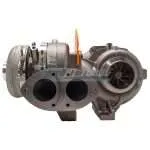
Turbos we list for the HE531VE and HE500VG
Listings for the turbo models named in this guide that can be ordered online today. Several part numbers can fit one engine by year and rating, so match the number on your turbo’s tag, or call (909) 824-1020 and we will match it for you.
Frequently Asked Questions
What turbocharger does the PACCAR MX-13 use?
The PACCAR MX-13 uses a variable geometry turbocharger (VGT) that manages boost across the engine’s power range while handling EGR heat and heavy duty cycles.
How much horsepower and torque does the PACCAR MX-13 produce?
The 12.9L inline-six MX-13 produces between 405 and 510 horsepower and up to 1,850 lb-ft of torque, all dependent on proper boost control from the VGT.
Which trucks use the PACCAR MX-13 turbocharger?
The PACCAR MX-13 turbocharger is commonly found in the Kenworth T680 and Peterbilt 579, both of which rely on precise boost control for performance.
Further reading: Learn more about turbocharger technology.
Need a Turbocharger?
PT Turbo has rebuilt and sold turbochargers since 1978. We stock remanufactured units for Cummins, Duramax, Power Stroke, Detroit Diesel, and more — backed by a 12-month unlimited mileage warranty. Units in stock at our shop in San Bernardino, CA ship the same day when ordered before 2 PM Pacific, Monday through Friday.
📞 (909) 824-1020 · 346 S I St. #3, San Bernardino, CA 92410 · [email protected]
More From PT Turbo
 Ford 6.7L Powerstroke Turbocharger: Problems, Symptoms and Replacement Guide
- Volvo D13 Turbocharger Guide: Holset HE451VE, Symptoms & Replacement Options
- Ford 7.3L Powerstroke Turbocharger Guide: TP38, E99 & GTP38 Models Explained
- Detroit DD16 Turbocharger Guide: Turbo-Compound System, Failure Symptoms & How It Differs from the Mack MP10