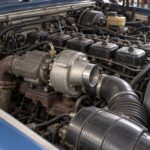
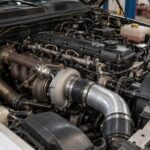
Massey Ferguson Tractor Turbocharger Guide: AGCO Power, Perkins & Cummins Engines
In this Massey Ferguson tractor turbocharger guide, we start with the tag on the turbo instead of the badge on the hood, because the tag tells you exactly which unit you need. Massey Ferguson tractors have been built with AGCO Power, Perkins and Cummins engines. A model name alone does not tell you the engine, its rating or the turbo bolted to it.
PT Turbo has been rebuilding turbochargers since 1978, and after more than 45 years as a family-owned shop we work from the turbo’s part number every time. This guide covers:
- How to read each turbo maker’s tag
- Which Holset turbos the Cummins engine families are listed with
- How tractor turbos fail in field work
- How to fit a replacement so it has the best chance of a long service life
AGCO Power, Perkins and Cummins: What Each Engine Means for the Turbo
AGCO, Massey Ferguson’s parent company, builds its own diesels through AGCO Power, and those engines sit in many current Massey Ferguson tractors. Turbo choice follows displacement, power rating and emissions level, so two tractors from the same series can carry different turbos. The turbo maker’s name and part number are on the turbo itself.
Perkins engines powered many Massey Ferguson tractors over the years. A Perkins engine number identifies the engine, not the turbo. Different ratings in one engine family can use different turbos, and replacement numbers get superseded.
Cummins engines show up in some larger Massey Ferguson and other AGCO machines. They are usually listed with Holset turbos, which fits: Holset is a Cummins brand, and the company has been Cummins Turbo Technologies since 2006. On a Cummins engine the CPL number is on the engine dataplate, not the turbo, so have both plates handy when you call.
Reading the Turbo Tag Before You Order
Every factory turbo carries a nameplate with the turbo maker’s assembly number. On factory-fitted units the engine maker’s part number usually appears as a separate field. That helps when a dealer quotes you by the AGCO, Perkins or Cummins number. The Wikipedia turbocharger overview covers the basics of how the compressor and turbine work together.
| Turbo maker | Where to look | Part number format | What else is on the tag |
|---|---|---|---|
| Holset | Data plate on the compressor housing | Seven digits plus a letter suffix (for example 3534610H) | Holset assembly number and the engine maker’s (customer) number as separate fields |
| Garrett | Nameplate on a housing; position varies by region and plant | Six digits, a dash, four digits, then S or W. First digit after the dash: 0 original equipment, 5 new aftermarket, 9 remanufactured | OE plates also show the vehicle maker’s number; W means a gasket kit is included |
| BorgWarner | Compressor housing | Six digits on older S-series, eleven on newer numbers; older KKK units are written 4-3-4 (5331-970-7101) | BorgWarner part number, serial number and, on factory units, the engine maker’s number |
Two warnings apply here:
- Casting numbers are not part numbers. One casting serves many turbos, so a casting number only narrows the search.
- The number does not describe the turbo. You cannot read wheel sizes or a wastegate out of a Holset or Garrett number, so match the whole number.
If the tag is gone or burnt off, send the engine dataplate details and the engine serial number. Add clear photos of both housings, the inlet and outlet flanges and any actuator. Wheel sizes and turbine housing A/R then confirm the match.
Turbos we list for the WH1E, HE300VG and HE300WG
Listings for the turbo models named in this guide that can be ordered online today. Several part numbers can fit one engine by year and rating, so match the number on your turbo’s tag, or call (909) 824-1020 and we will match it for you.
All WH1E listings · All HE300VG listings · All HE300WG listings
Holset Turbos Listed on Cummins Engine Families
The table shows the Holset models that Cummins engine families are listed with across trucks, machines and industrial installs. It is not a fitment list for any Massey Ferguson model. AGCO specified its own ratings, and the tag on your turbo decides.
| Cummins engine family | Holset turbos listed | Type |
|---|---|---|
| 4BT / 6BT (B-series) | Holset HX30 / Holset HX35 | HX family; go by part number |
| 4-cylinder B-series (QSB4.5, ISBe4, ISDe4) | Holset HE221W | Small wastegated Holset; numbers differ by rating and emissions level |
| QSB6.7 industrial, Tier 3 | Holset HX35W | Wastegated |
| QSB6.7 industrial, Tier 4 | Holset HE300VG or Holset HE341VE; Holset HE300WG on some ratings | Sliding-nozzle variable geometry with electronic actuator; HE300WG is wastegated |
| 8.3L C-series (6CTA) | Holset HX40 / Holset HX40W; Holset WH1E on our 6CTA listings | HX40 has no wastegate; HX40W and WH1E are wastegated |
One of our WH1E listings, 3534610H, carries an AGCO application row for a Cummins 6CTA 260 hp engine. AGCO sells machines under more than one brand, so that row does not prove which tractor a turbo came off. The WH1E is the wastegated version of the Holset H1E and belongs to the mechanical-engine era. There are no electronic codes and no actuator calibration on these units, and the wastegate actuator is tested with a hand pump.
The Tier 4 QSB6.7 turbos are variable geometry turbochargers, but Holset’s design moves a sliding nozzle ring rather than pivoting vanes. The HE300VG has no separate position sensor; position feedback is inside the actuator. After fitting, the electronic actuator is calibrated to its own turbo with Cummins INSITE or the eTool.
Never force the actuator’s arm by hand, because the self-locking gears break. Our Cummins ISB 6.7L turbocharger guide goes deeper on how these sliding-nozzle turbos work and fail.
How Tractor Turbos Fail in Field Work
Dust
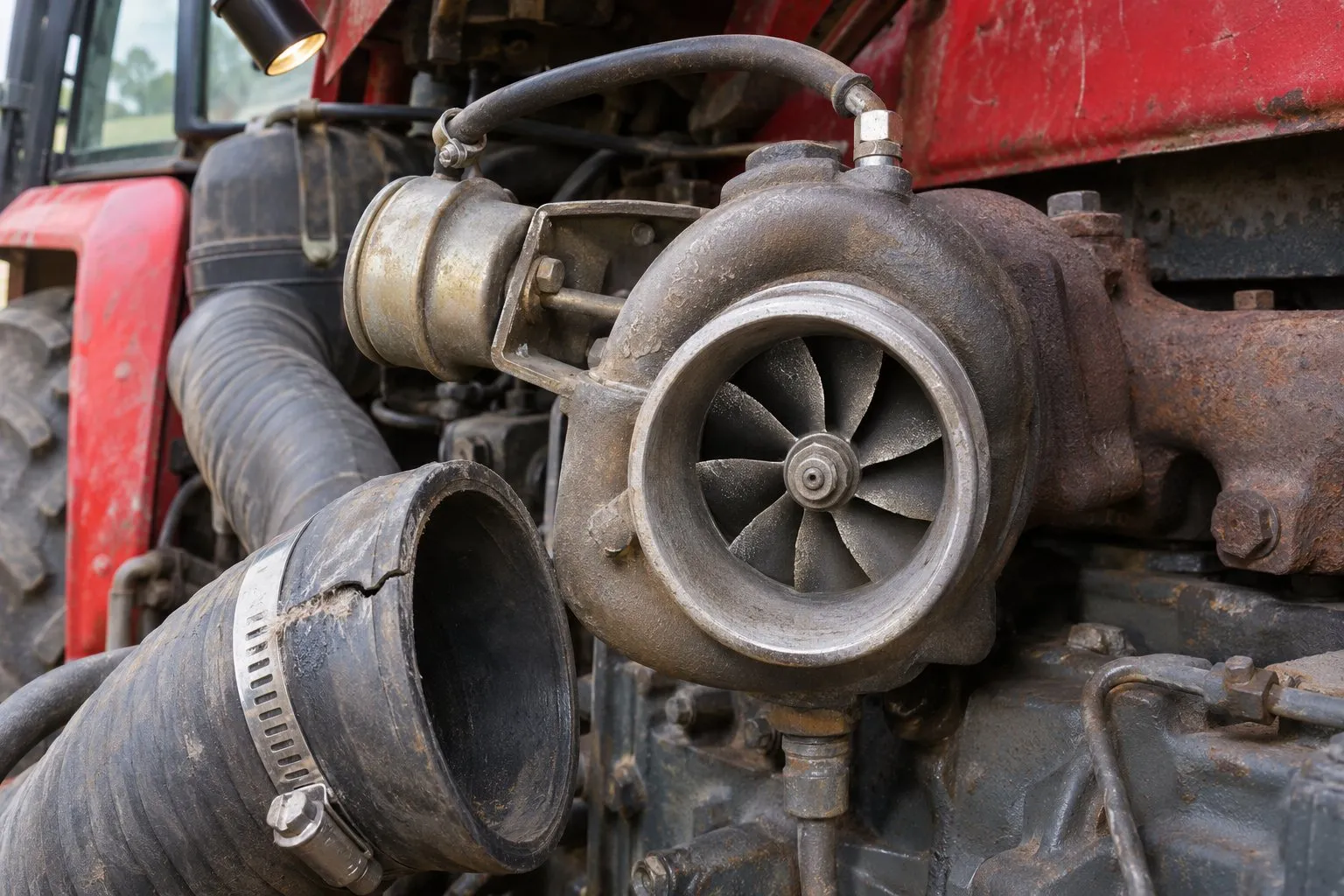
Field air is hard on a turbo. Dust that gets past the filter shows as pitting on the compressor inlet blades, while bent or chipped blades mean something solid went through. The inlet pipe between the filter and the turbo is under suction, so a crack, loose clamp or chafed hose lets dirt in without ever showing as a boost leak. Replace the air filter when the restriction indicator says so.
Oil supply and contamination
Garrett states that more than 90 percent of turbo failures come from oil starvation or oil contamination. Starvation comes from hard acceleration on cold oil, blocked or leaking oil pipes, or a turbo that was never primed at fitting. Contamination comes from:
- Carbon, which Garrett names as the most common contaminant
- Engine wear debris
- Dirt let in during servicing
- A faulty filter bypass
- Degraded oil
Follow the maker’s oil schedule, or its severe-service schedule if you work in dust or idle a lot.
Heat and shutdown habits
Shutting down hot after heavy PTO work or tillage cooks the oil in the center housing into carbon. Holset’s failure-diagnosis poster calls for two to three minutes at idle before shutdown. Cummins gives 3 to 5 minutes after extended full-throttle or high-power operation. For AGCO Power and Perkins engines, use the time in the operator’s manual.
At startup, idle only until oil pressure reads normal, then work the tractor gently until it is warm.
Drain and crankcase pressure
Oil leaves the turbo by gravity. The drain must run downhill, within about 15 to 20 degrees of straight down, and enter the pan above the oil level. A restricted drain backs oil up and leaks it at both ends of the turbo. There is no universal healthy crankcase pressure, so compare your reading with the engine’s service manual.
| Symptom | What it points to | Check first |
|---|---|---|
| Black smoke, low power under load | Low boost, too little air | Air filter restriction, charge-air leaks (at the maker’s test pressure), exhaust leaks before the turbine, wastegate or nozzle stuck open |
| Blue-gray smoke or pooled oil in charge pipes | Oil reaching intake or exhaust | Breather, air filter, oil level and drain, then the turbo seals |
| Oil at both ends of the turbo | Restricted drain or high crankcase pressure | Drain routing and kinks, crankcase pressure against the manual |
| Whine or siren noise | Exhaust leak before the turbine, boost leak, or a wheel rubbing | Every joint, then wheel contact with the housing |
| Overboost on a variable geometry turbo | Nozzle sticking closed | Actuator operation, carbon on the nozzle |
A light oil film in the charge pipes is normal crankcase vapor; pooled oil is not. Tractor engine controllers report their own fault codes through the maker’s service tool, not the generic OBD-II codes used on road vehicles, so look each code up in the engine maker’s documentation. On engines with a DPF, the filter sits after the turbo. Let an active regeneration finish when the maker advises it.
Replacing or Rebuilding a Massey Ferguson Turbo
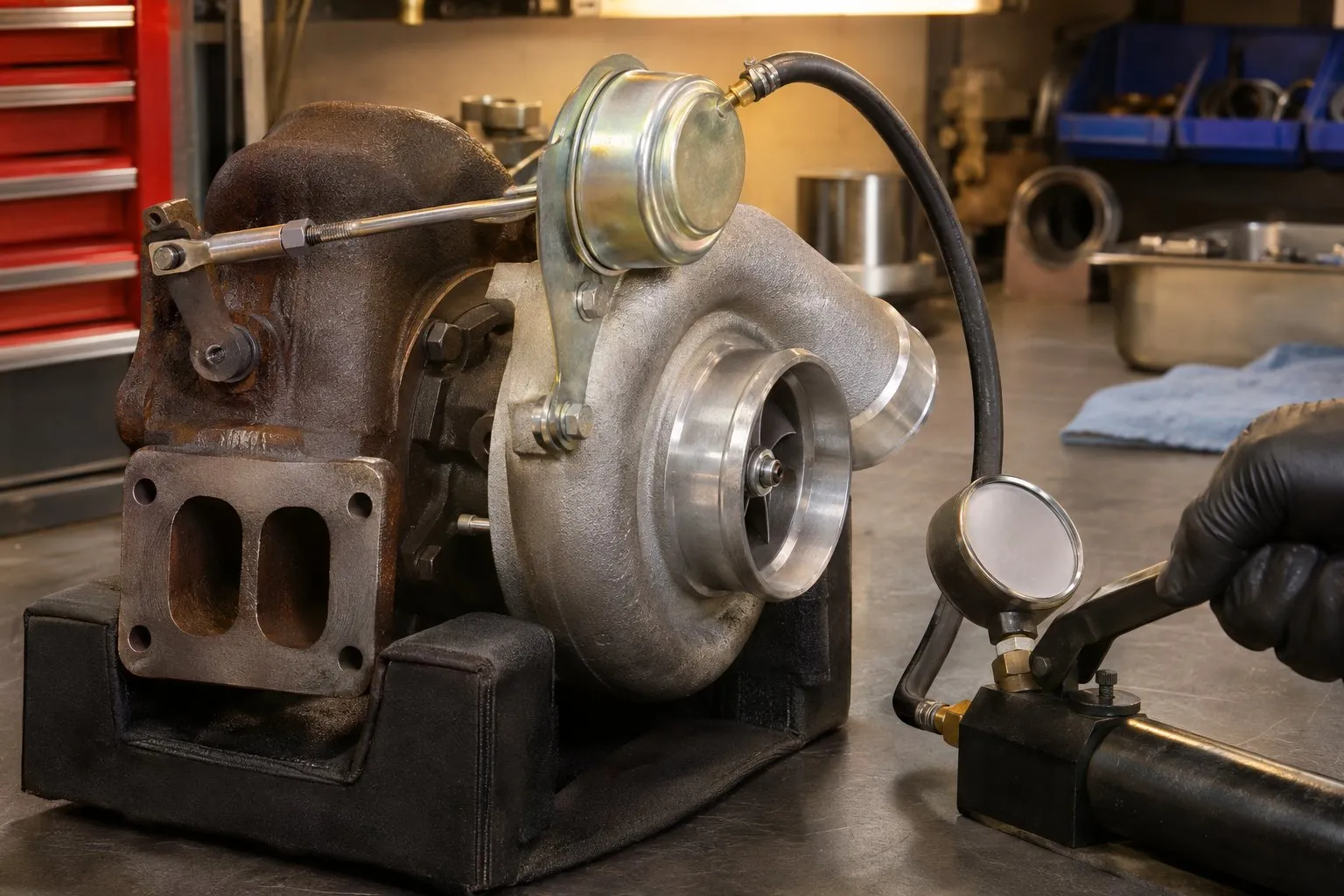
Before you condemn the old turbo, check the shaft. Some side-to-side rock is normal on a journal-bearing turbo. In-and-out play you can feel, or a wheel that touches its housing, condemns it. Then fit the replacement in this order:
- Fix the cause first. Find whatever starved, contaminated or overheated the old turbo.
- Replace the oil feed line after a bearing failure or coked oil, rather than flushing and reusing it.
- Replace the charge air cooler if the compressor wheel came apart. Metal in the fins cannot be flushed out reliably. Inspect the charge piping and clean or replace it.
- Use new gaskets and no sealant on the oil inlet or drain. Installation kits are matched to the turbo number, so send us the tag number.
- Prime before first start. Fill the oil inlet with clean engine oil and turn the wheel by hand. Crank 10 to 15 seconds without starting, disabling fueling by the engine maker’s procedure. Then idle 3 to 4 minutes and check for oil, exhaust and air leaks before load.
- Set up the actuator. Calibrate an electronic actuator to its turbo with the service tool. Test pneumatic wastegate actuators with a hand pump.
PT Turbo’s turbocharger rebuild service handles tractor turbos alongside truck and equipment units. Every in-house rebuild is balanced on a VSR (Vibration Sorting Rig). Each one then gets a final quality inspection: a leak test, a visual inspection and an actuator or wastegate function check.
Most rebuilds ship in 3 days or less. The rebuild price is confirmed after inspection and before work starts, and our turbo rebuild price list shows current figures by turbo. Rebuilds carry a 12-month warranty with unlimited mileage, and operations running several machines can arrange priority turnaround by phone.
To find a new or exchange unit, search our full turbo catalog or the remanufactured turbocharger category by the number on your turbo’s tag. Availability depends on core supply, and current pricing is on each product page or at (909) 824-1020. Cores go back within 30 days; if you need longer, call ahead and the shop can usually work with you. For a turbo you cannot find listed, contact PT Turbo with the tag number and photos.
Frequently Asked Questions
Can I order a turbo by my Massey Ferguson model number?
Not reliably. A tractor series can carry different engines, ratings and emissions levels, and each can use a different turbo. Order by the part number on the turbo’s tag. If the tag is missing, send the engine dataplate details and photos of the housings so the unit can be matched by wheel sizes and housing A/R.
Why does my tractor keep going through turbos?
Look at oil and air before blaming the turbo. Garrett states that more than 90 percent of turbo failures come from oil starvation or contamination, and field dust gets in through a leaking filter seal or a cracked inlet pipe. Check the oil feed and drain, the air filter and its restriction indicator, the inlet piping, and your shutdown habits after heavy work.
Should I rebuild my tractor turbo or replace it?
If the housings are sound and the cause of failure has been fixed, rebuilding your own turbo is often the practical route, especially on older engines where replacements are hard to find. PT Turbo confirms the rebuild price after inspection and before work starts, and most rebuilds ship in 3 days or less. If a housing is cracked or the damage is severe, the quote may point to a replacement instead.
Need a Turbocharger?
PT Turbo has rebuilt and sold turbochargers since 1978. We stock remanufactured units for Cummins, Duramax, Power Stroke, Detroit Diesel, and more — backed by a 12-month unlimited mileage warranty. Units in stock at our shop in San Bernardino, CA ship the same day when ordered before 2 PM Pacific, Monday through Friday.
📞 (909) 824-1020 · 346 S I St. #3, San Bernardino, CA 92410 · info@ptturbo.com