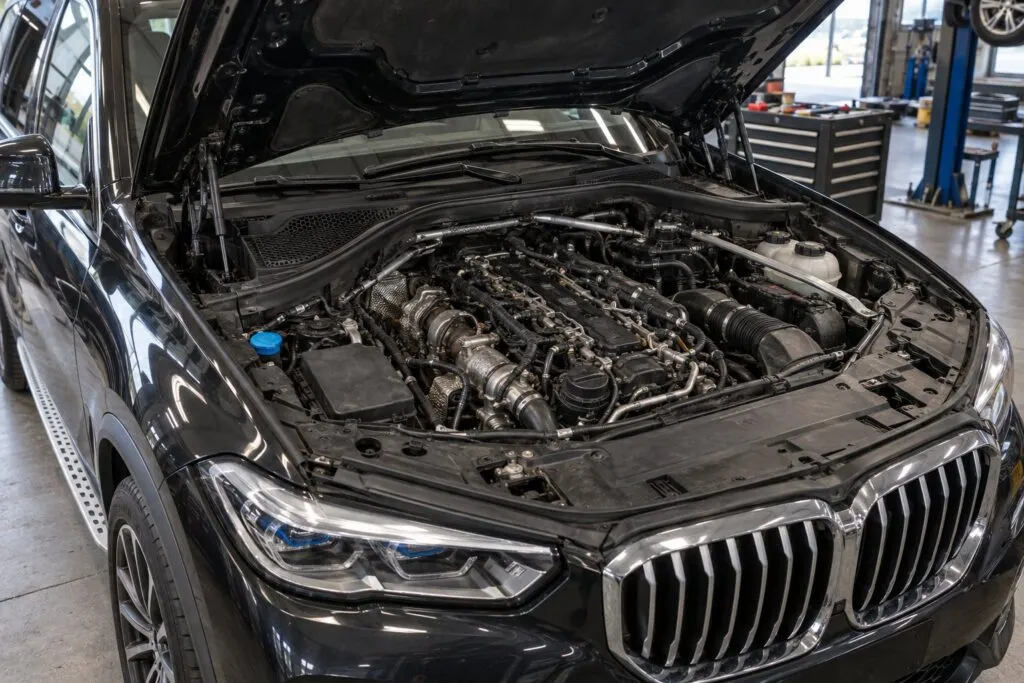
This BMW B57 Turbocharger Guide covers everything diesel technicians and owner-operators need to know about the turbocharging systems fitted to the 530d, 730d, and X5 40d, including how BMW’s staged multi-turbo layout actually works and where these units tend to fail. The B57 replaced the well-known N57 and brought tighter emissions control, higher injection pressure, and a more complex boost management strategy. If you service European diesels or run a fleet of BMW SUVs, understanding this platform saves you diagnostic time and prevents unnecessary parts swaps.
PT Turbo has spent 45+ years rebuilding, testing, and supplying turbochargers and actuators for everything from Cummins big rigs to European performance diesels. Below is the practical breakdown we give our own customers when a B57 rolls in with a boost complaint.
B57 Engine Overview: What You Are Working With
The B57 is BMW’s modular 3.0L (2993cc) inline-six diesel, part of the same B-series family as the four-cylinder B47. It uses DOHC 24-valve architecture, common-rail direct injection, and an aluminum crankcase whose cylinder bores carry a sprayed iron coating instead of cast-iron liners.
It appears across a huge range of chassis: the G30 530d and G11 730d, the G05 X5 xDrive40d, plus 540d, 740d, and X7 variants. Output depends heavily on the turbo configuration, not just the tune.
Here is where a lot of confusion starts. Buyers hear “tri-turbo” from the older N57S era and assume every high-output B57 uses three chargers. In reality, the B57 family runs single-turbo, twin-turbo, and quad-turbo layouts depending on the power variant.
BMW B57 Turbocharger Guide to the Staged Boost System
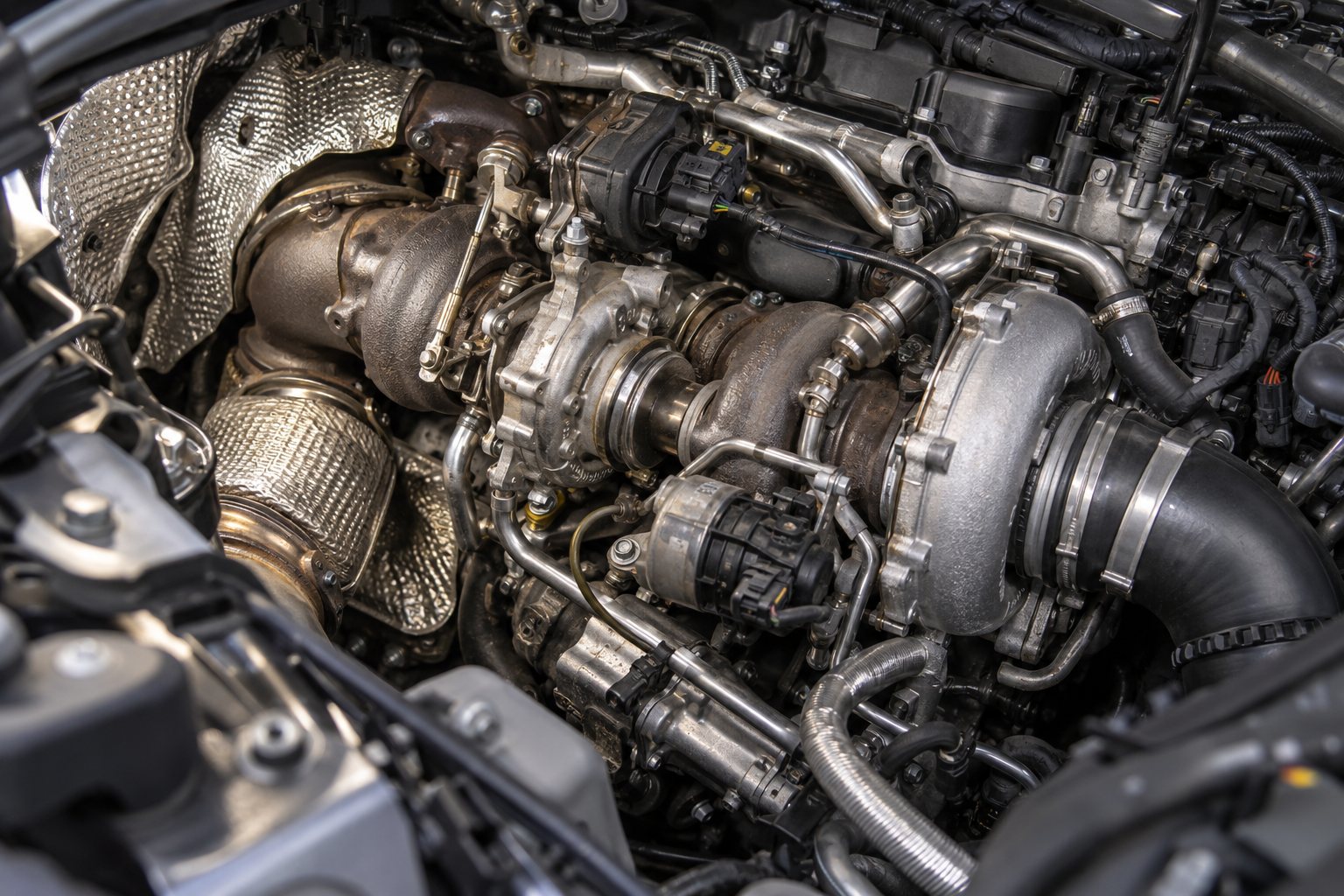
The B57 uses sequential, or two-stage, turbocharging on its higher-output models. Instead of one large turbo, BMW pairs a small high-pressure turbo with a larger low-pressure turbo so the engine gets fast spool at low rpm and strong flow up top.
The small charger spins up almost instantly off idle to kill turbo lag. As exhaust volume climbs, control flaps and a variable-geometry mechanism progressively hand airflow duties to the larger unit. This is why B57 diesels feel so responsive despite displacing only 3.0 liters.
Most of these turbos use variable-geometry turbocharger technology, where movable vanes change the effective housing geometry on the fly. Vane position is set by an electric actuator, and that actuator is one of the most common failure points on the entire platform.
Turbo Configuration by Model
| Model / Variant | Engine Code | Turbo Setup | Approx. Output |
|---|---|---|---|
| 530d / 730d (to mid-2020) | B57D30O | Single VGT | 265 hp / 620 Nm |
| X5 xDrive40d / 540d / 740d | B57D30T | Twin-turbo (two-stage) | 320-340 hp / 680-700 Nm |
| M50d (750d, X5/X7 M50d) | B57D30S | Quad-turbo | 400 hp / 760 Nm |
The takeaway: a base 530d or 730d built before the mid-2020 update runs a single variable-geometry charger (after it, the 30d engine is a two-stage twin-turbo as well), the 40d-badged cars run a genuine two-stage twin setup, and only the M50d models, the M550d and the 750d use four turbos, an engine BMW dropped in 2020. Knowing which system you are dealing with before you quote a repair is critical, because the parts and labor differ enormously.
Common B57 Turbo Failure Symptoms
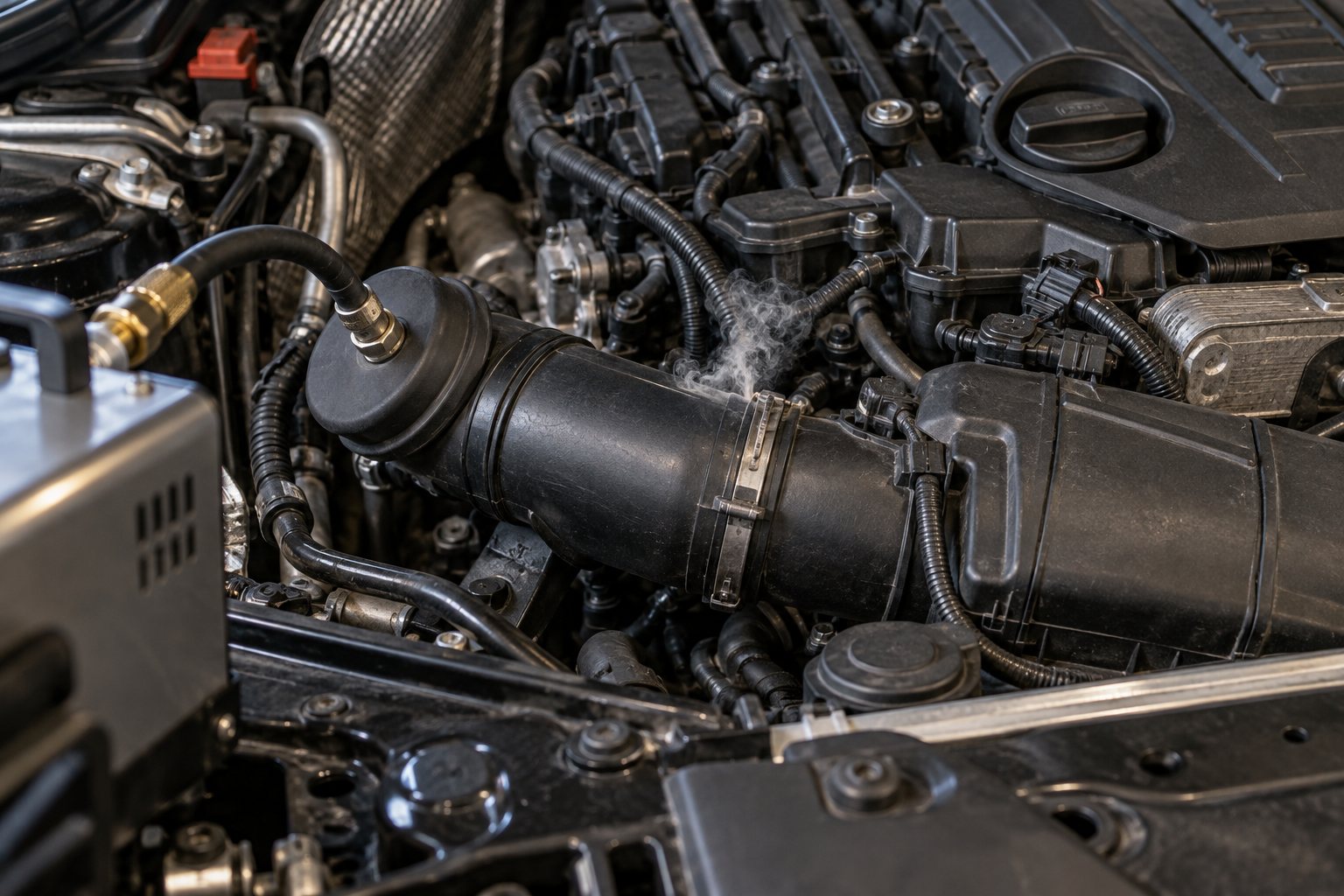
The B57 turbos themselves are robust, but the supporting hardware is where problems show up. Oil supply issues, sooty exhaust gas recirculation deposits, and worn actuators account for the majority of shop visits.
Watch for these patterns before condemning a complete turbo:
- Sticking VGT vanes: carbon buildup locks the vane mechanism, causing over-boost or under-boost limp mode faults.
- Failed actuator: an electric actuator that no longer holds position throws boost deviation codes.
- Whistle or siren noise: often a boost leak at the charge pipes or a compromised seal, not always the turbo core.
- Blue smoke and oil consumption: worn center bearing seals letting oil into the intake or exhaust.
- Loss of power with DPF regen faults: low boost disrupts regeneration cycles on the diesel particulate filter.
Symptom Severity Guide
| Symptom | Likely Cause | Severity |
|---|---|---|
| Intermittent limp mode, no smoke | Sticking vanes / actuator calibration | Low to moderate |
- Boost deviation codes with blue smoke: worn center bearing seals, high severity and a sign the core needs rebuilding rather than cleaning.
- Audible whistle under load: charge pipe or seal leak, usually low severity and cheap to chase down before touching the turbo.
- Repeated DPF regen failures with low boost: moderate to high, since unburned soot accelerates vane fouling and feeds the problem.
The pattern worth remembering is that soft faults, meaning intermittent limp mode and calibration drift without any oil smoke, almost always trace back to the vanes or actuator and can be resolved without replacing the core. Hard faults that show smoke, oil loss, or play in the shaft mean the center cartridge is worn and no amount of cleaning will bring it back.
Diagnose in that order and you avoid the most expensive mistake on this platform: condemning a healthy turbo when a stuck actuator or a clogged intake path was the real culprit.
Frequently Asked Questions
Does the BMW B57 have a tri-turbo system?
No. The tri-turbo engine was the older N57S. The B57 comes with a single variable-geometry turbo (530d and 730d up to mid-2020), a two-stage twin-turbo setup (540d, 740d, X5 40d, and the 30d models from mid-2020) or four turbos (the M50d models, the M550d and the 750d, up to 2020). On the multi-turbo versions, smaller and larger turbochargers take over at different engine speeds.
What is the difference between the BMW B57 and N57 engines?
The B57 replaced the N57 with tighter emissions control, higher injection pressure, and a more complex boost management system. These changes improve efficiency but also add complexity to the turbocharging setup.
What are common turbocharger failures on the BMW B57?
Common issues include wastegate actuator faults, boost pressure inconsistencies, and wear on the staged turbo components. Early diagnosis helps prevent costly damage to the wider engine.
PT Turbo rebuilds BMW B57 turbochargers. See our turbo rebuild service.
Need a Turbocharger?
PT Turbo has rebuilt and sold turbochargers since 1978. We stock remanufactured units for Cummins, Duramax, Power Stroke, Detroit Diesel, and more — backed by a 12-month unlimited mileage warranty and same-week shipping from San Bernardino, CA.
📞 (909) 824-1020 · 346 S I St. #3, San Bernardino, CA 92410 · [email protected]