New Holland T8 Series Tractor Turbocharger Guide: FPT Engine Applications
We wrote this New Holland T8 Series tractor turbocharger guide for owners, dealer technicians and farm shop mechanics who need the right turbo on a big row-crop tractor the first time. The T8 runs FPT power, and the parts listings for FPT Cursor 9 tractors show two very different turbos: a wastegated Holset on earlier engines and an electrically actuated Garrett variable nozzle unit on later emissions levels. The badge on the hood will not tell you which one you have. The tag on the turbo will.
FPT Cursor 9 Power: Start at the Engine Plate
New Holland builds the T8 around FPT Industrial’s Cursor 9. Check the engine data plate to confirm what is in your tractor. FPT also supplies Cursor engines for Iveco trucks and Case IH Magnum tractors, and the turbo listings we checked for Cursor 9 tractors name the Magnum rather than the T8.
The same engine name does not mean the same turbo. Rating, emissions level and build year all change the part number. Before you order, record two things:
- The engine data plate. The engine model and serial number tell the parts counter which build you have.
- The turbo tag. On a Holset, the data plate sits on the compressor housing. It shows the Holset assembly number (seven digits plus a letter, such as 3787091H) and the engine maker’s number as separate fields. A Garrett number reads six digits, a dash, four digits and an S. The first digit after the dash marks the sales channel: 0 for original equipment, 5 for new aftermarket and 9 for remanufactured. Where the Garrett nameplate sits varies by region and plant.
Ignore the casting numbers on the housings. One casting serves many turbos, so a casting number only narrows the search. The same rule holds across machine engines. Our Caterpillar C9 turbocharger guide shows how one engine name splits into several turbo part numbers.
Turbos Listed for FPT Cursor 9 Tractors
Earlier Cursor 9 tractors are listed with a Holset HX52W, the wastegated version of the HX52. The Holset HX52 family also appears on the Iveco Cursor 9 truck engine, so you will see these turbos cross-referenced between trucks and tractors. Do not order on that cross-reference alone.
Tier 4B Cursor 9 tractors from 2020 on are listed with an electrically actuated Garrett GTC4088V, part number 841805-5020S. The Holset HX55W appears in the listings mainly for Cursor combines, not tractors.
| Application as listed | Turbo | Boost control | What to check first |
|---|---|---|---|
| Earlier Cursor 9 tractors (listings name the Case IH Magnum) | Holset HX52W | Fixed geometry turbine with a wastegate | Wastegate flapper seating, free linkage, shaft play, oil supply and drain |
| Tier 4B Cursor 9 tractors, 2020 on | Garrett GTC4088V (841805-5020S) | Variable nozzle turbine, electric actuator | Actuator fault codes, carbon on the vanes and unison ring, vanes sticking |
| FPT Cursor combines | Holset HX55W (listed mainly for combines) | Fixed geometry turbine with a wastegate | The tag number. A combine turbo is not a tractor turbo by default |
Read the table as a map of what exists, not as a fitment chart for your serial number. If your tag shows a number that is not in this table, order by that number.
Turbos we list for the HX52W, HX52 and HX55W
Listings for the turbo models named in this guide that can be ordered online today. Several part numbers can fit one engine by year and rating, so match the number on your turbo’s tag, or call (909) 824-1020 and we will match it for you.
How the Two Designs Work and How They Fail
Wastegated Holset HX52W
In a Holset name, the W means wastegated, not water-cooled. The turbine housing is fixed. A wastegate valve lets part of the exhaust bypass the turbine once boost reaches its target.
The wastegate can fail in two directions:
- Flapper does not seat. Exhaust slips past the turbine, so you get low boost and slow spool under load.
- Gate sticks shut or opens late. You get overboost. If your actuator is the boost-opened diaphragm type, a leaking diaphragm makes the gate open late, not early.
Garrett GTC4088V Variable Nozzle
The V in a Garrett name marks a variable nozzle turbine. Movable vanes around the turbine wheel change the flow area. Closed down, they spin the turbo faster at low engine speed. Opened, they let exhaust through with less restriction at high load. On these Tier 4B tractors, an electric actuator moves the vanes on the engine controller’s command.
Vanes stuck closed give overboost and high drive pressure. Vanes stuck open give low boost and black smoke. Carbon and soot on the vanes and unison ring are a common reason they stick.
Never move an electric actuator’s arm by hand. The gears are self-locking and will break. Garrett calibrates its electronic actuators to their own turbo at assembly and publishes no per-part calibration data, so treat the turbo and actuator as a matched set.
Diagnosing Low Power, Smoke and Oil on a T8
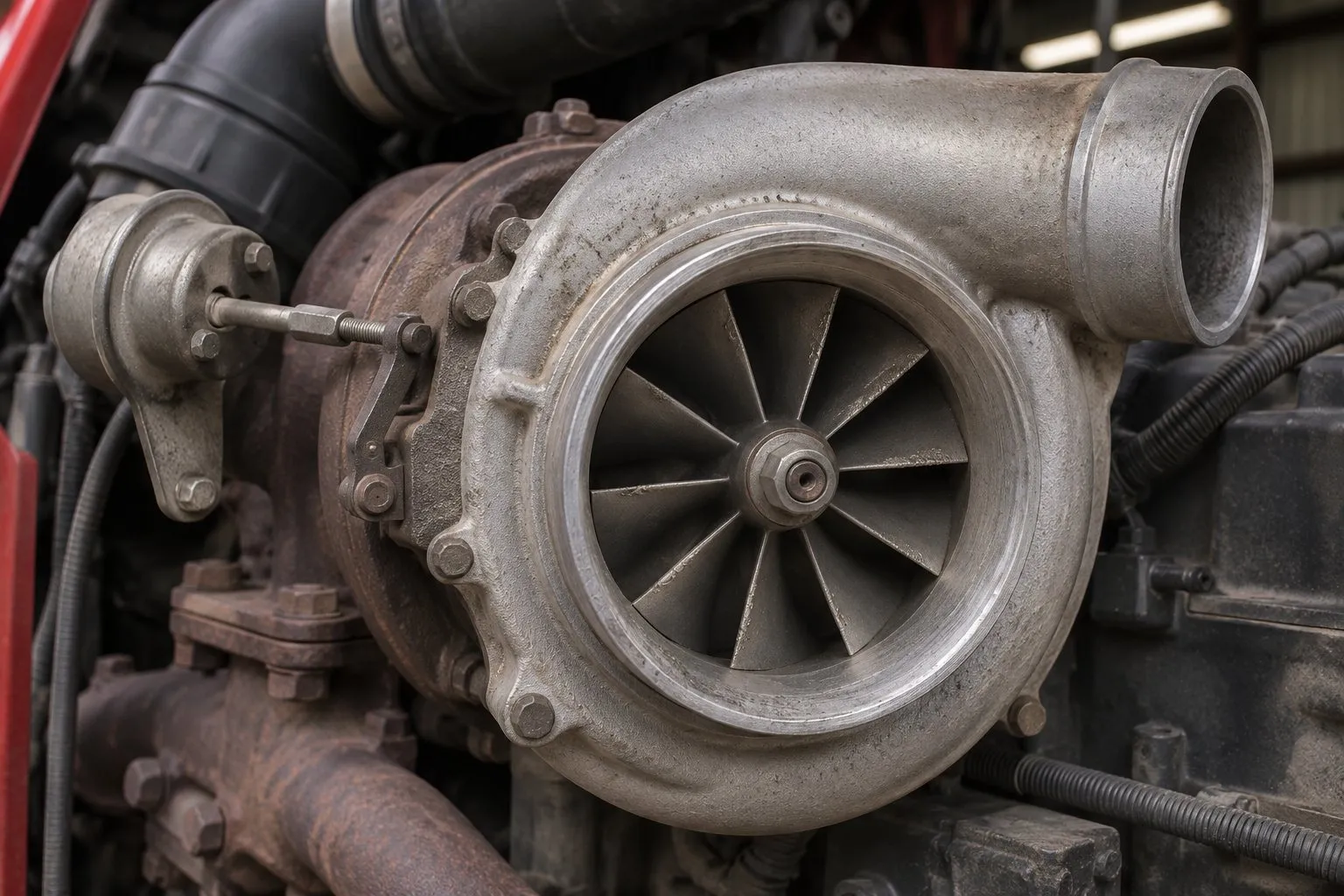
Low power with black or dark gray smoke means the engine is short of air. Before you condemn the turbo, work through the air path in this order:
- Air filter. Replace it when the restriction indicator says so, and check the housing seals.
- Inlet piping before the turbo. This side is under suction. A crack here cannot leak boost, but it lets field dust straight into the compressor.
- Charge air piping and cooler. A leak after the compressor makes the turbo spin faster to reach target boost, which can overspeed it.
- Exhaust leaks before the turbine. A leaking manifold gasket or joint lets exhaust escape before it does any work. The result is low boost, slow spool and higher exhaust temperature.
Then inspect the turbo itself:
- Compressor blades. Pitting on the inlet edges points to dust getting past the filter. Bent or chipped blades mean something solid went through.
- Shaft play. Some side-to-side rock at the wheel is normal on a journal bearing turbo with the engine off. In-and-out play you can feel, or a wheel that touches its housing, condemns the turbo.
Oil calls for the same order of checks. A light film in the charge pipes is normal crankcase vapor; pooled oil is not. Oil can reach the intake only past the compressor-side seal, and the exhaust only past the turbine-side seal. A restricted drain, high crankcase pressure, a blocked air filter or a high oil level can produce the same signs, so check the breather, air filter, oil level and drain before you blame the seals.
For fault codes, use the tractor’s display or the dealer service tool, and look up each code in CNH’s service information. Do not assume a generic road-vehicle definition applies.
Most turbo failures trace back to oil. Garrett states that more than 90 percent of turbo failures come from oil starvation or oil contamination. Starvation comes from:
- Loading the engine hard from cold
- Blocked or leaking oil pipes
- A turbo started without priming
A hot shutdown does a different kind of damage: it cokes the oil in the center section.
Fitting a Turbo to a Cursor 9 Tractor
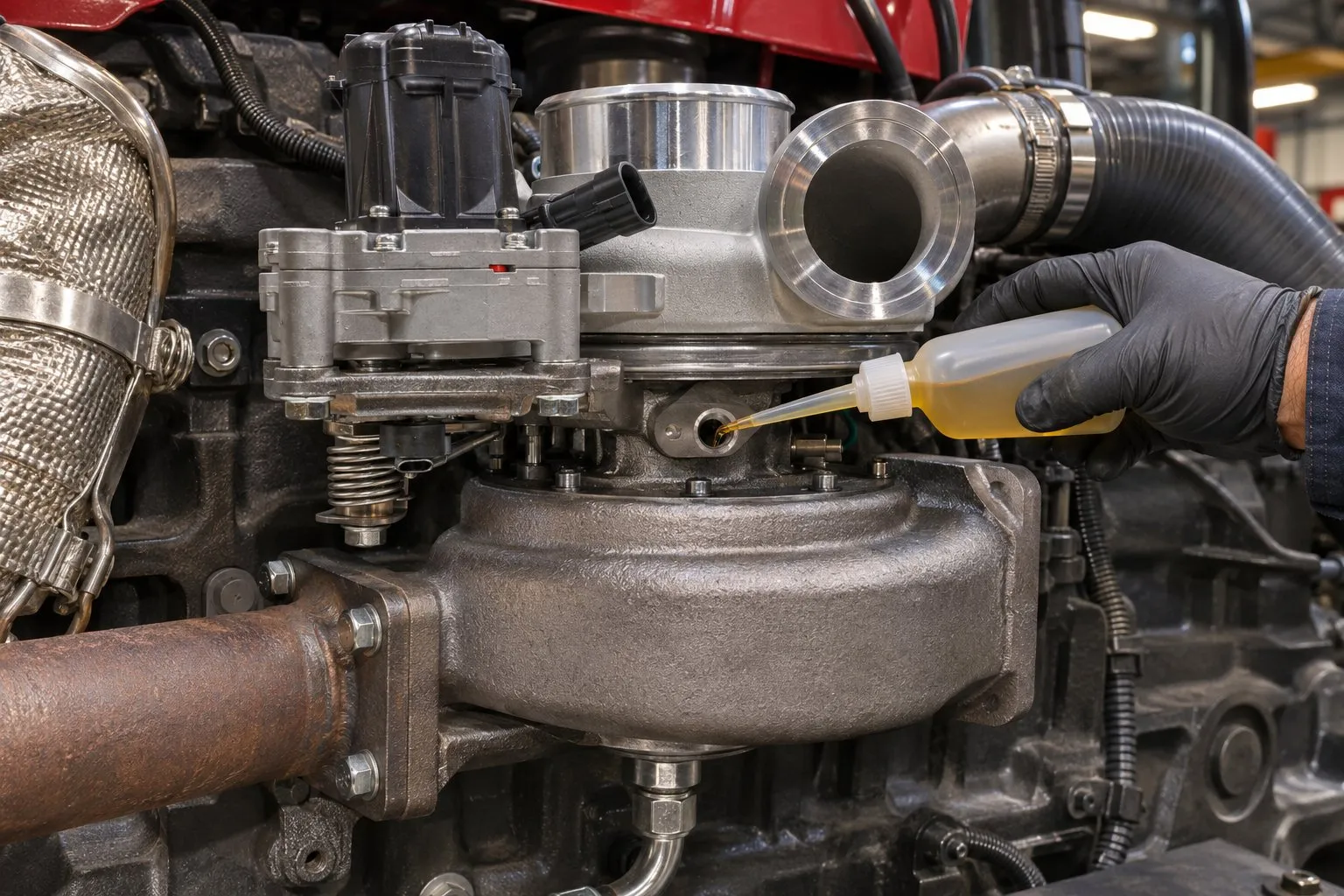
A new turbo fitted on top of an unfixed cause fails the same way. Find out why the old one died, then:
- Fit a new oil feed line after any bearing failure or coked oil. Do not flush and reuse the old one.
- Use new gaskets on the oil inlet and drain, with no sealant.
- Make sure the drain runs downhill, within about 15 to 20 degrees of straight down, and enters the sump above the oil level. A restricted drain backs oil up past the seals.
- If the old compressor wheel broke up, replace the charge air cooler. MAHLE and Nissens both advise this because metal in the fins cannot be flushed out reliably, and any debris left there goes into the engine. Inspect the charge piping too, and clean or replace it.
- On the Garrett variable nozzle unit, leave the actuator arm alone. Run any setup routine CNH’s service information calls for with the dealer tool.
Before the first start:
- Fill the oil inlet with clean engine oil and turn the wheel by hand.
- Disable fueling by the engine maker’s procedure, then crank for 10 to 15 seconds without letting the engine start.
- Start the engine and idle for 3 to 4 minutes, checking for oil, exhaust and air leaks before you put the tractor under load.
A turbo has no break-in, so there is no break-in schedule and no early oil change to follow.
Day to day, a few habits protect the new turbo:
- Change oil and filters on the maker’s schedule, or on its severe-service schedule if you work in dust or idle a lot.
- After heavy drawbar or PTO work, let the engine idle down for the time the operator’s manual gives before shutdown.
New, Rebuilt or Remanufactured: Getting the Right Unit
PT Turbo is family-owned and has been rebuilding turbochargers since 1978, more than 45 years, from our shop in San Bernardino, California. The fastest route to the right part is to search our store by the number on your turbo’s tag, not by tractor model.
Our catalog lists one Holset HX52W, 3787091H, whose application row names a “Case-New Holland (CNH) Magnum Tractor (Off-Highway) 8.7L.” If your tag carries that number, that listing is your match. Current pricing is on the product page, or call (909) 824-1020.
If your turbo is still a sound core, our in-house rebuild service can rebuild it. Every turbo we rebuild in-house is VSR balanced and gets a final quality inspection: a leak test, a visual inspection and an actuator or wastegate function check. Most rebuilds ship in 3 days or less. We confirm the rebuild price after inspection and before work starts; our turbo rebuild price list shows current figures by turbo.
Remanufactured exchange units depend on core supply, so check our remanufactured turbochargers by tag number. Return the core within 30 days; the customer pays return shipping. If you need longer, call ahead and we can usually work with you. Our warranty runs 12 months with unlimited mileage.
Farms and custom operators running several tractors can arrange priority or rush turnaround, and we can hold common cores for a fleet. Set that up by phone. If the tag is damaged, send the engine plate details and whatever the tag still shows through our contact page.
Frequently Asked Questions
Which turbocharger does my New Holland T8 use?
Go by the number on the turbo’s tag, not the tractor badge. The listings for FPT Cursor 9 tractors show a wastegated Holset HX52W on earlier engines and an electrically actuated Garrett GTC4088V (841805-5020S) on Tier 4B engines from 2020 on. The listings we checked name the Case IH Magnum, so match your number before you order.
Can I put a wastegated Holset on a tractor that came with the Garrett variable nozzle turbo?
Not as a direct swap. The Tier 4B engine controller drives the Garrett’s electric actuator and expects that turbo’s behavior. Replace it with the same part number or the newer number that supersedes it.
How long does a turbo rebuild take?
Most rebuilds ship in 3 days or less. We inspect the turbo first and confirm the rebuild price before any work starts. Farms with several tractors can arrange priority turnaround by phone at (909) 824-1020.
Need a Turbocharger?
PT Turbo has rebuilt and sold turbochargers since 1978. We stock remanufactured units for Cummins, Duramax, Power Stroke, Detroit Diesel, and more — backed by a 12-month unlimited mileage warranty. Units in stock at our shop in San Bernardino, CA ship the same day when ordered before 2 PM Pacific, Monday through Friday.
📞 (909) 824-1020 · 346 S I St. #3, San Bernardino, CA 92410 · info@ptturbo.com
More From PT Turbo
 BorgWarner K27 Turbocharger: Mercedes & European Diesel Application Guide
- Case IH Farmall & Puma Turbocharger Guide: Utility & Row Crop Tractor Applications
- Subaru EE20 2.0L Diesel Turbocharger Guide: Outback & Forester Applications
- BorgWarner EFR Series Turbocharger: Performance Diesel Applications Guide