Kubota M7 Series Tractor Turbocharger Guide: V6108 Engine Replacement
This Kubota M7 Series tractor turbocharger guide covers the turbo on the Kubota V6108 engine. It explains how the turbo works, how to find the exact replacement, which symptoms point to the turbo and which do not, and how to fit a new or rebuilt unit so it has the best chance of a long service life. It is written for dealer techs, independent ag mechanics and owners who do their own wrenching.
PT Turbo is a family-owned shop in San Bernardino, California, and has been rebuilding turbochargers since 1978. The guidance below is based on how these parts are built and how they fail.
How the Turbo Works on the Kubota V6108
The V6108 turbo works like any other turbo diesel unit. Exhaust gas spins the turbine wheel, a shared shaft turns the compressor wheel, and the compressor pushes dense air through the charge-air piping and cooler into the intake. The turbocharger shaft rides on bearings fed by pressurized engine oil, and that oil returns to the engine by gravity through the drain tube.
The duty cycle is what sets a tractor turbo apart. An M7 can spend a full day at heavy load on tillage or PTO work, then hours idling on loader jobs, often in dusty air. Sustained heat, long idle and dirt decide how long the turbo lives.
A modern diesel controls boost with either a wastegate or a variable geometry turbine, depending on the turbo fitted. The tractor model does not tell you which one you have. The number on the turbo’s tag identifies the exact unit on the engine and the control parts that go with it.
Tractors with a diesel particulate filter carry that aftertreatment after the turbo, and machines with a DEF tank also have SCR downstream. Anything the turbo puts into the exhaust, such as oil past a worn turbine-side seal, flows straight into the aftertreatment. A leaking turbo left in service can turn into an aftertreatment repair, so act early on rising oil consumption. Let an active regeneration finish as Kubota’s operator’s manual advises.
Finding the Right Turbo: Read the Tag, Not the Model Badge
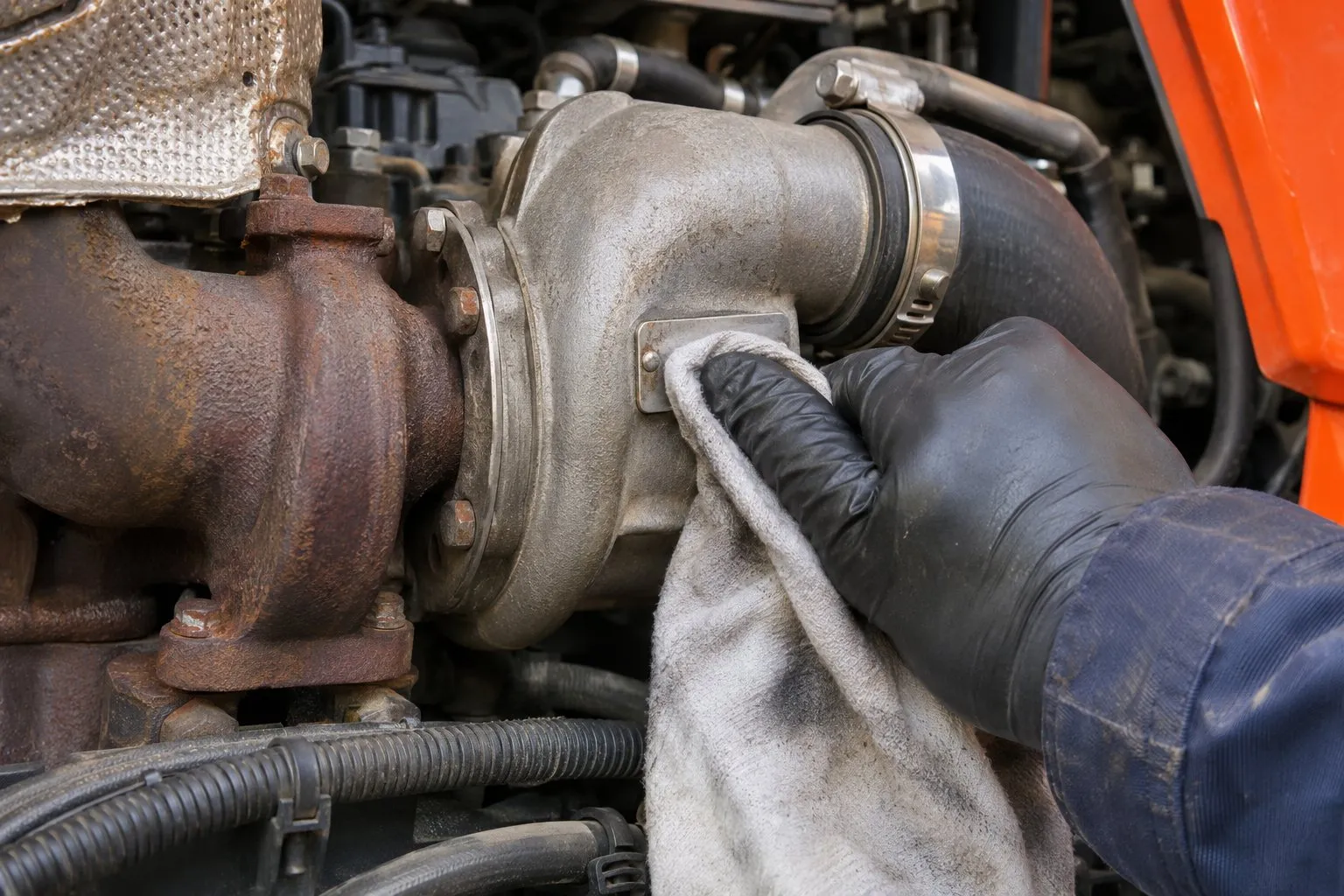
The M7 line has gone through several ratings and production updates, and two tractors with the same badge do not always carry the same turbo. Order by the part number on the turbo’s tag (data plate). Do not order by tractor model, engine name or serial range alone.
Do not order by a casting number either. One housing casting serves many different turbos, so a casting number can narrow a search but never confirms a match. Clean the tag with a rag and solvent, never a wire wheel, and photograph it before the turbo comes off. Many tags carry both the turbo maker’s number and the engine maker’s number, so write down both.
| Turbo maker | Part number format | Notes for identification |
|---|---|---|
| Garrett | Six digits, a dash, four digits, then S or W (765155-5007S format) | After the dash, 0 = original equipment, 5 = new aftermarket, 9 = remanufactured. Nameplate position varies by region and plant. |
| Holset | Seven-digit assembly number plus a letter suffix | Data plate on the compressor housing. The engine maker’s (customer) number is a separate field. |
| BorgWarner | Six digits (older S-series) or eleven digits | Nameplate on the compressor housing, with a serial number and, on factory-fitted units, the engine maker’s number. |
| IHI | Model name such as RHF5 plus part numbers | The letter after RH is the series and the number is the frame size (an RHF5 is larger than an RHF4). |
| Mitsubishi | Five digits, a dash, five digits (49187-00271 format) | Codes such as 16G name the compressor wheel only. Match the full part number. |
For the naming conventions behind each brand, see our Garrett turbocharger complete guide, the Holset turbocharger model guide and the IHI turbocharger model guide. Once you have the number, search our store for it. If nothing matches, send a photo of the tag through our contact page or call (909) 824-1020, and we will check it against current supply.
Turbos we list for the RHF5
Listings for the turbo models named in this guide that can be ordered online today. Several part numbers can fit one engine by year and rating, so match the number on your turbo’s tag, or call (909) 824-1020 and we will match it for you.
V6108 Turbo Symptoms and What to Check First
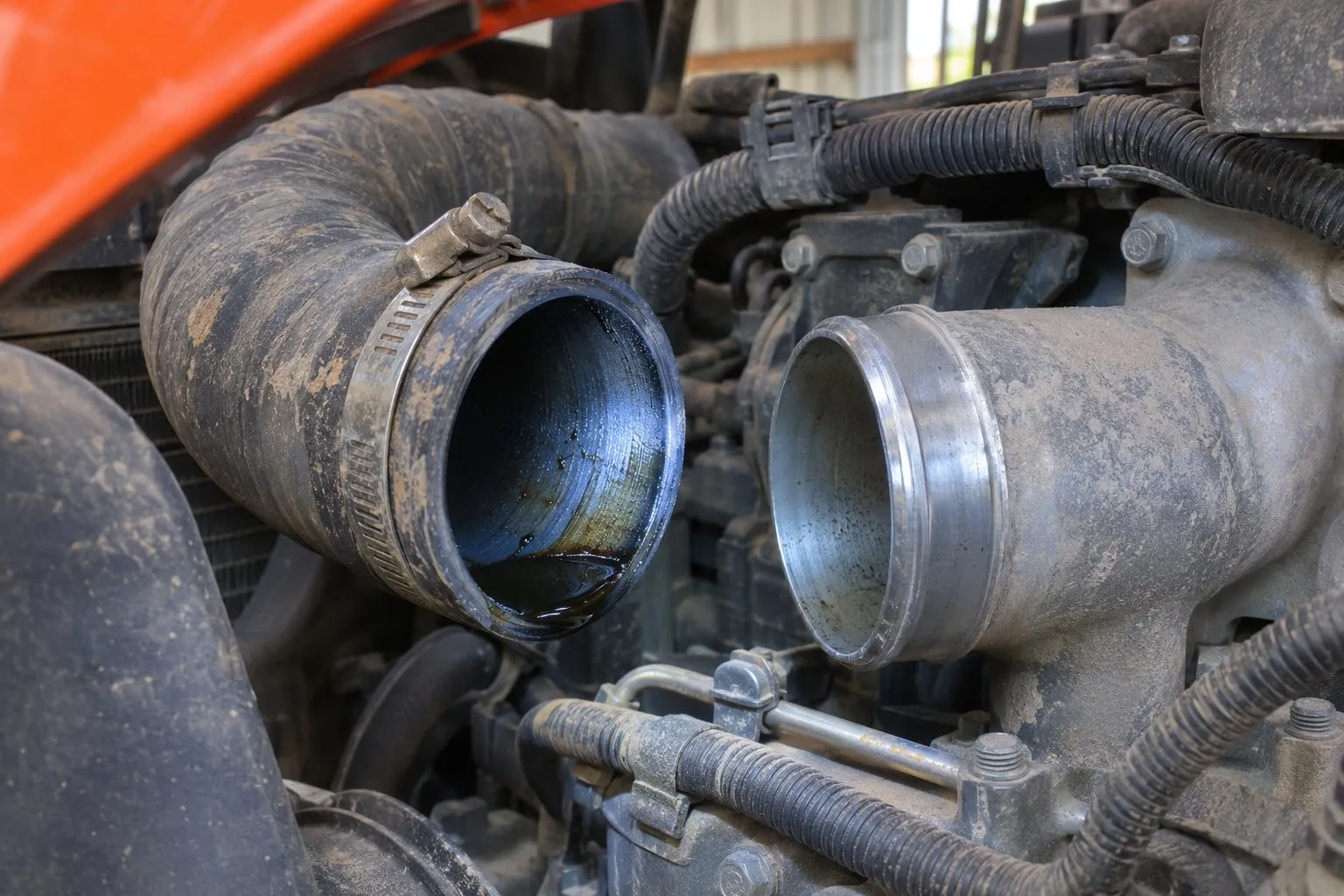
Many complaints blamed on the turbo start somewhere else. Rule out the cheap, common causes before pulling the turbo, because a new unit fitted to an engine with an air or oil problem will fail the same way.
| Symptom | What it usually points to | Check first |
|---|---|---|
| Low power, black or dark gray smoke | Not enough air: charge-air leak, restricted intake, exhaust leak before the turbine, sticking wastegate or nozzle, worn turbo | Air filter restriction indicator, charge-air hoses and clamps, cooler, manifold joints |
| Blue-gray smoke, oil use | Engine wear, crankcase pressure, restricted turbo drain, or a turbo seal | Breather, oil level, drain tube, then the turbo |
| Pooled oil in charge pipes or cooler | Oil past the compressor-side seal, or a breather or air filter fault | Air filter restriction, crankcase breather, drain routing |
| Whistle or siren under load | Charge-air or exhaust leak, wheel rubbing, foreign object, bent blades | Every joint after the compressor and before the turbine, then the wheels |
| Grinding, wheel touching housing | Bearing failure, usually from the oil supply | Shaft play, oil pressure, feed line |
| White smoke | Coolant, or unburned fuel on a cold engine. Not a turbo symptom by itself | Coolant level and cooling system |
To check shaft play, take the intake and exhaust connections off the turbo. Some side-to-side movement is normal on a journal-bearing turbo with no oil pressure. Condemn the turbo for in-and-out play you can feel, for either wheel touching its housing when rocked, or for play beyond the maker’s limit.
A light oil film in the intake is normal on an engine with closed crankcase ventilation, but pooled oil is not. Oil that appears at the exhaust after long idle usually shows at the turbine end first and often clears once the engine works under load.
Read stored faults with the dash display or Kubota’s diagnostic software, and look them up in the Kubota service manual. Our turbocharger fault codes index covers the generic OBD-II codes used on road vehicles. Do not assume a pickup’s code meaning carries over to a Kubota tractor.
Why Tractor Turbos Fail and How to Prevent It
Garrett names oil starvation, oil contamination and foreign objects as the three main causes of turbo failure. It states that more than 90 percent of failures come from oil starvation or contamination. On a farm, add dust to the list.
- Oil starvation: low oil pressure, a blocked or leaking feed line, hard throttle on a cold engine, or a first start with a dry turbo after a repair.
- Oil contamination: Garrett lists carbon as the most common contaminant, along with engine wear debris, dirt let in during servicing and degraded oil. Turbo journal bearings are bronze, so on a journal-bearing turbo, rising copper in an oil report deserves a look. Compare against your own baseline and the lab’s limits.
- Dust: pitting on the compressor inlet blades means unfiltered air is getting in. Check the filter seal, the housing and the pipe between filter and turbo. That pipe is under suction, so a crack pulls dirt in instead of leaking boost.
- Foreign objects: bent or chipped blades mean impact damage. Find what hit the wheel before fitting a replacement. Pieces of a failed compressor wheel travel downstream into the cooler and the engine.
- Hot shutdown: shutting down right after heavy work cokes oil in the center housing. That carbon then wears bearings and sticks seals.
- Restricted drain: a kinked or blocked drain backs oil up and pushes it past the seals at both ends.
Prevention is mostly routine maintenance done on time. Change oil and filters on Kubota’s schedule, or on its severe-service schedule if the tractor works in dust or idles for long hours. Replace the air filter when the restriction indicator calls for it, and inspect the housing seal every time. After a cold start, idle until oil pressure shows, then work the tractor gently until it is warm. After heavy PTO or tillage work, idle for the cool-down time in your operator’s manual before shutting down.
Replacement Options and Installation on the V6108
New, remanufactured or a rebuild of your turbo
| New turbo | Remanufactured exchange | Rebuild of your turbo | |
|---|---|---|---|
| Availability | Search the store by the tag number | Depends on core supply | Any rebuildable core with sound housings |
| Shipping or turnaround | In-stock items ship same day if ordered before 2 PM Pacific, Monday to Friday. Most other orders ship within 1 to 2 business days | Core due back within 30 days. The customer pays return shipping | Most rebuilds ship in 3 days or less |
| Testing | Maker’s own | Tested, flow-tested, actuator calibrated | VSR balanced, final quality inspection |
| Pricing | On the product page, or call (909) 824-1020 | On the product page, or call | Confirmed after inspection, before work starts |
When the housings are sound, rebuilding the tractor’s own turbo keeps the exact unit that came on the engine. Our turbo rebuild service replaces bearings, seal rings and thrust parts. Every turbo we rebuild in-house is VSR balanced and gets a final quality inspection, including a leak test, a visual inspection and an actuator or wastegate function check. A turbine wheel with blade damage is replaced, never rebalanced and reused. See the turbo rebuild price list for our prices by turbo. For an exchange unit, check our remanufactured turbochargers by tag number, or call. If you need more than 30 days to return a core, call ahead and we can usually work with you.
Before the new turbo goes on
- Find and fix the cause of the failure first: oil supply, drain, air filter and intake piping.
- Fit a new oil feed line after a bearing failure or coked oil. Do not flush and reuse the old one.
- Make sure the drain is clear, runs downhill and stays within about 15 to 20 degrees of straight down.
- Use new gaskets, with no sealant on the oil inlet or drain.
- If the old compressor wheel shed metal, replace the charge-air cooler (MAHLE advises this, because metal cannot be reliably flushed out of the fins). Clean or replace the charge piping as well.
- Tighten every fastener to Kubota’s specification.
- If the turbo has an electronic actuator, never force its arm by hand, because the gears can break. Follow the service manual for any calibration it needs with Kubota’s diagnostic software. If the turbo has a pneumatic wastegate actuator, check the rod, hose and diaphragm.
First start
Follow the turbo makers’ first-start steps. Fill the oil inlet with clean engine oil, turn the wheel by hand, then connect the feed line. Crank the engine for 10 to 15 seconds while keeping it from starting, using the method in the Kubota service manual, so oil reaches the bearings.
Then start the engine and idle it for 3 to 4 minutes (Garrett’s figure), checking for oil, exhaust and air leaks before you put it under load. After that, the tractor can go back to normal work.
Frequently Asked Questions
Which turbo fits my Kubota M7 with the V6108 engine?
The correct turbo is the one whose part number matches the tag on your current turbo. The M7 has had several ratings and production updates, so the tractor model alone is not enough to identify it. Record both the turbo maker’s number and the engine maker’s number, then search our store by them, or call (909) 824-1020 with a photo of the tag.
Is it worth rebuilding the original V6108 turbo?
A rebuild is worth considering when the housings are not cracked and the damage is limited to the rotating assembly and bearings. A rebuild replaces the bearings, seal rings and thrust parts, and every unit is VSR balanced before it ships. Most rebuilds ship in 3 days or less, and the price is confirmed after inspection, before any work starts.
How long should the engine idle before I shut it off?
Idle for the cool-down time given in your Kubota operator’s manual, especially after heavy PTO, tillage or high-load loader work. Shutting down hot cokes oil in the center housing, and that carbon later wears the bearings. At startup the rule is different: idle only until oil pressure shows, then work the tractor gently until it is warm.
Need a Turbocharger?
PT Turbo has rebuilt and sold turbochargers since 1978. We stock remanufactured units for Cummins, Duramax, Power Stroke, Detroit Diesel, and more — backed by a 12-month unlimited mileage warranty. Units in stock at our shop in San Bernardino, CA ship the same day when ordered before 2 PM Pacific, Monday through Friday.
📞 (909) 824-1020 · 346 S I St. #3, San Bernardino, CA 92410 · info@ptturbo.com
More From PT Turbo
 Land Rover TDV6 3.0L Turbocharger Guide: Discovery, Range Rover & Sport Applications
- Garrett GT45 Turbocharger: High-Flow Diesel Applications & Sizing Reference
- Garrett GT25 Series Turbocharger: Light Diesel Application & Fitment Guide
- Holset HX55 Turbocharger: Cummins ISM Large Displacement Application Guide