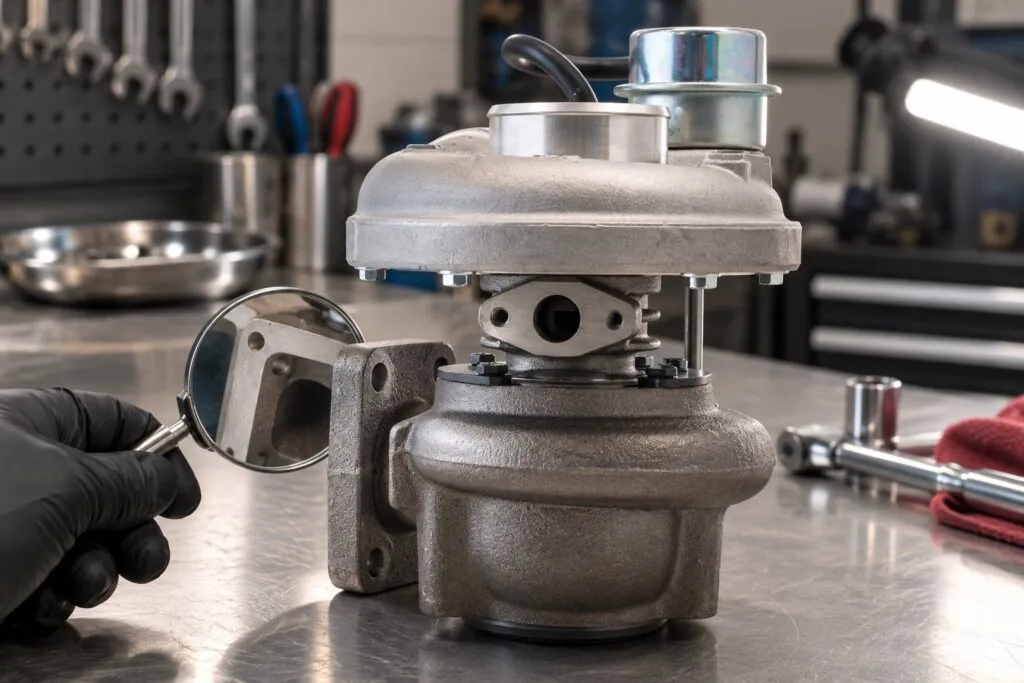
The Garrett GT25 Series Turbocharger is one of the most widely applied small-frame units Garrett has ever built, and that is exactly why it causes so much confusion at the parts counter. The frame covers everything from gasoline performance builds to small light-duty and commercial diesels, which means two turbos that share the “GT25” family name can bolt up to completely different engines with different compressor wheels, turbine housings, and vane control. This guide walks through what the frame actually is, how to read the tag, and how to confirm fitment before you order.
PT Turbo has been working on turbochargers since 1978, more than 45 years, and we stock both new and remanufactured units along with in-house rebuild service. The information below reflects how these turbos are actually built and how they actually fail, not marketing copy.
What the Garrett GT25 Frame Is
In Garrett’s GT naming convention, the first two digits are the frame size and the last two are the compressor wheel outer diameter in millimeters. So a GT2554 carries a 54 mm compressor wheel, a GT2560 a 60 mm wheel, and so on, all on the same 25-series center housing and bearing system.
The GT25 is the modern successor to the older Garrett T25, the turbo many enthusiasts know from small-displacement applications. On the diesel side, the 25-frame and the closely related 20-frame cover light engines in the roughly two-liter to three-liter class, where a small, fast-spooling turbo matters more than peak airflow.
You can browse everything we carry for the family on our GT25 turbochargers page. Garrett’s own technical documentation is also worth bookmarking at garrettmotion.com.
Reading the Part Number and the Tag
The single most important habit with any GT25-family turbo is to go by the number stamped on the data plate, not by the engine name. Garrett part numbers run as a six-digit base number, a dash, a four-digit suffix, and an “S” (for example, 836023-5004S). The first digit after the dash tells you the sales channel: 0 for original equipment, 5 for new aftermarket, and 9 for remanufactured.
Casting numbers on the housings are not part numbers. One casting serves many different turbos, so never order by a number you found cast into the compressor or turbine housing. Pull the base and suffix off the nameplate instead.
A “V” in the model name marks a variable nozzle turbine. That one letter changes the entire replacement job, because fixed and variable units are not interchangeable even within the same frame.
| Example model | Compressor wheel OD | Turbine style | How to confirm it |
|---|---|---|---|
| GT2554 | 54 mm | Fixed geometry | Base + suffix on the tag |
| GT2556 | 56 mm | Fixed geometry | Base + suffix on the tag |
| GT2560 | 60 mm | Fixed geometry | Base + suffix on the tag |
| GT25xxV | Varies by rating | Variable nozzle (VNT) | “V” in the name + actuator type |
Light Diesel Fitment: Match the Number, Not the Engine
Light diesels that use a 25-frame Garrett turbo are typically small commercial vans, pickups, and industrial power units. Within a single engine family, manufacturers often ran several turbo part numbers across model years and power ratings, so the engine badge alone will not get you the right unit.
Before you order, write down three things: the full Garrett base and suffix number from the tag, the turbine housing inlet flange and bolt pattern, and the actuator type. If any of those three do not match, the turbo is wrong even if the box says GT25.
If the tag is unreadable or missing, do not guess from the engine code. Send us the turbo or clear photos of the compressor housing, turbine housing, and actuator, and we will identify it against the catalog. A wrong turbo costs more downtime than a one-day identification call. You can reach the shop through our contact page or at (909) 824-1020.
What varies between light diesel GT25 units
- Compressor wheel size (the last two digits), which sets the airflow and the spool character.
- Turbine housing A/R and flange, which must match the manifold and the downpipe.
- Fixed vs variable nozzle, which changes how boost is controlled.
- Actuator style and electrical connector, which must match the vehicle harness or vacuum plumbing.
Variable Nozzle vs Fixed Geometry GT25 Diesel Units
Many light diesel versions in this family use a variable nozzle turbine to broaden the torque curve and cut turbo lag. The vanes can be moved two different ways depending on the engine and era, and it matters which one you have.
A vacuum (pneumatic) VNT actuator holds the vanes in one position at rest, and engine vacuum moves them. These are tested with a hand vacuum pump and have a rod that can be set to spec. An electronic actuator, by contrast, is driven by the ECU and must be calibrated to the turbo with a service tool after replacement.
Do not assume which one your engine uses. The verified rule is simple: go by the number on the unit, and confirm the actuator type before ordering. Installing a fixed-geometry turbo where a variable one belongs, or an electronic actuator where a vacuum one belongs, will set boost faults and leave you chasing codes that are really a parts mismatch.
On light diesels this family may trigger generic boost codes such as P0299 (underboost) or P0234 (overboost). Those point to a boost problem, not to a specific failed part, so diagnose the whole system, including the EGR and the charge piping, before condemning the turbo.
Common Failure Modes on the Garrett GT25 Series Turbocharger
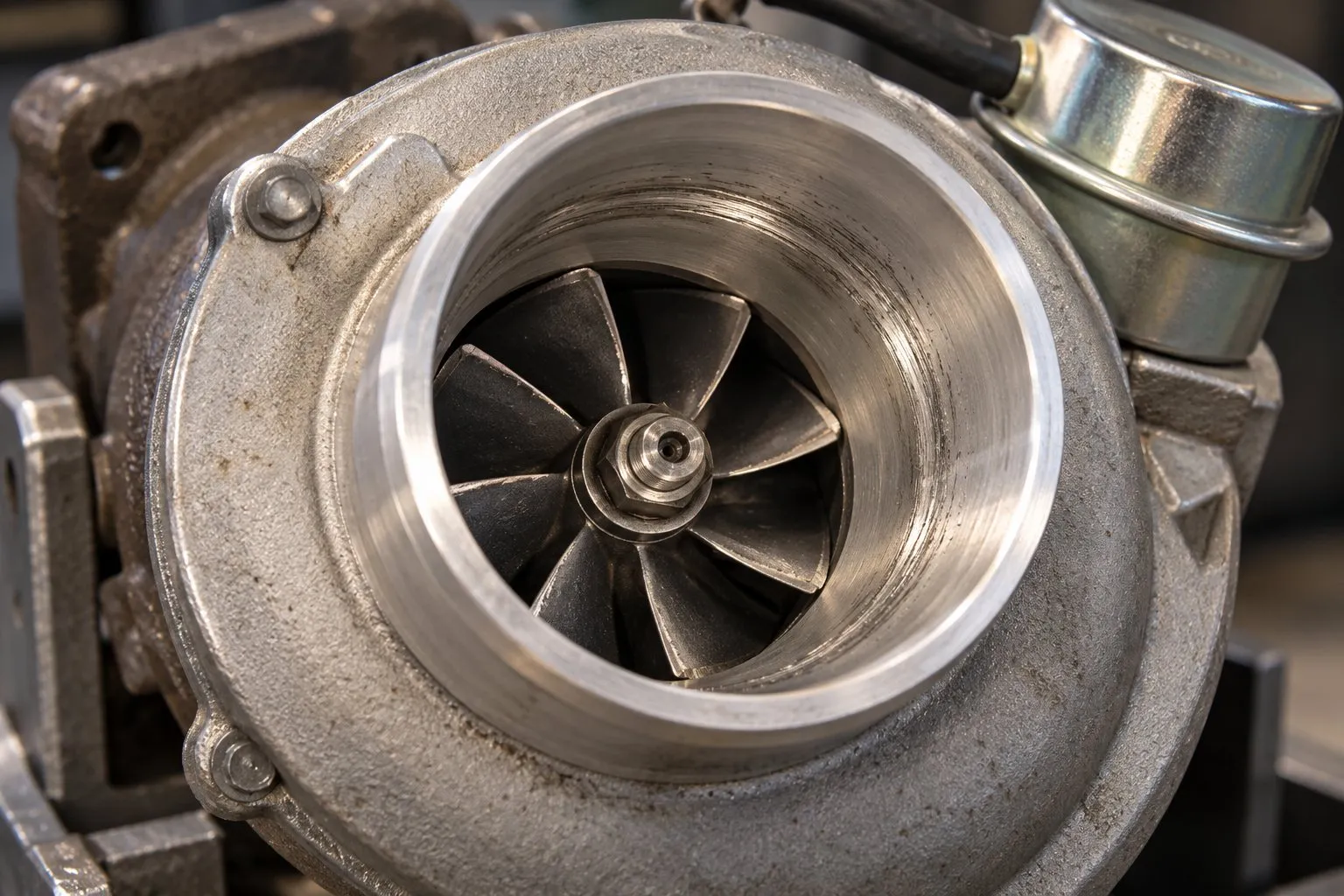
Most GT25-family failures are oil-related. Garrett’s own data puts more than 90 percent of turbo failures down to oil supply, oil contamination, or oil drain problems, and under 1 percent down to manufacturing defects. That is where you start any diagnosis.
Here is how the common faults show themselves and what to check first:
| Symptom | Likely cause | Check first |
|---|---|---|
| Oil in the charge pipes | Compressor-side seal, or normal blow-by | Breather, air filter, oil level, drain before the seal |
| Blue smoke at idle, clears under load | Oil pooling at the turbine end | Long idle time, drain routing, oil level |
| Low boost, slow spool | Exhaust leak before the turbine, or vanes stuck open | Up-pipe and manifold joints, vane movement |
| Overboost, high drive pressure | VNT vanes stuck closed | Actuator function, soot-bound vanes |
| Noise and shaft wear | Bearing damage from oil or imbalance | Oil feed line condition, play at the shaft |
On a journal-bearing GT25 cartridge, some side-to-side shaft play is normal with no oil pressure. Condemn the turbo only for in-and-out (axial) play you can feel, for wheel contact against the housing, or for play beyond the maker’s limit, never for “any movement.”
If you do find a bearing failure or coked oil, replace the oil feed line rather than reusing it. A journal-bearing turbo normally has a feed around a quarter inch in bore with no restrictor, and sealant does not belong on the oil inlet or drain gaskets. The drain must run downhill into the pan above the oil level, or oil backs up past the seals.
New, Remanufactured, or Rebuilt
You have three good paths with a GT25-family diesel turbo, and the right one depends on the condition of your core and how fast you need the truck back.
- New: a fresh unit when the core is damaged or missing. Browse the full catalog in our store.
- Remanufactured: a balanced, tested unit at a lower cost than new. See our remanufactured turbochargers.
- Rebuild your core: we remanufacture in-house with a typical turnaround of 3 to 5 business days after inspection. Details are on our turbocharger rebuild service page.
For what a rebuild costs on your exact model, check our turbo rebuild price list rather than relying on a ballpark. Pricing on new and reman GT25 units is listed on each product page, or call (909) 824-1020 and we will confirm the correct number for your vehicle.
If you are cross-shopping other makers for the same light diesel, our BorgWarner turbocharger guide covers the competing frames you will run into on vans and small commercial trucks.
Frequently Asked Questions
How do I know which GT25 turbo my light diesel needs?
Read the Garrett base and suffix number off the data plate, then confirm the turbine flange and the actuator type match your vehicle. The engine badge alone is not enough, because one engine family often used several part numbers. If the tag is gone, send us the turbo or clear photos and we will identify it.
What does the “V” mean in a GT25 part number?
The V marks a variable nozzle turbine, where movable vanes change the effective turbine housing to broaden the torque curve. Those vanes are driven either by a vacuum actuator or by an electronic actuator depending on the engine, and the two are not interchangeable, so always confirm which one your unit uses before ordering.
Is a little shaft play normal on a GT25 cartridge?
On a journal-bearing unit, some side-to-side movement with no oil pressure is normal. Replace the turbo only if you feel in-and-out play, find the wheel touching the housing, or measure play beyond the maker’s limit. If you are unsure, our team can inspect the cartridge and tell you whether it is within spec.
Shopping by part number?
Every part number we stock for the Garrett GT25 is on one page, with live prices and stock: Garrett GT25 turbos and parts.
Need a Turbocharger?
PT Turbo has rebuilt and sold turbochargers since 1978. We stock remanufactured units for Cummins, Duramax, Power Stroke, Detroit Diesel, and more — backed by a 12-month unlimited mileage warranty and same-week shipping from San Bernardino, CA.
📞 (909) 824-1020 · 346 S I St. #3, San Bernardino, CA 92410 · [email protected]