

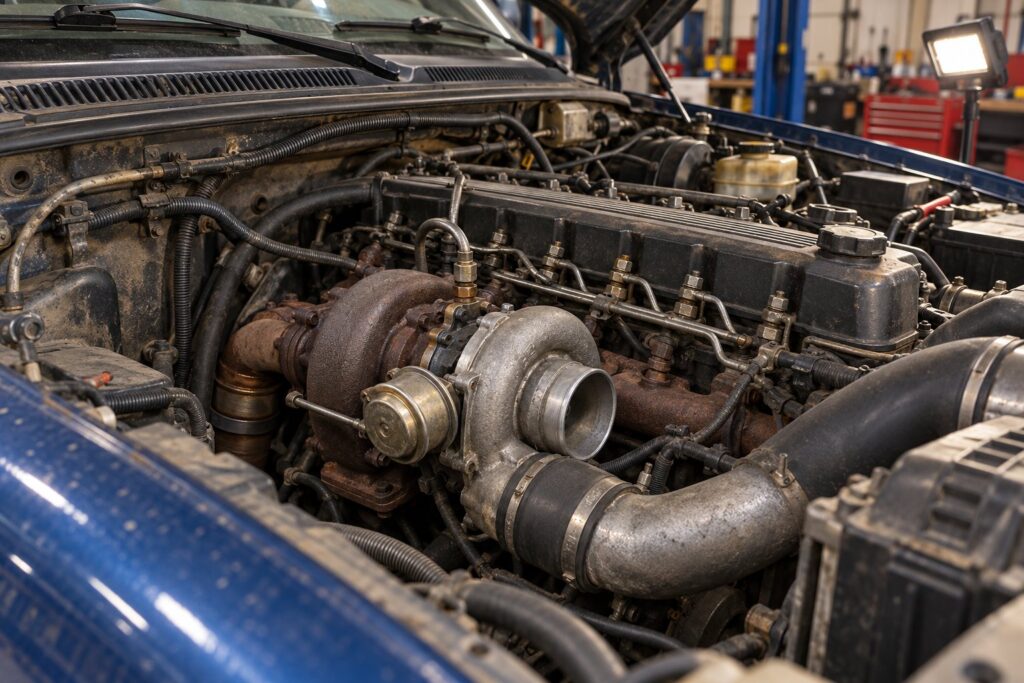
PT Turbo rebuild prices: most turbos cost $450 to $975 to rebuild at our shop. See the turbo rebuild price list for yours.
How long does a turbocharger rebuild take? It is the first question most owner-operators and fleet managers ask once a turbo starts smoking, whining, or dropping boost, because every day the truck sits is a day it isn’t earning. The honest answer depends on the unit, its condition when it arrives, and parts availability, but there is a realistic timeline you can plan around. This guide breaks down what actually happens during a professional rebuild, why some jobs move faster than others, and how to keep your downtime short.
PT Turbo has been rebuilding turbochargers since 1978, more than 45 years of hands-on work out of San Bernardino, California. The shop stocks both new turbos and units it remanufactures in-house, so the timeline below reflects how the work really flows, not a sales pitch.
How Long Does a Turbocharger Rebuild Take at PT Turbo
The shop standard is 3 to 5 business days after inspection. That clock starts once your turbo is on the bench and the teardown is complete, not the moment it ships from your dock.
Why after inspection? Because a turbo’s needs are not visible from the outside. A unit that spun a bearing on clean oil may only need a cartridge rebuild. One that ingested debris or coked its oil feed can need a new shaft and wheel set, a housing, and an actuator. The inspection tells the tech which path the job takes, and that determines parts.
Shipping time to and from your location sits on top of the 3 to 5 business days. If you are across the country, build in transit both directions. If you are local to Southern California, you can often drop off and pick up, which cuts the mail out of the equation entirely.
What Happens During the Rebuild (And Why Each Step Takes Time)
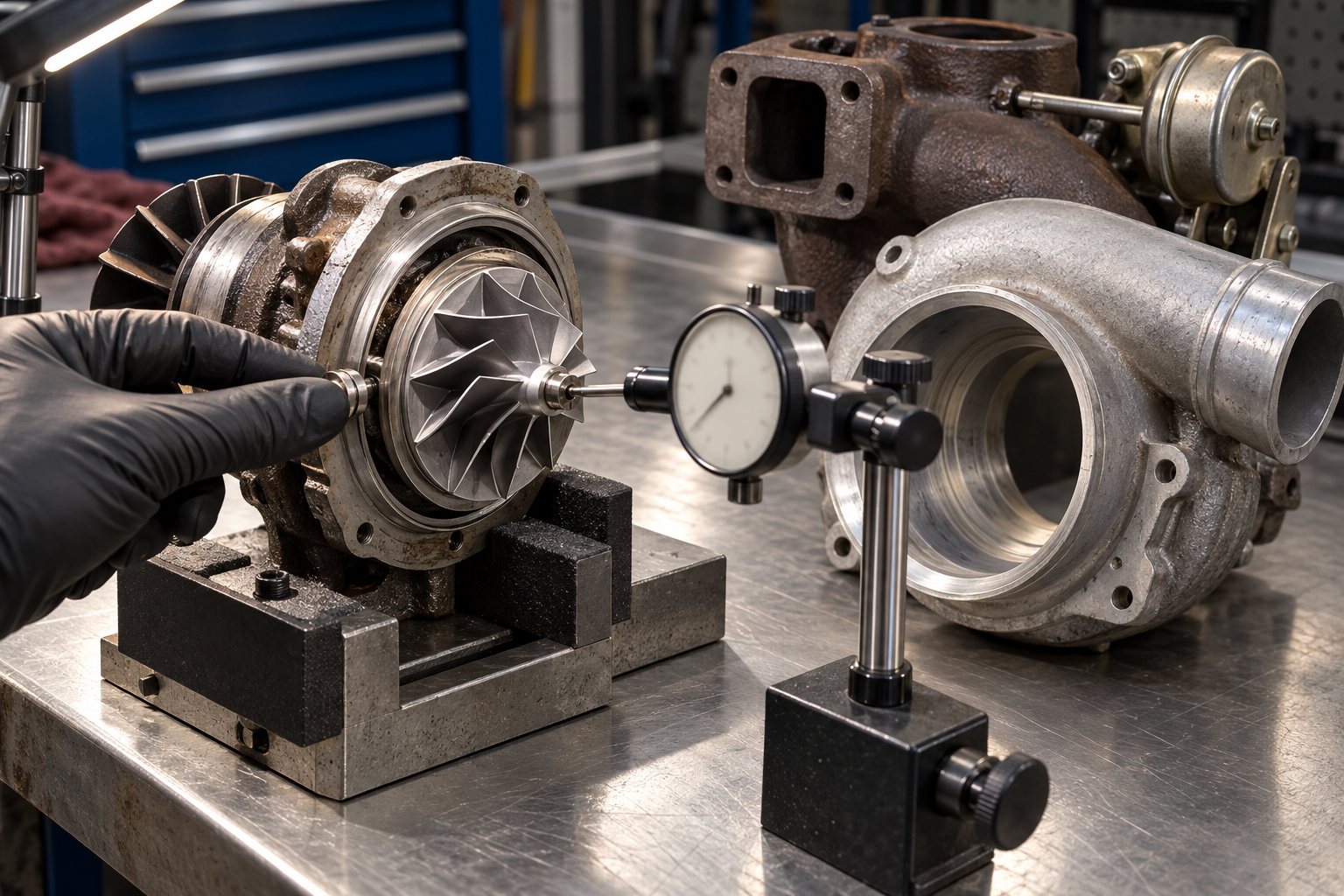
A proper rebuild is not a parts swap. Each stage has to be done in order, and skipping any of them is how a “rebuilt” turbo comes back three months later.
1. Teardown and Inspection
The turbo comes apart completely. The tech measures axial (in and out) play and radial (side to side) play, checks the wheels for blade damage, and looks at the bearing bores and seal ring grooves for scoring. On a journal-bearing turbo, some shaft movement is normal, so the unit is condemned for wheel contact with the housing or play beyond the maker’s limit, not for any movement at all.
Turbine wheels with damaged leading edges are replaced, never re-balanced and run again. Debris strikes the inlet (leading) edges, and a cracked or chipped blade will not survive at operating speed.
2. Cleaning and Parts Decision
Housings and reusable hardware are cleaned. The tech then builds the parts list: bearings, seal rings and thrust components at minimum, plus any wheels, shaft, or housing the inspection flagged. This is where parts availability can stretch a timeline on an unusual unit.
After a bearing failure or coked oil, the oil feed line should be replaced, not reused. Debris trapped in that line will kill a fresh cartridge on the first start.
3. Reassembly and Balancing
The cartridge is reassembled to spec and balanced. PT Turbo balances on a VSR, a Vibration Sorting Rig, which runs the cartridge in its own bearings on pressurized oil, driven by compressed air, so vibration is measured at operating speed. Correction is made at the compressor end, and the pass limit is set per turbo model.
4. Actuator Setup, Where It Applies
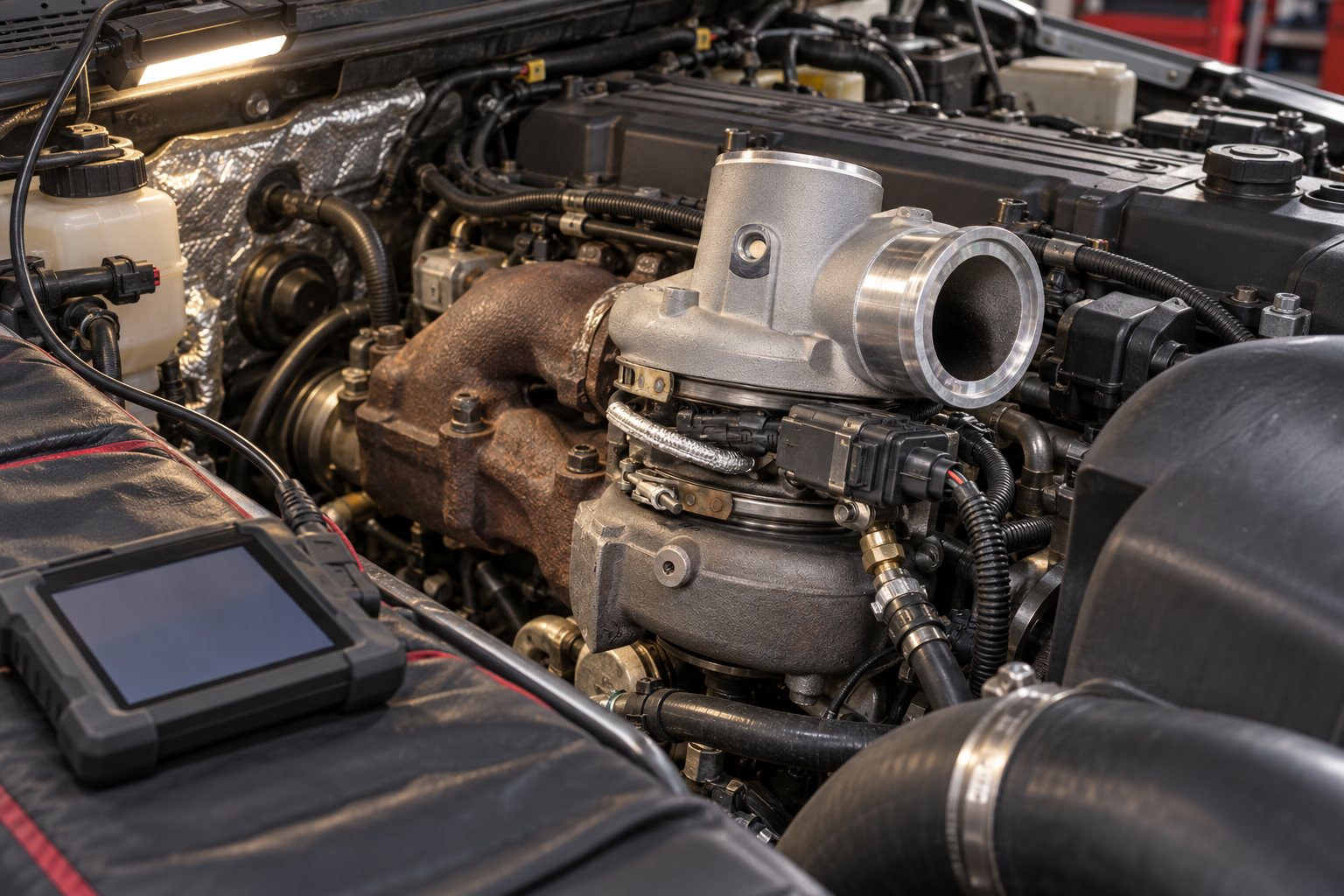
If the turbo has a variable geometry nozzle or a wastegate, the control side gets attention here. A pneumatic actuator is tested with a vacuum or pressure pump and its rod set; an electronic actuator is calibrated to the turbo with a service tool. On the Cummins 6.7L, for example, the HE351VE and HE300VG both carry electronic actuators that must be calibrated. Never move the arm of an electronic actuator by hand, as the internal gears break.
What Makes a Rebuild Faster or Slower
The 3 to 5 business day window is the baseline. Several factors push a specific job toward one end of it or stretch it beyond.
| Factor | Faster rebuild | Slower rebuild |
|---|---|---|
| Damage extent | Bearings and seals only | New wheels, shaft, or housing needed |
| Turbo type | Fixed geometry, common unit | VGT with actuator calibration |
| Parts on hand | Common Holset or Garrett kit in stock | Rare or obsolete components to source |
| Core condition | Housings clean and reusable | Cracked housing or seized hardware |
| Shipping distance | Local drop-off | Cross-country both directions |
A common fixed-geometry unit like a Holset HX35W off a 5.9L Cummins, or an HX40W off an 8.3L, moves through quickly because the parts are standard and these two carry a pneumatic wastegate actuator, which only needs testing and its rod set; there is no electronic actuator to calibrate. (Some newer wastegated turbos do use an electric actuator, and those are set up by their own procedure.) A variable geometry heavy-truck Holset, or a Garrett VGT, takes a bit more hands-on time on the control side.
For a deeper look at the two major VGT families you will meet on a Class 8 truck, the Cummins ISX turbocharger guide breaks down the HE400VG, HE451VE, and HE561VE differences. If you run a 5.9L Ram, the 5.9L Cummins turbo guide covers the HX35, HY35, and HE351CW.
Rebuild vs Buying a Remanufactured Unit Off the Shelf
If downtime is the enemy, a rebuild on your own core is not always the fastest path. Buying a remanufactured turbocharger that is already built and on the shelf means you install it the day it arrives and send your core back afterward. Your truck does not wait for teardown at all.
A rebuild on your own unit keeps your original housings and tag, which matters when matching numbers is critical or when the core itself is hard to find. Here is how the two compare on the things that actually affect your schedule.
| Consideration | Rebuild your core | Reman off the shelf |
|---|---|---|
| Downtime for your truck | Waits for ship + inspection + rebuild | Install as soon as it arrives |
| Keeps your original tag/housings | Yes | No (core exchange) |
| Core needed up front | Yes, your unit | Returned after install |
| Best when | Rare core, exact-number match | Common unit, truck must move now |
Either way, PT Turbo’s turbocharger rebuild service carries a 12-month, unlimited-mileage warranty. For what a rebuild runs on your specific model, the turbo rebuild price list is organized by turbo, and the final figure is confirmed after inspection and before any work starts.
How to Keep Your Downtime Short
You control more of the timeline than you might think. A few habits at removal and shipping keep the job from stalling at intake.
- Send the number off the tag. The data plate on the compressor housing carries the maker’s part number. Matching that number is how the right parts get pulled before the unit even arrives. Casting numbers on the housings are not part numbers, so do not go by those.
- Include the actuator and hardware on a VGT so the control side can be set and calibrated with the turbo, not sourced separately.
- Note what failed if you know it. Oil smoke, a bearing noise, a boost code like P0299 (underboost) or P0234 (overboost), or a VGT fault helps the tech know where to look first.
- Fix the cause before reinstalling. Most turbo failures trace back to the oil supply, through starvation or contamination. A restricted drain, a plugged breather, or dirty oil will take out the rebuild too. The reference overview at Wikipedia’s turbocharger entry is a decent primer on how the system works if you want to brief a newer tech.
On install, prime the new unit: fill the oil inlet with clean engine oil, turn the wheel by hand, crank without starting for 10 to 15 seconds, then idle a few minutes before loading it. Skip that and you risk a dry start on fresh bearings.
Whether you want a rebuild on your own core or a reman unit ready to bolt on, you can browse the full turbo catalog or reach the shop directly through the contact page or at (909) 824-1020.
Price ranges in this article are general estimates to help with budgeting, not PT Turbo quotes. Our current prices are on each product listing, and our rebuild prices are on the turbo rebuild price list.
Frequently Asked Questions
Can a turbo rebuild be done the same day?
No. A proper rebuild requires full teardown, inspection, cleaning, parts, balancing, and control-side setup, which cannot be rushed into a single day without cutting corners. The realistic window is 3 to 5 business days after the unit is inspected, with shipping on top of that. If your truck has to move immediately, a remanufactured unit off the shelf is the faster route.
Does a variable geometry turbo take longer to rebuild than a fixed one?
It can, because a VGT has a nozzle mechanism and an actuator that must be set up and, on electronic units, calibrated to the turbo with a service tool. A fixed-geometry turbo has no variable nozzle to set up; where it has a wastegate, the actuator is tested and set by the procedure for that turbo, so there is usually less bench time on the control side. Both still run through the same teardown, balancing, and inspection steps.
Should I rebuild my turbo or replace it?
If the housings and core are sound and you want to keep your original tag and numbers, a rebuild makes sense. If the truck cannot wait or the core is a common unit, an off-the-shelf reman gets you running sooner. Call the shop with the number off your tag and the symptoms, and they will tell you which path fits your situation and timeline.
Need a Turbocharger?
PT Turbo has rebuilt and sold turbochargers since 1978. We stock remanufactured units for Cummins, Duramax, Power Stroke, Detroit Diesel, and more — backed by a 12-month unlimited mileage warranty and same-week shipping from San Bernardino, CA.
📞 (909) 824-1020 · 346 S I St. #3, San Bernardino, CA 92410 · [email protected]