Hino J08 Turbocharger Guide: Medium Duty Truck Replacement & Common Failures
This Hino J08 Turbocharger Guide is built for the mechanics, fleet managers, and owner-operators who keep medium duty Hino trucks earning their keep. The J08 series, found in the Hino 268, 338, and countless FD, FE, and GD chassis worldwide, is one of the most durable inline-six diesels in the class. But like every forced-induction engine, its turbocharger is a wear item, and when it goes, your uptime goes with it.
At PT Turbo we have spent more than 45 years diagnosing, rebuilding, and supplying turbochargers for engines exactly like this one. Below is the practical, no-nonsense breakdown of how the J08 turbo works, how it fails, and what it costs to fix it right the first time.
Hino J08 Engine and Turbocharger Overview
The Hino J08 is a 7.7-liter (8.0L in some earlier variants) inline-six turbo diesel producing between 200 and 260 horsepower depending on model year and emissions calibration. It powers Class 6 and Class 7 trucks and has been used in dump, box, tow, and vocational applications for decades.
The J08C runs a wastegated fixed-geometry turbo. The J08E in the US-market 238, 258, 268 and 338 is listed with a Garrett variable nozzle turbo and an electronic actuator; Hino changed the turbo part number between the 2005-2007 and 2008-2010 trucks and again later, so the engine suffix alone does not settle the part. Understanding which one you have is the first step to ordering the correct replacement.
The variable geometry turbo on J08E engines in the Hino 268 and 338 is a Garrett GT3576 or GTB3576-family unit with an electronic actuator. The actuator, whether a pneumatic wastegate actuator on the J08C or the electronic one on the VGT, is one of the most commonly replaced components on these engines because it lives in a brutal heat environment right off the exhaust manifold.
| Engine Variant | Displacement | Turbo Type | Typical Application |
|---|---|---|---|
| J08C | 8.0L | Wastegated fixed geometry | FD/GD medium duty, older chassis |
| J08E-TA / TB | 7.7L | Variable nozzle, electronic actuator (per parts listings) | Hino 238, 258, 268, 338 from 2005 |
| J08E-VB / VC | 7.7L | Variable geometry (VGT) | Later 258/268/338 with DPF |
Common Hino J08 Turbocharger Failures
The J08 is a tough engine, but the turbo takes constant thermal and mechanical stress. Here are the failures we see most often on the bench.
1. Stuck or Failed Actuator
On wastegated turbos a pneumatic actuator moves the wastegate, and over time its diaphragm cracks or the rod seizes. On the variable geometry turbo an electronic actuator moves the vanes, and it fails internally or its linkage binds. The result is overboost, underboost, or a total loss of boost control.
Symptoms include a hard hesitation under load, black smoke, and boost-related fault codes. A failing actuator is often mistaken for a bad turbo. Replacing just the actuator can save you thousands if the CHRA is still healthy.
2. Bearing Wear and Shaft Play
Journal bearing turbos rely on a constant, clean oil supply. Extended oil change intervals, coking after hot shutdowns, or a restricted feed line all lead to excessive shaft play. Once the compressor or turbine wheel contacts the housing, the turbo is done.
3. Oil Leaks and Seal Failure
Blue smoke on startup or under deceleration can point to failed seal rings letting oil past the wheels, but check the oil drain, crankcase ventilation and air filter first. On the J08 this is frequently caused by a clogged crankcase breather building crankcase pressure, not the turbo itself, so check the breather before you condemn the unit.
4. Foreign Object Damage
A failed air filter or debris from a prior failure that was not fully cleaned out will chew up the compressor wheel. Always inspect the intake tract and intercooler before installing a replacement turbo.
5. VGT Vane Sticking
On J08E engines with the variable nozzle turbo, soot buildup from EGR and DPF regeneration can jam the variable vanes. This mimics an actuator fault. You can read more about how these systems work in our Cummins ISB 6.7L variable geometry turbocharger guide, which explains the same operating principle used on many medium duty diesels.
Symptoms by Severity: When to Act
Not every turbo symptom means immediate replacement. Use this table to prioritize.
| Severity | Symptom | Likely Cause | Action |
|---|---|---|---|
| Low | Slight whistle, minor boost lag | Loose clamp or leaking boot | Inspect and reseal charge piping |
| Medium | Black smoke, boost codes, poor throttle response | Failing actuator or sticking vanes | Test and replace actuator |
| High | Blue smoke, oil consumption | Seal failure or crankcase pressure | Check breather, then rebuild or replace |
| Critical | Grinding, metallic noise, no boost | Bearing failure, wheel contact | Stop driving, replace immediately |
Driving on a critical turbo failure risks sending metal downstream into the intercooler and cylinders. That turns a turbo job into an engine job.
Replacement Actuators for the Hino J08 Turbocharger Guide
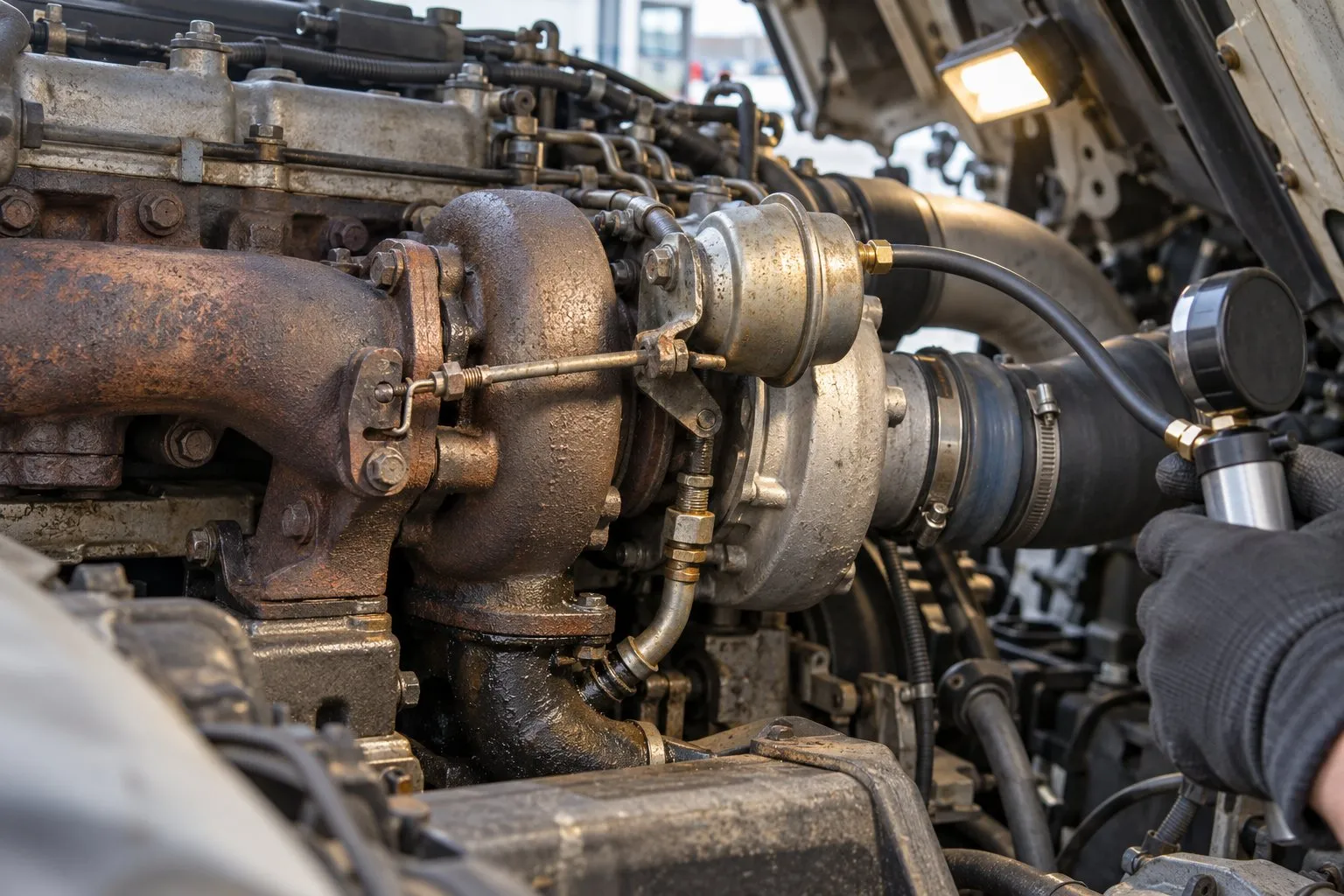
Because actuator failure is so common on these units, matching the right part matters: the actuator is specific to the turbo part number, and the electronic ones differ by voltage.
Always match the actuator to your exact turbo part number and preset boost calibration. A mismatched actuator will not hold the correct wastegate crack pressure, and you will chase boost codes all day. When in doubt, send us your turbo part number through our contact page and we will confirm the correct unit.
New vs Remanufactured: What Makes Sense for the J08
When the CHRA is gone, you have three paths: a new OEM turbo, a quality remanufactured unit, or a professional rebuild of your existing core. Each has a place depending on budget and downtime.
| Option | Typical Cost | Lead Time | Best For |
|---|---|---|---|
| New OEM turbo | $1,071 to $4,658 (7 listings) at PT Turbo | In stock to several weeks | Warranty-critical fleet trucks |
| Remanufactured turbo | Quoted by part number | Usually in stock | Best value for most owners |
| Rebuild your core | From $575 at PT Turbo (price list) | 3 days or less for most rebuilds | Rare or hard-to-source units |
| Actuator only | see actuator prices | In stock | Boost control faults, healthy CHRA |
Price ranges in this article are general estimates to help with budgeting, not PT Turbo quotes. Our current prices are on each product listing, and our rebuild prices are on the turbo rebuild price list.
A properly done remanufactured turbocharger uses new bearings, seals, and a balanced rotating assembly, and it comes with a warranty. For most J08 owners it is the sweet spot between cost and reliability.
If you have a good core, our turbocharger rebuild service restores your original unit to spec, VSR balanced, at a fraction of new cost. You can also browse everything we carry on our main shop page.
Installation and Longevity Tips
A new turbo installed on a dirty or neglected engine will fail again. Follow these steps to protect your investment.
- Prime the oil feed before startup and always use a fresh, high-quality oil feed line.
- Replace the air filter and clean the intercooler and all charge piping.
- Inspect and clear the crankcase breather to prevent seal-blowing pressure.
- Torque the oil drain line correctly, restricted drainage causes seal leaks.
- Let the engine idle for a few minutes before shutdown after hard work so the turbo can shed heat and the oil does not coke in the bearing housing.
- Do a careful leak check on all boost connections before the first road test, since a loose clamp will mimic a failing turbo and send you back to square one.
The J08 rewards clean oil, honest change intervals, and a few minutes of patience at the end of a shift. Treat the support systems right and a quality turbo or rebuild will outlast the next set of tires. Cut corners on the breather, the oil supply, or the intake, and you will be reading this guide again in a year.
Running UD trucks in the same fleet? See our UD/Nissan FE6 turbocharger guide.
Frequently Asked Questions
What are common symptoms of a failing Hino J08 turbocharger?
Common signs include loss of power, excessive exhaust smoke, whining noises, and increased oil consumption. Reduced boost pressure and poor fuel economy are also frequent indicators.
What causes Hino J08 turbocharger failure?
Frequent causes include oil contamination or starvation, foreign object damage, worn seals, and carbon buildup. Neglecting oil changes and driving with a clogged air filter accelerate wear.
Which trucks use the Hino J08 engine and turbocharger?
The J08 series is found in the Hino 268 and 338, along with FD, FE, and GD chassis models worldwide. It’s one of the most durable inline-six diesels in the medium duty class.
Need a Turbocharger?
PT Turbo has rebuilt and sold turbochargers since 1978. We stock remanufactured units for Cummins, Duramax, Power Stroke, Detroit Diesel, and more — backed by a 12-month unlimited mileage warranty. Units in stock at our shop in San Bernardino, CA ship the same day when ordered before 2 PM Pacific, Monday through Friday.
📞 (909) 824-1020 · 346 S I St. #3, San Bernardino, CA 92410 · [email protected]
More From PT Turbo
 Audi 2.0L TDI Turbocharger Guide: A3, A4, A5 & Q3 Common Failures & Replacement
- Holset HX30 Turbocharger: Small Block Cummins B-Series Application Guide
- VW 1.9L TDI Turbocharger Guide: ALH, BEW & BRM Engine Replacement Reference
- Holset HE400WG Turbocharger: Wastegate Application Guide for Cummins ISLe, Volvo/Mack & DAF Engines