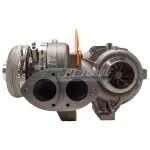
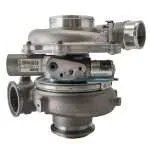
Ford F-650 & F-750 Turbocharger Guide: Cummins ISB & 6.7L Powerstroke Applications
Welcome to our Ford F-650 & F-750 Turbocharger Guide, built for the diesel mechanics, fleet managers and owner-operators who have to match the right turbo to a medium-duty Ford before ordering a part. These trucks have run several very different engines over their life, and the turbo bolted to one chassis has almost nothing in common with the one on the truck parked next to it. Getting the engine family right, then confirming the exact unit by the number on the tag, is the whole job.
PT Turbo has been rebuilding turbochargers since 1978, and in that time the medium-duty Ford has worn Caterpillar, Cummins and Ford power. We stock both new and remanufactured units and remanufacture in-house at our San Bernardino shop, so the guidance below is aimed at helping you identify the turbo correctly the first time.
How to Use This Ford F-650 & F-750 Turbocharger Guide
The F-650 and F-750 were sold with more than one engine, and the engine decides the turbo. From 2000 to 2015 the trucks were built by Blue Diamond, Ford’s joint venture with Navistar, with the 7.3L and later the 6.0L Power Stroke, the Caterpillar 3126 and later the C7 (until Cat left the on-highway market for 2010), or the Cummins ISB 5.9L and later the ISB 6.7L. From the 2016 model year Ford builds them in Ohio with its own 6.7L Power Stroke.
Start by confirming the engine, then pull the data plate on the turbo’s compressor housing and read the part number off it. Casting numbers stamped into the housings are not part numbers, because one casting serves many turbos; they only narrow the search while wheel sizes and the turbine A/R confirm it. A wrong application is worse than no application, so order by the tag number, not by the model year alone.
Cummins ISB 6.7L Turbocharger
The Cummins ISB 6.7L used in medium-duty trucks runs a Holset variable geometry turbocharger. On a Holset VGT the airflow is managed by a sliding nozzle, not by pivoting vanes on a unison ring the way a Garrett VGT works, and the position is set by an electronic actuator. You can read more about the principle on variable-geometry turbochargers.
Medium-duty ISB 6.7 engines are listed with the Holset HE351VE or the HE341VE turbochargers. The letters matter here: a Holset model ending in VE carries an electronic actuator, so these are not air-operated and there is no vacuum line to test. Related Holset VGTs in the same family include the HE300VG, which is why reading the tag is essential before you buy.
Because the actuator is electronic and calibrated to its own turbo, you cannot swap an actuator over and drive away. The correct Cummins procedure is to run the INSITE install routine with the new actuator plugged in but not yet bolted to the turbo, then mount it and calibrate without cycling the key. Never move the actuator’s arm by hand, because the self-locking gears inside are easy to strip.
Ford 6.7L Power Stroke Turbocharger
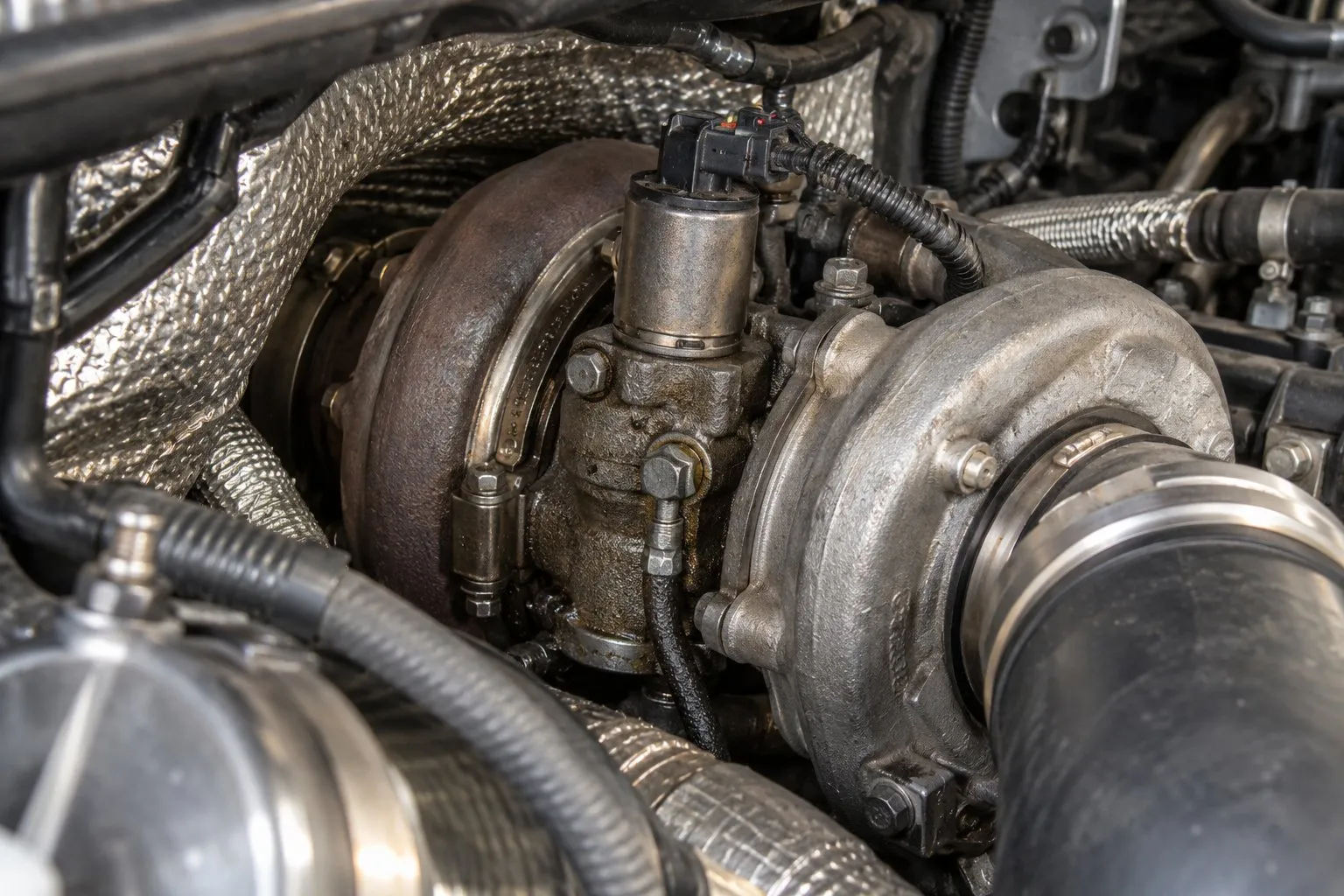
From the 2016 model year Ford built the F-650 and F-750 in-house with the 6.7L Power Stroke, which uses a Garrett variable geometry turbo. The 6.7L turbo was never a BorgWarner; BorgWarner built the compound pair on the earlier 6.4L. The 6.7L cab-and-chassis and medium-duty units are not the same part numbers as the pickups, so again the tag number is what you order from.
How the vanes are moved changed partway through the 6.7L’s life, and this is the single biggest point of confusion:
- 2011 to 2019: engine oil moves the vanes through a PCM-driven VGT solenoid, exactly as on the earlier 6.0L. There is no external electric vane actuator to replace or calibrate.
- 2020 and later: the turbo uses an electronic vane actuator with a position sensor, and a position learn is required after replacement.
On the pickups, 2011 to 2014 trucks carried the Garrett GT32 SST, which uses a double-sided compressor wheel with two inlet streams feeding one outlet working in parallel, not as two stages. From 2015 the Power Stroke moved to a larger Garrett GT37 with a conventional single compressor wheel. The medium-duty and cab-and-chassis units differ from these, which is one more reason to go by the number on your truck’s turbo. You can see Garrett’s current product information at garrettmotion.com.
If you also run earlier Ford medium-duty or Super Duty units, our write-ups on the 6.0L Power Stroke turbocharger and the 6.4L Power Stroke twin-turbo system cover those platforms in depth.
Turbo Applications at a Glance
| Engine | Turbo type | How the vanes/wastegate are controlled | Service note |
|---|---|---|---|
| Ford 7.3L and 6.0L Power Stroke, Caterpillar 3126, Cummins ISB 5.9L (2000-2007 trucks) | Varies by engine | Varies by engine and year | Identify by the part number on the tag, or call (909) 824-1020 |
| Caterpillar C7 (earlier trucks) | BorgWarner, fixed or variable-vane by rating | Varies by rating; only 2007-on C7 had variable vanes | Identify by the part number on the tag |
| Cummins ISB 6.7L | Holset variable geometry (sliding nozzle) | Electronic actuator (VE model), calibrated to the turbo | INSITE install routine, then calibrate |
| Ford 6.7L Power Stroke, 2016-2019 | Garrett variable geometry | Engine oil via PCM-driven VGT solenoid; no external electric actuator | No vane actuator to calibrate |
| Ford 6.7L Power Stroke, 2020 on | Garrett variable geometry | Electronic vane actuator with position sensor | Position learn required after replacement |
Use the table to narrow the family, then confirm the exact unit on the data plate before you buy. Two trucks the same model year can carry different turbos.
Common Failure Modes and What to Check First
Most turbo failures trace back to the oil supply, whatever the engine. A turbo that has lost its bearings, or one coked by heat, should get a new oil feed line rather than a flushed and reused one, and the drain must run downhill and enter the pan above the oil level. A restricted drain backs oil up and leaks at both ends; a leaking drain gasket is an external leak instead.
On any variable geometry turbo, soot from combustion can foul the nozzle mechanism. A nozzle stuck closed gives overboost and high drive pressure; stuck open gives low boost and a lazy spool. These are symptoms to diagnose on the specific unit, not reasons to condemn a turbo on sight.
Before blaming a seal for oil in the charge piping, check the crankcase breather, air filter, oil level and the drain, because a light oil film from closed crankcase ventilation is normal. On the high-pressure EGR the Cummins and Ford engines use, EGR gas is returned to the intake and never passes through the turbine or reaches the compressor wheel (the 2007-on Cat C7 is different: its Clean Gas Induction feeds filtered exhaust in ahead of the compressor), so EGR carbon does not land directly on the turbo. For background on that system, see exhaust gas recirculation.
When you check a used core, some side-to-side rock at the wheel is normal on a journal-bearing turbo. Condemn it for in-and-out play you can feel, for wheel contact with the housing, or for play beyond the maker’s limit, not for any movement at all. If a compressor wheel has come apart, replace the charge air cooler as well, because metal in the fins cannot be flushed out reliably.
New, Remanufactured and Rebuild Options from PT Turbo
With more than 45 years in the business, PT Turbo stocks both new and remanufactured turbochargers and offers an in-house turbo rebuild service on your own core. A rebuild kit restores the bearings, seal rings and thrust parts, and every unit is balanced before it ships.
For the cost of rebuilding your exact turbo, see our turbo rebuild price list; the price is confirmed after inspection and before any work starts. Most rebuilds ship in three days or less, remanufactured units carry a 30-day core return, and our warranty is 12 months with unlimited mileage.
Fleet operators running a yard full of F-650 and F-750 trucks can arrange priority turnaround and have us stock their common cores. If you are not sure which turbo your truck carries, send us the number off the tag or call PT Turbo at (909) 824-1020 and we will match it.
Frequently Asked Questions
How do I tell which engine and turbo my F-650 or F-750 has?
Confirm the engine first, since these trucks were sold with Caterpillar, Cummins and Ford power over the years. Then read the part number off the data plate on the turbo’s compressor housing. Model year alone is not enough, because two trucks built the same year can carry different turbos, and the tag number is what we match a replacement to.
Does the Cummins ISB 6.7L turbo need calibration after replacement?
Yes. The Holset variable geometry turbo on the ISB uses an electronic actuator that is calibrated to its own turbo. Run the Cummins INSITE install routine with the new actuator plugged in but not yet bolted on, then mount it and calibrate without cycling the key. Never turn the actuator arm by hand, because the internal gears strip easily.
Does the 6.7L Power Stroke in these trucks have an electric vane actuator?
It depends on the year. On 2011 to 2019 Power Stroke turbos, engine oil moves the vanes through a PCM-driven VGT solenoid and there is no external electric vane actuator to calibrate. From the 2020 model year the turbo uses an electronic vane actuator with a position sensor, and a position learn is needed after replacement.
Need a Turbocharger?
PT Turbo has rebuilt and sold turbochargers since 1978. We stock remanufactured units for Cummins, Duramax, Power Stroke, Detroit Diesel, and more — backed by a 12-month unlimited mileage warranty. Units in stock at our shop in San Bernardino, CA ship the same day when ordered before 2 PM Pacific, Monday through Friday.
📞 (909) 824-1020 · 346 S I St. #3, San Bernardino, CA 92410 · [email protected]
More From PT Turbo
 Ford F-250/F-350 Super Duty Turbocharger Guide: 6.0L, 6.4L & 6.7L Powerstroke Compared
- Peterbilt 389 Turbocharger Guide: Cummins ISX & PACCAR MX-13 Applications
- Duramax LLY Turbocharger: Symptoms, Garrett GT3788VA Replacement & Cost (2004-2005)
- Detroit DD16 Turbocharger Guide: Turbo-Compound System, Failure Symptoms & How It Differs from the Mack MP10