Caterpillar 950 Wheel Loader Turbocharger Guide: C7 & C7.1 Engine Applications
This Caterpillar 950 wheel loader turbocharger guide covers the turbos on the C7 and C7.1 versions of the 950: what each engine carries, how loader work wears a turbo out and how to order the right replacement the first time. A 950 works in dust, short cycles and heavy hydraulic load, and the turbo absorbs all of it. Every turbo job starts with two facts: which engine is in the machine and what number is on the turbo tag.
Which Engine Is in Your 950
The 950 name has covered several loader series. The engine depends on the series and on the emissions tier the machine was built to. Two loaders with the same decal can have different engines, so read the engine serial number plate instead of going by the series letter.
The C7 followed the 3126 in Caterpillar’s lineup. The C7.1 is a different engine, 7.0 L (427.7 cu in). Never assume a C7 turbo fits a C7.1 or the reverse. Treat them as separate parts searches from the start.
Caterpillar does not build its own turbochargers. Garrett and BorgWarner supply them. The tag on the turbo carries the turbo maker’s part number, and on factory-fitted units Caterpillar’s number as well. That tag number is what you order by.
C7 Turbochargers: BorgWarner S200 and S300
On most C7 ratings the turbo is a BorgWarner, usually a version of the BorgWarner S200 (S200AG and S200G numbers). Some C7 ratings carry an S300 instead. The engine name doesn’t tell you which one you have. The rating decides it, and the tag confirms it.
The two frames are different sizes. The S200 turbine wheel is about 70 mm. The S300 uses a 76 mm or 80 mm turbine wheel depending on the version. Never assume one frame replaces the other without checking flanges, oil lines and mounting.
Many C7 turbos are wastegated, and that applies to early C7 engines as well as later ones. Variable vanes appeared on C7 engines only from 2007. If your engine is a 2007 or later unit, check whether the tag number belongs to a variable-vane turbo. A fixed geometry turbo and a variable-vane turbo are not swapped for each other.
BorgWarner part numbers have six digits on older S-series units or eleven on newer ones, never seven. The nameplate sits on the compressor housing. Ignore the casting numbers on the housings when you order. One casting serves many turbos, so a casting number only narrows a search.
Our catalog includes remanufactured turbochargers from BorgWarner listed for C7 engines. C7 turbos change by rating, so search by the number on your tag, not by engine name.
Turbos we list for the S300 and S200
Listings for the turbo models named in this guide that can be ordered online today. Several part numbers can fit one engine by year and rating, so match the number on your turbo’s tag, or call (909) 824-1020 and we will match it for you.
C7.1 Turbo Layout: One Turbo or Two in Series
The C7.1 runs one of two layouts: a single wastegated turbo, or two turbos in series on higher ratings. Neither layout uses variable geometry. There are no vanes to stick and no vane actuator to calibrate, and the wastegate does the boost control.
In a series system the low-pressure turbo compresses the air first and the high-pressure turbo compresses it again. The exhaust runs the other way, through the high-pressure turbine first and then the low-pressure one. Debris only travels downstream:
- Pieces of a failed low-pressure compressor wheel go into the high-pressure compressor.
- Pieces of a failed high-pressure turbine go into the low-pressure turbine.
When one turbo of the pair lets go, inspect the other. The same series principle appears on the truck engines in our Caterpillar C15 turbocharger guide.
Wastegate faults can push boost either way:
- Flapper that does not seat: exhaust bypasses the turbine, giving low boost and slow response.
- Gate held shut: overboost. On a gate opened by boost pressure, a leaking actuator diaphragm does exactly that, because the gate opens late.
For C7.1 turbos, search our store by the number on the turbo tag. On a series pair, use both tags. If a number doesn’t come up, we can quote a replacement by part number or rebuild your core.
C7 and C7.1 Turbo Setups Side by Side
| Item | C7 | C7.1 |
|---|---|---|
| Turbo supplier | BorgWarner on most ratings | Read it off the tag (Caterpillar buys from Garrett and BorgWarner) |
| Turbo family | S200 versions on most ratings, S300 on some | Go by the tag number |
| Layout | Single turbo | Single turbo, or two in series on higher ratings |
| Boost control | Fixed geometry, many wastegated; variable vanes only on 2007 and later engines | Wastegate; no variable geometry |
| Tags to read | One | One, or two on a series system |
| Extra check after a failure | Charge air cooler if the compressor wheel shed metal | The downstream turbo on a series pair, plus the charge air cooler |
How Loader Work Wears Out a 950 Turbo
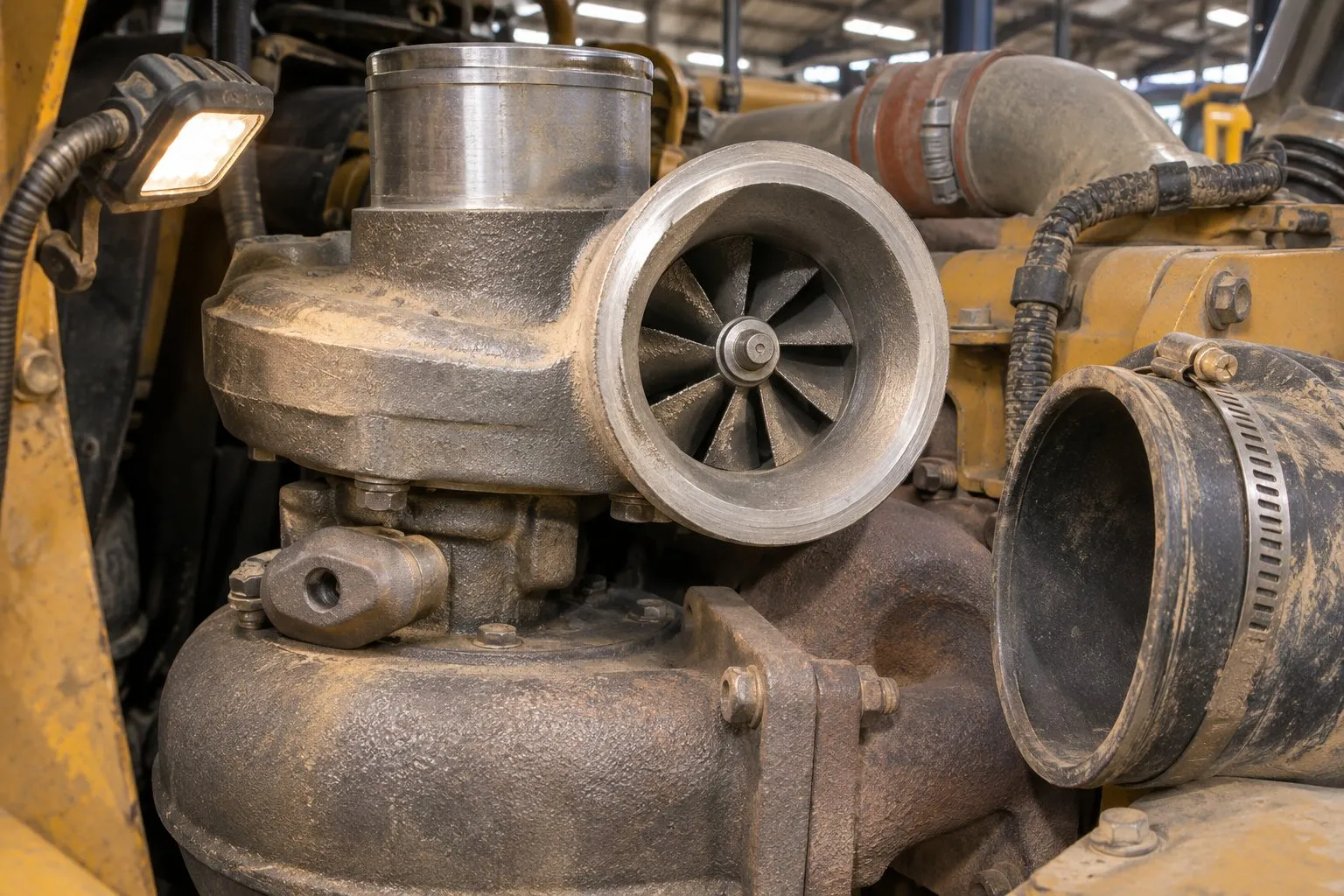
Garrett states that more than 90 percent of turbo failures come from oil starvation or oil contamination. It names foreign objects as the third main cause. Loader work feeds all three, so check the oil and air systems before you blame the turbo.
Oil Starvation and Coking
Starvation has a handful of causes:
- Low oil pressure.
- A blocked or leaking feed line.
- Hard load on a cold engine before oil reaches the bearings.
- A new turbo started without priming.
A hot shutdown causes a different failure. Oil left in the center housing cooks into carbon that later scores the bearings. After a hard working cycle, idle down for the time Caterpillar gives in the machine’s Operation and Maintenance Manual before you shut off.
Dust
Dirt that gets past the air filter sandblasts the compressor, leaving pitting on the compressor inlet blades. Bent or chipped blades mean something else: impact damage from a solid object. Replace the filter when the restriction indicator calls for it, and check the filter seals and clamps. Also check the intake pipe between filter and turbo. That pipe is under suction, so a crack there doesn’t leak boost; it pulls dirt in.
Contaminated Oil and Drain Problems
Abrasive bearing wear comes from carbon, engine wear debris, dirt let in during servicing, a filter running in bypass, or degraded oil. Turbo journal bearings are bronze, so check the turbo when copper climbs against your own oil analysis baseline. The drain is a gravity return that must run downhill and enter the pan above the oil level. A restricted drain backs oil up and leaks it at both ends of the turbo.
Symptoms and What to Check First
| Symptom | Points to | Check first |
|---|---|---|
| Black or dark gray smoke, low power | Too little air, low boost | Air filter restriction, charge-air leaks, exhaust leaks before the turbine, wastegate seating |
| Blue-gray smoke | Oil burning | Oil level, drain line, crankcase pressure, engine wear, then the turbine-side seal |
| Oil pooled in charge pipes or aftercooler | Oil past the compressor-side seal, or crankcase vapor | Breather, air filter, oil level, drain; a light film alone is normal |
| Whine or siren noise under load | A leak or a rubbing wheel | Every exhaust and charge-air joint first, then shaft play and wheel contact |
| Pitted compressor inlet blades | Dust past the filter | Filter seals, clamps, cracks in the inlet pipe |
| Overboost | Wastegate held shut | Linkage, actuator and its supply |
Inspection and Replacement Checklist
A 950 logs Caterpillar diagnostic codes, not the P-codes a pickup sets. Read them with Cat ET and compare boost against Caterpillar’s figure for your rating. Then work through the hardware:
- Shaft play: some side-to-side movement is normal on a journal-bearing turbo with no oil pressure. Condemn the turbo for in-and-out play you can feel, wheel contact with the housing, or play beyond the maker’s limit. Axial play on a journal-bearing turbo is typically 0.001 to 0.004 in.
- Oil feed line: fit a new one after a bearing failure or coked oil. Don’t flush and reuse it.
- Gaskets: fit new oil inlet and drain gaskets with no sealant.
- Drain: keep it within about 15 to 20 degrees of straight down, with no kinks, entering above the oil level.
- Charge air cooler: replace it if the old compressor wheel shed metal, because metal in the fins cannot be flushed out reliably. Clean or replace the charge piping as well.
- Intake path: fit a new air filter and clean the ducting ahead of the turbo.
- First start:
- Fill the oil inlet with clean engine oil and turn the wheel by hand.
- Crank 10 to 15 seconds without letting the engine start, disabling fueling by Caterpillar’s procedure.
- Start the engine and idle 3 to 4 minutes, checking for oil, exhaust and air leaks before you put it under load.
Rebuild, Remanufactured or New
PT Turbo has been rebuilding turbochargers since 1978, family-owned for more than 45 years in San Bernardino, California. Our in-house turbo rebuild service strips your core, replaces the bearings, seals and thrust parts, and VSR balances the cartridge. Every rebuild finishes with a final inspection: a leak test, a visual check and a wastegate or actuator function check.
Most rebuilds ship in 3 days or less. We confirm the rebuild price after inspection and before any work starts. The turbo rebuild price list shows our rates by turbo.
Our remanufactured units are tested, flow-tested and have their actuators calibrated before they ship. Core returns are due within 30 days, and you pay the return shipping. If the machine is down longer than that, call ahead and we can usually work with you. Our warranty runs 12 months.
In-stock items ship the same day when ordered before 2 PM Pacific, Monday through Friday. Most other orders ship within 1 to 2 business days. If your tag is unreadable, reach us through the contact page or call (909) 824-1020 with the engine serial number. Fleets running Cummins-powered machines alongside their Cats can use our Cummins QSB turbocharger guide for those engines.
Frequently Asked Questions
Does the C7.1 in a 950 have a variable geometry turbo?
No. The C7.1 uses a single wastegated turbo or, on higher ratings, two turbos in series, and neither layout has variable geometry. There are no vanes to clean and no vane actuator to calibrate. Boost faults point to the wastegate, leaks, the air filter or the turbo itself.
Where is the part number on a 950 turbo?
It’s on the nameplate. On a BorgWarner the nameplate is on the compressor housing and shows the BorgWarner part number, a serial number and, on factory units, Caterpillar’s number. Order by that tag number, not the housing casting number, which serves many different turbos.
Do I need a new aftercooler after a turbo failure?
If the compressor wheel came apart, yes. Metal lodged in the fins cannot be flushed out reliably, and it goes straight into the engine on the next start. If the wheel stayed whole, inspect the cooler and its connections and clean or replace the charge piping as needed.
Need a Turbocharger?
PT Turbo has rebuilt and sold turbochargers since 1978. We stock remanufactured units for Cummins, Duramax, Power Stroke, Detroit Diesel, and more — backed by a 12-month unlimited mileage warranty. Units in stock at our shop in San Bernardino, CA ship the same day when ordered before 2 PM Pacific, Monday through Friday.
📞 (909) 824-1020 · 346 S I St. #3, San Bernardino, CA 92410 · info@ptturbo.com
More From PT Turbo
 Cummins ISB 6.7L Turbocharger Guide: Variable Geometry Operation & Common Failures
- International MaxxForce DT Turbocharger: VGT Actuator Problems & Replacement
- Duramax L5P Turbocharger Guide: What Changes in the 2017+ Generation
- 2020 Ford 6.7L Powerstroke Turbocharger Guide: Gen 3 Changes & What to Know