BorgWarner K04 Turbocharger: Upgraded K03 Applications & Fitment Guide
If you are chasing more airflow out of a small-frame gasoline turbo engine, the BorgWarner K04 Turbocharger is one of the most common and well-understood step-ups from a factory K03, and understanding exactly what separates the two keeps you from buying the wrong unit. The K03 and K04 belong to the same K-series family, share mounting architecture on many engines, and look nearly identical at a glance. The differences that matter are on the inside, and the part number on the tag is the only thing that settles fitment for certain.
At PT Turbo we have been working on turbochargers since 1978, more than 45 years, and the K-series is one of the families we see owners trying to decode most often. This guide walks through where the K04 came from, how it differs from the K03, how to confirm what actually bolts to your engine, and how these units fail.
What the BorgWarner K04 Turbocharger Is
The K-series is a line of fixed geometry turbochargers that trace back to KKK (Kühnle, Kopp & Kausch, also branded 3K). KKK became part of BorgWarner in the late 1990s, and Schwitzer followed shortly after, which is why you will see the same hardware wearing KKK, 3K and BorgWarner markings depending on the era. The BorgWarner K04 turbochargers we handle are that same lineage.
Every K-series unit, including the K03, K04, K14, K16, K24, K26, K27, K29 and K31, is a fixed geometry turbo. That means no movable vanes and no unison ring. Depending on the application a K-series turbo may have a wastegate or no wastegate at all. There is no variable nozzle and no vane actuator to calibrate on these units, so do not expect to find one.
If you want the wider view of how BorgWarner’s lineup fits together, our BorgWarner turbochargers guide covers the K-series alongside the S-frame and EFR families. For a plain-English refresher on how a turbo works, Wikipedia’s turbocharger overview is a solid primer.
K03 vs K04: What Actually Changes
On the engines where both are offered, the K04 is the larger-breathing member of the pair. It is not a different mounting system or a different control strategy. It is a bigger-capacity version of the same basic turbo, aimed at engines that need more airflow than the K03 turbochargers were sized to deliver.
Because exact wheel and housing dimensions vary by part number within each family, use the figures stamped and documented for your specific unit rather than a blanket K03-versus-K04 number. The comparison below is about what differs in kind, not invented measurements.
| Characteristic | K03 | K04 |
|---|---|---|
| Family | BorgWarner / KKK K-series, fixed geometry | BorgWarner / KKK K-series, fixed geometry |
| Relative airflow capacity | Smaller of the pair | Larger of the pair |
| Vane control | None (fixed geometry) | None (fixed geometry) |
| Wastegate | Present or absent by application | Present or absent by application |
| Typical role | Factory-sized turbo | Upgrade or higher-output factory fit |
| Fitment confirmation | By part number on the tag | By part number on the tag |
The practical takeaway: a K04 generally supports more power than the K03 it replaces, but only within the limits of your engine’s fueling, cooling and tuning. A larger compressor on an engine that cannot feed it just moves the airflow peak higher in the rev range and can make the turbo feel softer off idle.
Fitment: Match the Number on the Tag
This is where buyers get burned. A wrong turbo is worse than no turbo, because it costs you a second round of shipping, labor and downtime. “K04” by itself is a family, not a single interchangeable part, and the same is true of “K03.” Within each family there are multiple part numbers with different compressor housings, turbine housings, wastegate arrangements, oil and coolant connections and clocking.
One factory fitment we can state with certainty: the Mini Cooper S 1.6 turbo engine uses a BorgWarner K03. Beyond confirmed applications like that, do not assume a K04 drops onto any engine that ran a K03. Some engines were offered with one or the other, some share a bolt pattern but not a wastegate connection, and some need different lines entirely.
Before you order, do the following:
- Find the data tag on the compressor housing and read the full BorgWarner part number, not just “K03” or “K04.”
- Note whether your unit is water-cooled (coolant lines present) or oil-only.
- Check the oil feed and drain style and the wastegate actuator connection.
- Confirm the compressor outlet and turbine inlet clocking against your existing unit.
Send us that number and we will match it. If you are not sure what you have, contact PT Turbo or call (909) 824-1020 and we will work from the tag rather than a guess.
How K03 and K04 Turbos Fail
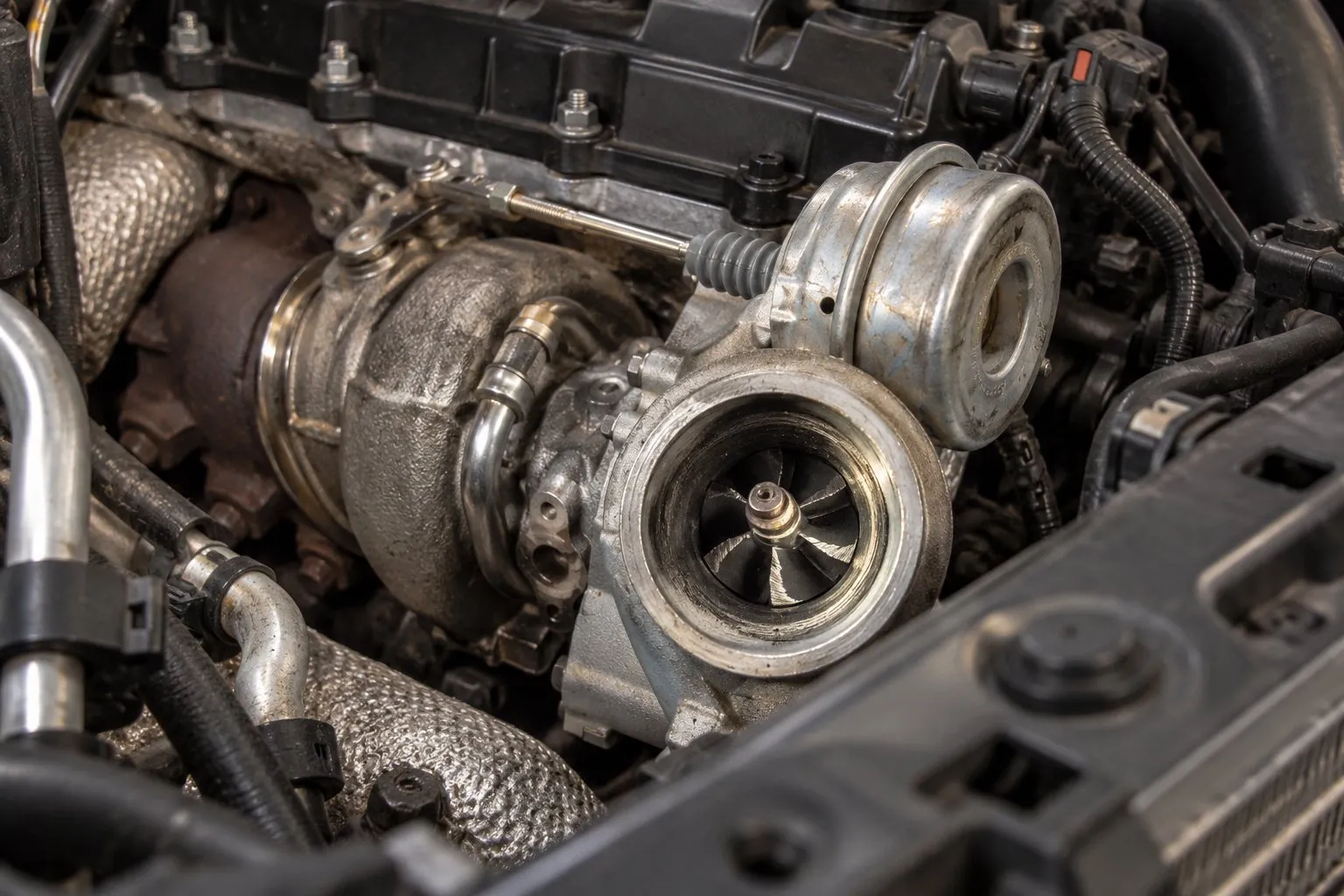
Most turbo failures, across every family, trace back to the oil supply, and the K-series is no exception. A small-frame turbo like this spins very fast, and it lives or dies on clean oil arriving at the right pressure and draining away freely.
The failure patterns we see on these units:
- Oil starvation or coked oil: a restricted feed line, extended oil-change intervals or hot shutdowns cook the oil in the bearing housing. The bearings wear, the shaft develops play, and the wheels eventually contact their housings.
- Blocked or kinked oil drain: a restricted drain backs oil up past the seals, so you get smoke and oil in the charge pipes even though the feed side is fine.
- Seal leaks: oil reaches the intake only past the compressor-side seal and the exhaust only past the turbine-side seal. Before condemning a seal, check the breather, air filter, oil level and drain, because some oil film in the charge pipes is normal with closed crankcase ventilation.
- Foreign object damage: debris on the turbine inlet or compressor leading edges, usually from something upstream that broke loose or was left in the intake tract.
When you check shaft play, remember that some side-to-side movement is normal on a journal-bearing turbo with no oil pressure. Condemn a unit for in-and-out play you can feel, for wheel contact with the housing, or for play beyond the maker’s limit, not for any movement at all.
If a bearing has failed or the oil has coked, replace the oil feed line rather than reusing it. Debris trapped in that line is the fastest way to kill a freshly rebuilt or new turbo.
New, Remanufactured, or Rebuild Your Core
You have three sensible paths with a K03 or K04, and the right one depends on what you have in hand and how quickly you need the truck or car back on the road.
| Option | Best when | Notes |
|---|---|---|
| New turbo | No usable core, or you want factory-fresh everything | In stock at the shop ships same day when ordered before 2 PM Pacific, Mon–Fri |
| Remanufactured | You need a known-good unit now and have a core to return | Core return within 30 days; customer pays return shipping |
| Rebuild your own | Your housings and shaft are good and you want your exact part number back | Most rebuilds ship in 3 days or less; price confirmed after inspection |
PT Turbo stocks both new and remanufactured turbochargers, and we remanufacture in-house. For current pricing on a specific K03 or K04 part number, check the model page or call (909) 824-1020, since the catalog is the source of truth and we will not quote from memory.
If you want to keep your original housings and clocking, our turbocharger rebuild service rebuilds the cartridge with new bearings, seal rings and thrust parts, then balances it. Rebuild cost depends on the model, so see our turbo rebuild price list rather than a number we might misquote. Every rebuilt and replacement turbo carries a 12-month, unlimited-mileage warranty.
First Start
Whether you install a new, reman or freshly rebuilt K04, follow the turbo maker’s priming routine and skip the folklore. Fill the oil inlet with clean engine oil, turn the compressor wheel by hand, then crank or idle for a few minutes before putting the unit under load.
There is no break-in mileage schedule, no boost ceiling for the first miles, and no mandatory early oil change beyond your normal service. What matters is that oil is reaching the bearings before the turbo sees load, and that whatever caused the last failure, a dirty feed line, a bad drain, debris in the intake, has been corrected first.
Frequently Asked Questions
Will a K04 bolt straight onto a K03 application?
Not automatically. The K03 and K04 share a family and often a general mounting layout, but part numbers within each family differ in housings, wastegate connections, cooling and clocking. Read the full part number on the data tag and confirm the swap against that number rather than assuming “K04 replaces K03” on every engine.
Is the BorgWarner K04 a variable geometry turbo?
No. The entire K-series, including the K03 and K04, is fixed geometry. There are no movable vanes, no unison ring and no vane actuator to calibrate. Some applications have a wastegate and some do not, so check what your specific unit uses.
How do I know whether to rebuild my core or buy a reman unit?
If your housings and shaft are in good shape and you want your exact part number and clocking back, a rebuild is usually the move. If you need a known-good unit fast and have a core to send back, a remanufactured turbo is quicker. Send us the part number from the tag and we will tell you which makes sense for your situation.
Shopping by part number?
Every part number we stock for the BorgWarner K04 and BorgWarner K03 is on one page, with live prices and stock: BorgWarner K04 turbos and parts · BorgWarner K03 turbos and parts.
Need a Turbocharger?
PT Turbo has rebuilt and sold turbochargers since 1978. We stock remanufactured units for Cummins, Duramax, Power Stroke, Detroit Diesel, and more — backed by a 12-month unlimited mileage warranty. Units in stock at our shop in San Bernardino, CA ship the same day when ordered before 2 PM Pacific, Monday through Friday.
📞 (909) 824-1020 · 346 S I St. #3, San Bernardino, CA 92410 · [email protected]