Signs Your VW or Audi 1.9 TDI Turbo Is Failing (And What To Do)
If you’re running a 1.9 TDI making 105 HP, you already know that little Garrett variable-geometry turbo is the heart of the engine. When it starts to go, the symptoms show up fast: lazy throttle response, a haze of blue or black smoke, and a limp-mode warning that kills your boost right when you need it. Catching a failing turbocharger early is the difference between a straightforward swap and a full engine teardown after a shattered compressor wheel ingests itself. Here’s how to read the signs, diagnose the cause, and fix it right the first time.
Why the 105 HP TDI Turbo Fails in the First Place
The 105 HP 1.9 TDI engines from Volkswagen and Audi run a variable nozzle turbine (VNT) turbocharger, typically a Garrett GT1646MV (part number 751851) or a BorgWarner BV39 depending on the build year. These are sophisticated units. The variable vanes inside the turbine housing pivot to control exhaust flow, giving you boost down low and top-end power without lag. That sophistication is also the weak point.
The most common failure modes we see at PT Turbo come down to a handful of root causes:
- Sticking VNT vanes: Soot and carbon build up around the variable vanes and the unison ring, gumming up the mechanism. The vanes can’t move freely, so boost control goes haywire.
- Oil contamination and coking: Extended oil change intervals, the wrong oil spec, or a clogged feed line let carbon coke up the center bearing housing. This kills the journal bearings.
- Actuator failure: The vacuum actuators on these turbos wear out, leak, or seize.
- Oil starvation: A partially blocked oil supply line, a common problem on high-mileage TDIs, wipes out the bearings in minutes.
- Foreign object damage: A chunk of carbon coming loose can nick the turbine wheel, and debris from the intake side can nick the compressor wheel.
Knowing the cause matters because slapping a new turbo on a contaminated oil system just buys you a second failure.
The Warning Signs, From Mild to Catastrophic
A turbo rarely dies all at once. It tells you it’s struggling for weeks or months. Learn to read the progression so you can act before the wheels let go.
| Symptom | Likely Cause | Severity | Action |
|---|---|---|---|
| Sluggish acceleration, soft throttle | Sticking VNT vanes, leaking or sticking actuator | Mild | Clean vanes, check and adjust the actuator |
| Whistling or whining that rises with RPM | Boost leak or early bearing wear | Mild to moderate | Pressure test intake, inspect shaft play |
| Blue smoke on startup or acceleration | Failing seals, oil into the hot side | Moderate | Plan replacement soon |
| Black smoke and poor fuel economy | Overfueling from low boost, stuck vanes | Moderate | Scan for boost codes, inspect VNT |
| Limp mode, P0234/P0299 boost codes | Over or underboost, actuator fault | Severe | Diagnose immediately, stop driving hard |
| Metallic grinding or rattling | Bearing failure, wheel contact | Critical | Stop driving, replace now |
1. Loss of Power and Lazy Throttle
This is the number one complaint. The engine feels gutless, especially under load or on a hill. On the 105 HP TDI, this almost always points to the VNT mechanism. When the vanes stick from carbon, the ECU can’t control boost properly, and you lose the low-end punch that makes these engines drivable.
2. Excessive Smoke
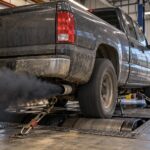
Color tells you everything. Blue smoke means oil is getting past the turbo seals and burning in the combustion chamber, classic sign of failing bearings and seals. Black smoke means you’re dumping fuel without enough air, usually because boost has collapsed. Either way, the turbo is involved.
3. Unusual Noise
A healthy turbo spools with a smooth, faint whoosh. A failing one whistles, whines, or in the worst cases makes a grinding or fluttering sound. A siren-like whine that gets louder with RPM is the tell-tale sign of a compromised shaft and bearing. If you hear metal on metal, shut it down.
4. Limp Mode and Boost Codes
The TDI ECU monitors boost pressure constantly. When actual boost deviates from the target, it triggers limp mode to protect the engine. Pull the codes. P0234 (overboost), P0299 (underboost), and the manufacturer-specific VNT actuator codes all point straight at the turbo system.
How to Confirm It’s the Turbo and Not Something Else
Before you condemn a turbo, rule out the cheap stuff. We’ve seen plenty of “bad turbos” that turned out to be a $15 boost hose. Run through this checklist:
- Pressure test the intake system. Cracked intercooler hoses and split boots mimic turbo failure perfectly. Pressurize the system and listen for leaks.
- Inspect the actuator. With the engine off, check that the actuator arm moves freely and returns. A seized or leaking actuator is often repairable without pulling the turbo.
- Check shaft play. With the intake pipe off, wiggle the compressor wheel. Slight side-to-side play is normal. Any contact with the housing or excessive axial movement means the bearings are done.
- Look for oil in the intercooler. Pull the lower intercooler hose. A film of oil is normal; pooling oil needs a closer look, starting with the breather, the air filter, the oil level and the turbo oil drain before seal failure is blamed.
- Scan VNT operation. A diagnostic tool with VAG capability lets you command the vanes and watch them respond. Sticking vanes show up clearly.
- Verify oil supply. Before fitting a replacement, confirm the feed line is clear. A blocked line will destroy a new turbo just as fast.
Repair, Recondition, or Replace?
Once you’ve confirmed the turbo, you’ve got three paths. The right choice depends on what failed and your mileage.
Clean and adjust works if the only issue is sticking vanes and the bearings are still tight. Carbon cleaning and a check of the vacuum actuator’s travel can restore a turbo with shaft play within the maker’s limits. It’s the cheapest fix, but it’s a gamble on high-mileage units.
Rebuild with a CHRA (center cartridge) replacement makes sense when the core is worn but the housings are good. You’re replacing the bearings, seals, and wheels in one cartridge.
Full replacement with a new or remanufactured complete turbo is the most reliable fix, especially if there’s wheel damage or housing wear. This is what most fleet operators choose because downtime costs more than parts.
| Option | Typical Cost Range | Best For | Reliability |
|---|---|---|---|
| Clean and adjust | Varies by shop | Sticking vanes, tight shaft | Moderate |
| CHRA cartridge rebuild | $575 for a rebuild at PT Turbo (price list) | Worn core, good housings | Good |
| Remanufactured complete turbo | $600 (1 listing) at PT Turbo | Most failures, best value | Excellent |
| New OEM turbo | $629 to $1,524 (18 listings) at PT Turbo | Warranty-critical builds | Excellent |
Price ranges in this article are general estimates to help with budgeting, not PT Turbo quotes. Our current prices are on each product listing, and our rebuild prices are on the turbo rebuild price list.
For most 105 HP TDI owners, a quality remanufactured unit hits the sweet spot. PT Turbo has been in the turbocharger business since 1978, and we stock both new and remanufactured options for these VW and Audi diesels. A properly reman turbo is built to OEM tolerances and costs a fraction of new.
Do the Job Right: Don’t Reuse Old Gaskets and Lines
Here’s where a lot of installs go wrong. You bolt on a fresh turbo, reuse the crusty old gaskets and oil lines, and a week later you’ve got a leak or, worse, oil starvation. Every turbo replacement on these engines needs fresh seals, gaskets, and clean oil feed components.
For the VW-Audi platform, the Ajusa Volkswagen-Audi Installation Kit (JTC11378) at $21.26 gives you the gaskets and seals you need to do the job properly. At that price, there’s no excuse to reuse old hardware. Prime the new turbo with clean oil before startup, crank it without firing to build oil pressure, then let it idle for several minutes before driving. Skipping that step is the fastest way to kill a brand-new bearing.
And again, flush or replace the oil feed line. The carbon buildup that killed the old turbo is sitting in that line waiting to do it again.
Prevent the Next Failure
A turbo is only as healthy as the system around it. Keep these in check:
- Stick to short oil change intervals with the correct VW 507.00 spec oil. Coked oil and carbon-stuck vanes are the two big turbo killers on these engines.
Frequently Asked Questions
Why does a 1.9 TDI go into limp mode under acceleration?
Boost has strayed from its target. The ECU monitors boost pressure constantly and triggers limp mode to protect the engine when actual boost deviates, with codes such as P0234 or P0299. Vanes sticking from soot and carbon are a common reason on the 105 hp TDI.
Can sticking vanes on a TDI turbo be cleaned without replacing the turbo?
Yes, if sticking vanes are the only fault and the bearings are still tight. Carbon cleaning can restore a turbo that has shaft play within the maker’s limits, and it is the cheapest fix, but it is a gamble on high-mileage units.
Is a little oil in the intercooler hose normal on a TDI?
Yes. A film of oil in the intercooler piping is normal on an engine with closed crankcase ventilation. Pooling oil deserves a closer look: check the breather, air filter, oil level and turbo oil drain before blaming the turbo seals.
Many of these symptoms point to wear that a rebuild can fix. PT Turbo’s turbocharger rebuild service covers these turbos.
Need a Turbocharger?
PT Turbo has rebuilt and sold turbochargers since 1978. We stock remanufactured units for Cummins, Duramax, Power Stroke, Detroit Diesel, and more — backed by a 12-month unlimited mileage warranty. Units in stock at our shop in San Bernardino, CA ship the same day when ordered before 2 PM Pacific, Monday through Friday.
📞 (909) 824-1020 · 346 S I St. #3, San Bernardino, CA 92410 · [email protected]
More From PT Turbo
 Contaminated Engine Oil and Turbocharger Failure: Identifying the Pattern
- Excessive Turbo Lag on a Diesel: Causes, Diagnosis & Whether to Repair or Replace
- Black Smoke and Turbocharger Failure: How to Tell If the Turbo Is the Cause
- P003A Turbocharger Boost Control Code: Diagnosis Guide for Cummins & Duramax