Komatsu PC300 Excavator Turbocharger: SAA6D114 Engine Replacement Guide
A Komatsu PC300 excavator turbocharger has a harder life than most truck turbos: long hours under steady load, dust in the air, and plenty of idle time between loading cycles. When it fails, you lose power at the bucket, see smoke, or find oil where it should not be. If you fit a new turbo without fixing what killed the old one, the replacement can fail the same way.
This guide covers the SAA6D114 engine in the PC300 class. It explains which turbo the engine carries, how that turbo fails in excavator work, what to check before you unbolt it, and how to install the replacement so it has the best chance of a long service life.
Identify the Engine and Turbo on Your PC300
The PC300 class has not used one engine for its whole run. Older machines carry Komatsu’s 108-series engine. The machines this guide covers carry the SAA6D114. Read the engine nameplate before you order anything, because the turbos on these engines are different units.
The SAA6D114 belongs to the Cummins 8.3 / 8.9 liter engine family. Komatsu’s SAA6D114E is its version of the Cummins QSL9. Before Tier 4, the turbo on this engine is a Holset, a brand Cummins has owned since 1973.
On the Cummins side of the family, the 8.3L C-series used the Holset HX40 and many QSL engines used the Holset HX40W. In Holset names the W marks a wastegate, not water cooling. Your turbo tag tells you which Holset your engine actually carries.
Tier 4 versions of the SAA6D114 are different. Komatsu fitted its own variable geometry turbocharger, the KVGT, and moves the geometry hydraulically. Diagnosis on those machines follows Komatsu’s procedure, not the checks for a fixed or wastegated Holset.
On the older 108-series machines, BorgWarner S2B, S2D and S3A units are listed as replacements across Komatsu’s 95, 108 and 125 series. The part number decides which one fits. Our Komatsu diesel turbocharger guide covers the wider Komatsu lineup.
| Engine | Machine class | Turbo type | Identify by |
|---|---|---|---|
| Komatsu 108-series | Older PC300-class machines | BorgWarner S2B / S2D / S3A families listed as replacements | Number on the turbo tag |
| SAA6D114 (before Tier 4) | PC300 class | Holset, Cummins 8.3 / 8.9 family | Holset and Komatsu numbers on the tag |
| SAA6D114 (Tier 4) | Tier 4 machines | Komatsu KVGT, variable geometry, moved hydraulically | Komatsu number on the tag |
| SAA6D125E-5 | PC400 class | Komatsu KTR90 | Komatsu number on the tag |
Read the Tag, Not the Housing
The data plate sits on the compressor housing. A Holset tag shows two numbers in separate fields:
- The Holset assembly number, seven digits plus a letter suffix.
- The engine maker’s number, which on these machines is a Komatsu number.
Either number identifies the unit.
Do not order by the casting numbers on the housings. One casting serves many turbos, so a casting number only narrows the search. If the tag is missing or burned off, have the engine serial number ready and contact us to match it.
How SAA6D114 Turbos Fail in Excavator Work
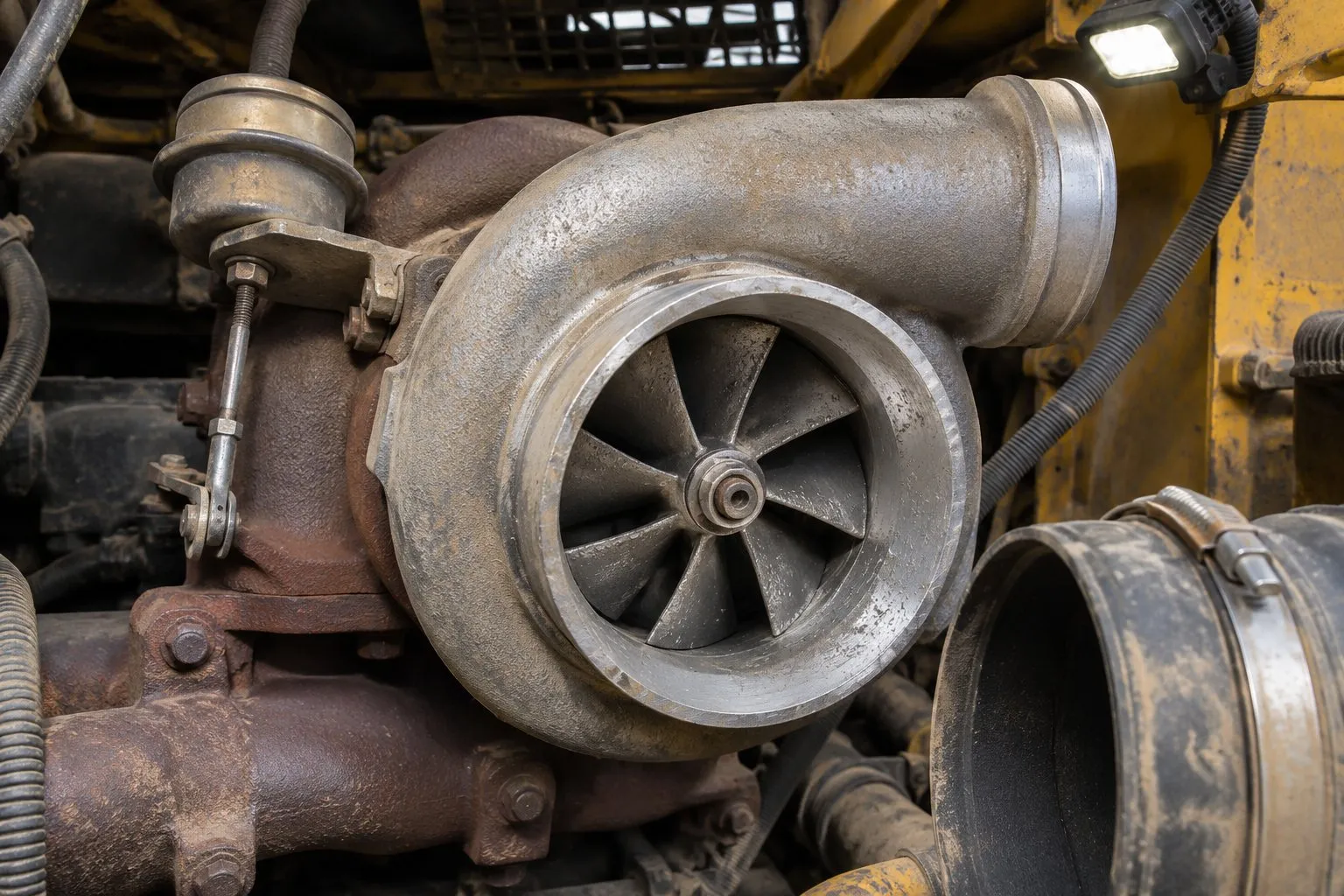
According to Garrett, more than 90 percent of turbo failures come from oil starvation or oil contamination, and foreign objects are the third main cause. An excavator gives all three plenty of chances.
Dust and the Intake Path
The duct between the air cleaner and the compressor inlet runs under suction. A cracked duct or loose clamp there does not leak boost. Instead it pulls unfiltered dust straight into the compressor, with no warning until the wheel is worn.
Dust leaves pitting on the compressor inlet blades. Bent or chipped blades point to impact from a solid object instead. Replace the air filter element when the restriction indicator calls for it, and check the housing seals, duct and clamps at every service.
Oil Supply, Drain and Shutdown
Starvation is a feed-side fault. Common causes are:
- Low oil pressure.
- A blocked or leaking feed line.
- Hard work from a cold start.
- A first start after service before oil reaches the turbo.
Contamination wears the bearings abrasively. The sources are carbon, engine wear debris, dirt let in during servicing, a faulty filter bypass, or degraded oil. Turbo journal bearings are bronze, so watch copper in oil reports and compare it with your machine’s baseline and the lab’s limits.
Shutting down hot after heavy digging does not starve the turbo, but it cokes the oil left in the center housing. Holset’s failure-diagnosis guidance calls for two to three minutes of idle before shutdown. Where your Komatsu operation manual gives its own figure, follow that.
The drain is a gravity return. It must run downhill and enter the pan above the oil level. A kinked drain hose or high crankcase pressure backs oil up in the center housing until it leaks at both ends.
Leaks and Overspeed
On a wastegated or variable geometry turbo, a charge-air leak at the pipes, boots or aftercooler makes the turbo spin faster to reach target boost, which can overspeed it. Overspeed shows as an orange-peel finish on the back of the compressor wheel, along with damaged or cracked blades.
An exhaust leak before the turbine, at a manifold gasket or a cracked manifold, lets exhaust escape before it does any work. The result is low boost, slow response and higher exhaust temperature.
Turbos we list for the HX40 and HX40W
Listings for the turbo models named in this guide that can be ordered online today. Several part numbers can fit one engine by year and rating, so match the number on your turbo’s tag, or call (909) 824-1020 and we will match it for you.
Diagnose Before You Pull the Turbo
A turbo that makes noise or passes oil is often the victim of another fault. Work through the system first, then judge the turbo by what you find at the wheels.
| Symptom | Common causes | Check first |
|---|---|---|
| Low power, black or dark gray smoke | Low boost: charge-air leak, exhaust leak before the turbine, restricted air cleaner, wastegate not seating, damaged wheels | Air cleaner restriction, charge pipes and boots, manifold, then the wheels |
| Blue-gray smoke, oil pooled in charge pipes | Breather fault, air cleaner restriction, high oil level, restricted drain, crankcase pressure, then the compressor seal | Breather, air cleaner, oil level, drain hose (a light oil film is normal) |
| Oil at the exhaust after long idle | Normal at long idle if it clears under load; otherwise a restricted drain or crankcase pressure | Run the machine under load, then check the drain and crankcase pressure |
| Whine or siren noise | Exhaust leak before the turbine, charge-air leak, wheel rubbing the housing | Every joint first, then wheel contact |
| Overboost (wastegated units) | Wastegate opening late or not at all | Wastegate actuator and linkage |
| White smoke | Coolant, or unburned fuel on a cold engine | Cooling system, not the turbo |
| Boost faults on Tier 4 KVGT machines | KVGT or its hydraulic control | Fault codes on the machine monitor, Komatsu’s procedure |
Crankcase pressure has no universal healthy range. Test it the way Komatsu specifies and compare the result with the service manual limit.
Checking the Wheels and Shaft
With the intake duct and exhaust off, inspect both wheels and turn the shaft by hand. Some side-to-side rock is normal on a journal-bearing turbo. Condemn the turbo if you find any of these:
- In-and-out play you can feel.
- Wheel contact with the housing.
- Play beyond Holset’s limit for that unit.
Rebuilders give typical axial play of 0.001 to 0.004 in on journal-bearing turbos. Debris from the engine damages the turbine wheel’s inlet edges. A wheel with blade damage must be replaced, never rebalanced and reused.
Replacing the Turbo on an SAA6D114
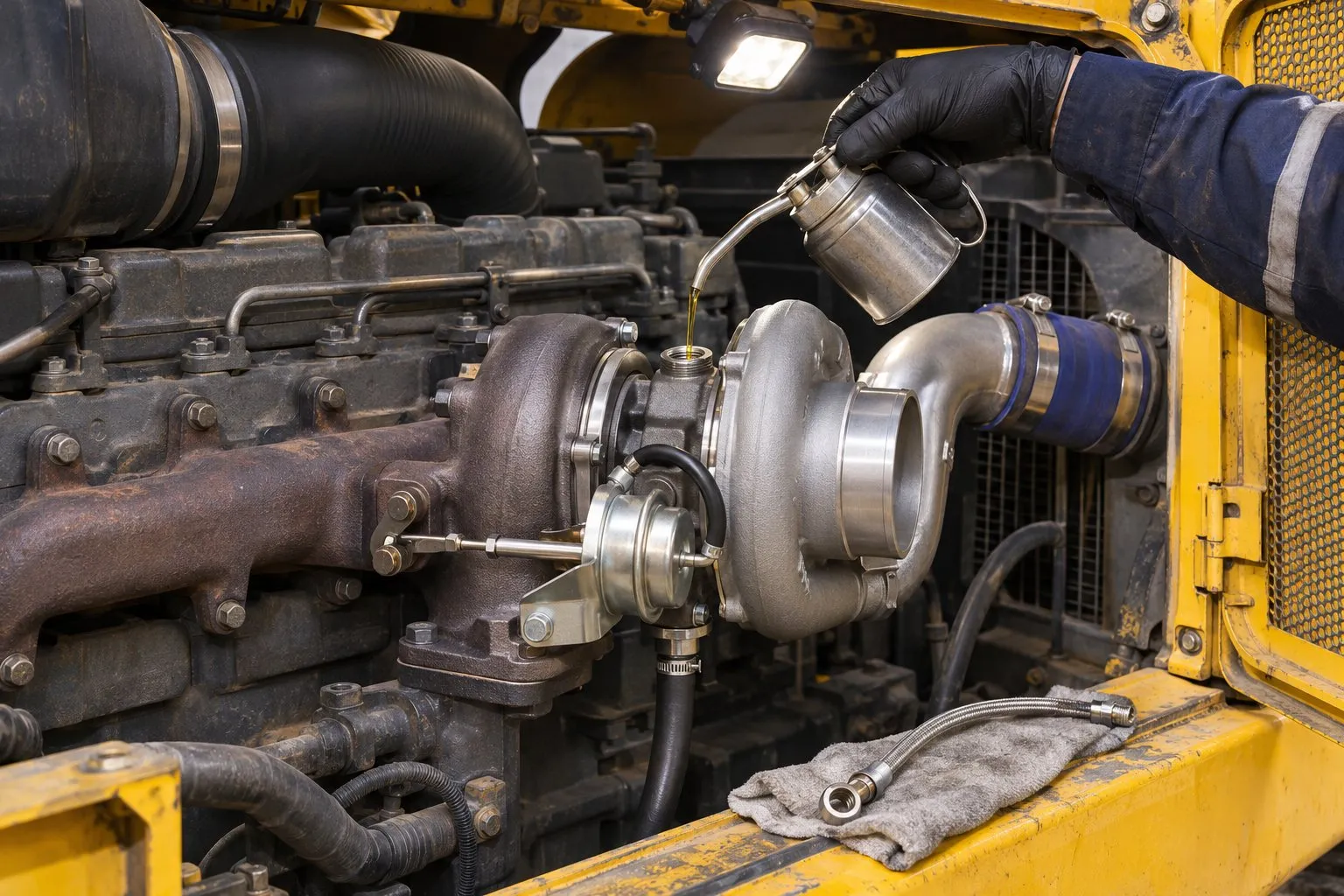
Use the torque figures and procedure in the Komatsu shop manual for your engine. These steps decide whether the new turbo survives:
- Fix the cause first: air cleaner and intake duct, oil feed and drain, crankcase pressure, manifold and charge-air leaks.
- Fit a new oil feed line after a bearing failure or coked oil. Do not reuse the old line.
- Fit new gaskets at the oil inlet, drain and exhaust, with no sealant on the oil gaskets.
- Route the drain hose downhill, within about 15 to 20 degrees of straight down, with no kinks or soft spots.
- If the old compressor wheel shed metal, replace the aftercooler. MAHLE and Nissens both say metal in the fins cannot be flushed out reliably. Clean or replace the charge piping as well.
- If the failure put debris into the oil, change the oil and filter before the new turbo goes on.
- Prime the turbo: fill the oil inlet with clean engine oil, not assembly lube, and turn the wheel by hand.
- Crank for 10 to 15 seconds while keeping the engine from starting by Komatsu’s procedure. Then start it and idle 3 to 4 minutes, checking for oil, exhaust and air leaks before you load the machine.
There is no break-in beyond those first-start steps.
Rebuild or Replace with PT Turbo
PT Turbo is a family-owned shop in San Bernardino, California, and has been rebuilding turbochargers since 1978, more than 45 years.
Our in-house rebuild service handles SAA6D114 Holset units:
- Every turbo we rebuild is VSR balanced.
- Each one gets a final quality inspection: a leak test, a visual inspection and a wastegate or actuator function check.
- Most rebuilds ship in 3 days or less.
- The rebuild price is confirmed after inspection, before any work starts. Our turbo rebuild price list shows current rebuild prices by turbo.
For a Tier 4 KVGT, call first.
For a replacement, search our store by the Holset or Komatsu number on your tag. Availability of remanufactured turbochargers for this engine depends on core supply. Current pricing is on each product page, or call (909) 824-1020.
Our turbos carry a 12-month warranty. Cores for remanufactured units are due within 30 days, and the customer pays return shipping; if you need longer, call ahead and we can usually work with you. Contractors running several machines can arrange priority turnaround or have us keep common cores on hand.
For other machines on the jobsite, see our construction equipment turbocharger guide.
Frequently Asked Questions
What turbo does the SAA6D114 engine in a PC300 use?
Before Tier 4, it uses a Holset from the Cummins 8.3 / 8.9 liter family, where the C-series used the HX40 and many QSL engines the wastegated HX40W. Tier 4 versions carry Komatsu’s own KVGT, moved hydraulically. Older 108-series PC300s use different turbos entirely, so match the number on the tag before you order.
Why does my PC300 drip oil from the exhaust after a long idle?
At long idle, oil shows up at the turbine end first and usually clears once the machine works under load. If it does not clear, check the drain hose for kinks or low spots, the breather, and crankcase pressure against Komatsu’s limit. A restricted drain backs oil up past the seals.
Do I need to replace the aftercooler when I replace the turbo?
Yes, if the old compressor wheel broke and sent metal downstream. MAHLE says the charge air cooler should always be replaced after that kind of failure, because metal in the fins cannot be flushed out and would go on into the engine. If the wheel was intact, inspect the cooler, its connections and the charge piping during the turbo change.
Need a Turbocharger?
PT Turbo has rebuilt and sold turbochargers since 1978. We stock remanufactured units for Cummins, Duramax, Power Stroke, Detroit Diesel, and more — backed by a 12-month unlimited mileage warranty. Units in stock at our shop in San Bernardino, CA ship the same day when ordered before 2 PM Pacific, Monday through Friday.
📞 (909) 824-1020 · 346 S I St. #3, San Bernardino, CA 92410 · info@ptturbo.com