Mitsubishi TD08 Turbocharger: Marine & Heavy Industrial Applications
This guide covers the Mitsubishi TD08 turbocharger as it appears on Yanmar engines and on the large Mitsubishi and Isuzu diesels in Kobelco, Tadano and Hitachi machines. These engines work long hours, often far from a parts counter, so getting the right unit the first time matters. Below are the part numbers our catalog lists, how the TD08 fails in marine and heavy equipment service, and what to check before you pull one.
Where the TD08 Sits in Mitsubishi’s TD Family
Mitsubishi’s TD turbos cover a wide range, from small frames on passenger cars to large frames on trucks, construction machines and marine engines. Mitsubishi TD06 turbochargers show up on Fuso FK and FM trucks with the 6M60. The TD07S appears on the Mitsubishi 6D14T and on the 6D16T 7.5L in Fuso trucks and Kobelco excavators. The TD08 listings in our catalog name heavier engines, including the 11.9L Mitsubishi 6D24T and the 15.7L Isuzu 6WG1.
Mitsubishi model names follow a pattern. The TD number and the letters right after it (the H in TD08H) describe the frame and turbine side. The code after the dash, such as the 26M in TD08H-26M or the 22D in TD08-22D, names the compressor wheel.
That code tells you the wheel family, not the engine. Two TD08H turbos with different part numbers can differ in compressor wheel, turbine housing and fittings, because each engine builder matched the turbo to its own rating. They do not interchange just because the frame letters match. The part number on the tag is what identifies the turbo, not the model name.
Mitsubishi TD08 Turbocharger Part Numbers by Engine
The table lists the TD08 numbers in our catalog and the engine each listing names. Every part we list for this model is on our Mitsubishi TD08H turbochargers page. Stock changes daily, so check the product page for current availability and pricing, or call (909) 824-1020.
| Part number | Model on listing | Listing type | Engine named in our listing |
|---|---|---|---|
| 49188-01100 | TD08H | Complete turbo | Yanmar 6KH-UTN |
| 49188-01150 | TD08H | Complete turbo | Yanmar 6HA2M |
| 49188-01161 | TD08H | Complete turbo | Yanmar 6HA2M |
| 49S88-01110 | TD08H | Complete turbo | Yanmar 6HAL |
| 49S88-01120 | TD08H | Complete turbo | Yanmar 6HAL |
| 49188-01651 | TD08H | Complete turbo | Mitsubishi 6D24T 11.9L (Kobelco and Tadano machines) |
| 49S88-01832 | TD08H | Complete turbo | Isuzu 6WG1 15.7L (Hitachi machines) |
| 49188-02601 | TD08H-26M | Complete turbo | Isuzu 6SD1TC |
| 49188-08110 | TD08H | CHRA | Yanmar |
| 49188-08710 | TD08H | CHRA | None named: match by tag number |
| 49174-08110 | TD08-22D | CHRA | None named: match by tag number |
Two things stand out. One engine family can carry more than one number: the Yanmar 6HA2M and 6HAL each appear on two listings, so the engine name alone does not pick the turbo. The equipment badge does not pick the frame either. Kobelco appears on a TD08H listing for the 6D24T and on a TD07S listing for the 6D16T, so a Kobelco machine can carry either frame depending on its engine.
A CHRA is the center section without the compressor and turbine housings. Fitting one means reusing your housings, so inspect them for cracks, erosion and wheel rub marks before you commit to that route.
Reading the tag
The part number is on the turbo’s tag (data plate). Write down every number on it before you call or search. Do not order by a housing casting number: one casting can serve many turbos, so it only narrows the search.
The prefixes are not uniform either. The TD08H listings start 49188 or 49S88, the TD08-22D CHRA starts 49174, and the TD07S numbers start 49187. Match the whole number, suffix included.
Turbos we list for the TD08H
Listings for the turbo models named in this guide that can be ordered online today. Several part numbers can fit one engine by year and rating, so match the number on your turbo’s tag, or call (909) 824-1020 and we will match it for you.
What Marine and Heavy Equipment Duty Does to a TD08
Marine and off-highway work puts a turbo through long stretches at steady load, plenty of idling, dust or salt air, and shutdowns that happen whenever the job ends. Each of those has its own way of killing a turbo.
Oil supply and oil condition
Garrett attributes more than 90 percent of turbo failures to oil starvation or oil contamination, and the same physics applies to a Mitsubishi center housing. Carbon is the most common contaminant. Engine wear debris, dirt let in during servicing, a faulty filter bypass and broken-down oil also show up.
Starvation comes from low oil pressure, a blocked or leaking feed line, hard acceleration from cold, or a first start without priming. Change oil and filters on the engine maker’s schedule, or its severe-service schedule for dusty sites, heavy idling and long runs at high load.
Heat soak and hot shutdowns
Shutting down straight after a long, hard run leaves oil sitting in a very hot center housing, where it cooks into carbon. That coking is the damage a hot shutdown does: the carbon then scores the bearings and sticks the seal rings. After hard running, give the engine the cool-down idle its maker specifies, whether that means a boat coming in from a long run at high load or a machine finishing a heavy cycle.
Long idling is the opposite problem. With almost no boost, a turbo can show oil at the turbine end, which usually clears once the engine works under load again. Do not condemn the seals on that alone.
Dust on job sites
Construction machines breathe dusty air all day. Dust that gets past the filter pits the compressor inlet blades, and whatever the engine ingests ends up as wear debris in the oil. Replace the air filter when the restriction indicator says so.
Check the pipe between the filter and the turbo as well. It runs under suction, so a crack there lets unfiltered dirt in rather than letting air out. A restricted air inlet can also pull oil past the compressor-end seal.
Salt air and water on marine engines
Salt-laden engine room air corrodes clamps, studs and fasteners. That makes the next turbo change harder and can let a joint start to leak.
On engines with a wet exhaust, a failed mixing elbow or water backing up the exhaust can reach the turbine side of a stopped engine and rust the turbine wheel and housing. If a marine turbo is hard to turn by hand or its turbine wheel shows rust, find the water path before you fit a new unit.
Diagnosing a TD08 Before You Pull It
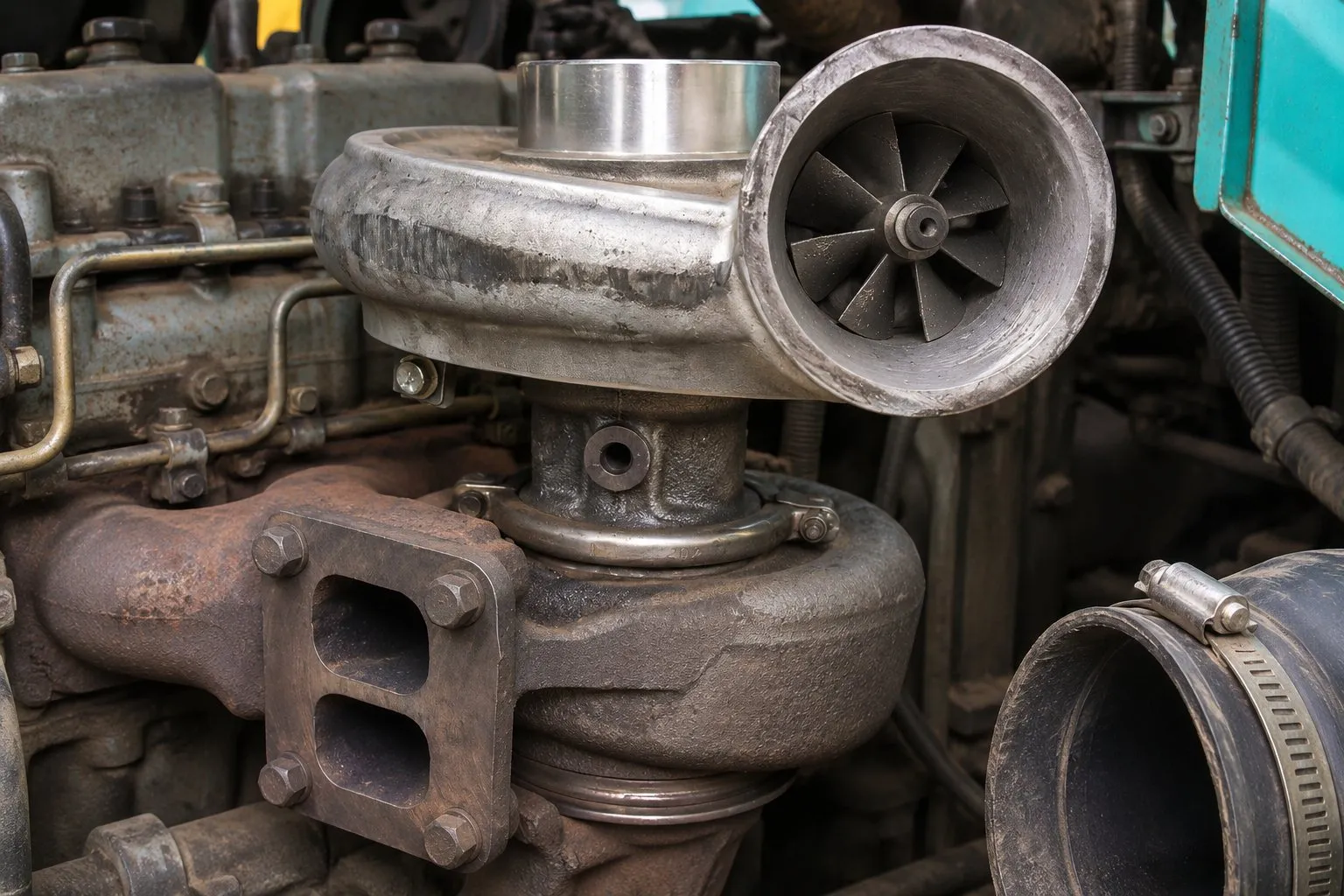
Generic OBD-II P-codes belong to road vehicles, so do not expect them on marine and off-highway engines. Use the machine’s own diagnostics where it has them. Otherwise, smoke color, boost on a gauge where one is fitted, sound and a hands-on inspection tell you most of what you need. Rule out the simple causes first.
| Symptom | What it points to | Check first |
|---|---|---|
| Black or dark gray smoke, low power | Too little air: low boost | Air filter restriction, charge-air leaks, exhaust leaks before the turbine, compressor wheel damage |
| Blue-gray smoke | Oil burning, past the turbine seal or through the engine | Drain routing and restriction, crankcase pressure against the service manual figure, engine wear, long idle periods |
| Pooled oil in intake piping or cooler | Oil past the compressor seal, or crankcase vapor | Air filter restriction, breather, oil level, drain (a light film is normal) |
| Whine or siren under load | Exhaust leak before the turbine, boost leak, or a wheel rubbing | Every joint and clamp, then shaft play and wheel contact |
| Wheel touches housing when rocked | Worn bearings | Replace or rebuild, but trace the oil or dirt cause first |
| White smoke | Coolant, or unburned fuel on a cold engine; not a turbo fault | Cooling system and fuel injection |
An exhaust leak ahead of the turbine lets gas escape before it does any work, which gives low boost, slow response and higher exhaust temperature. Oil at both ends of the turbo usually means a restricted drain or high crankcase pressure, not two failed seals at once.
For the shaft check, remove the intake and exhaust connections and feel the wheels. Some side-to-side rock is normal on a journal-bearing turbo. In-and-out play you can feel, a wheel that touches its housing when rocked, or play beyond the maker’s limit condemns it. Debris damage on a turbine wheel shows on the inlet (leading) edges, and a wheel with blade damage is replaced, never rebalanced and reused.
Fitting a Replacement TD08 or Rebuilding Yours
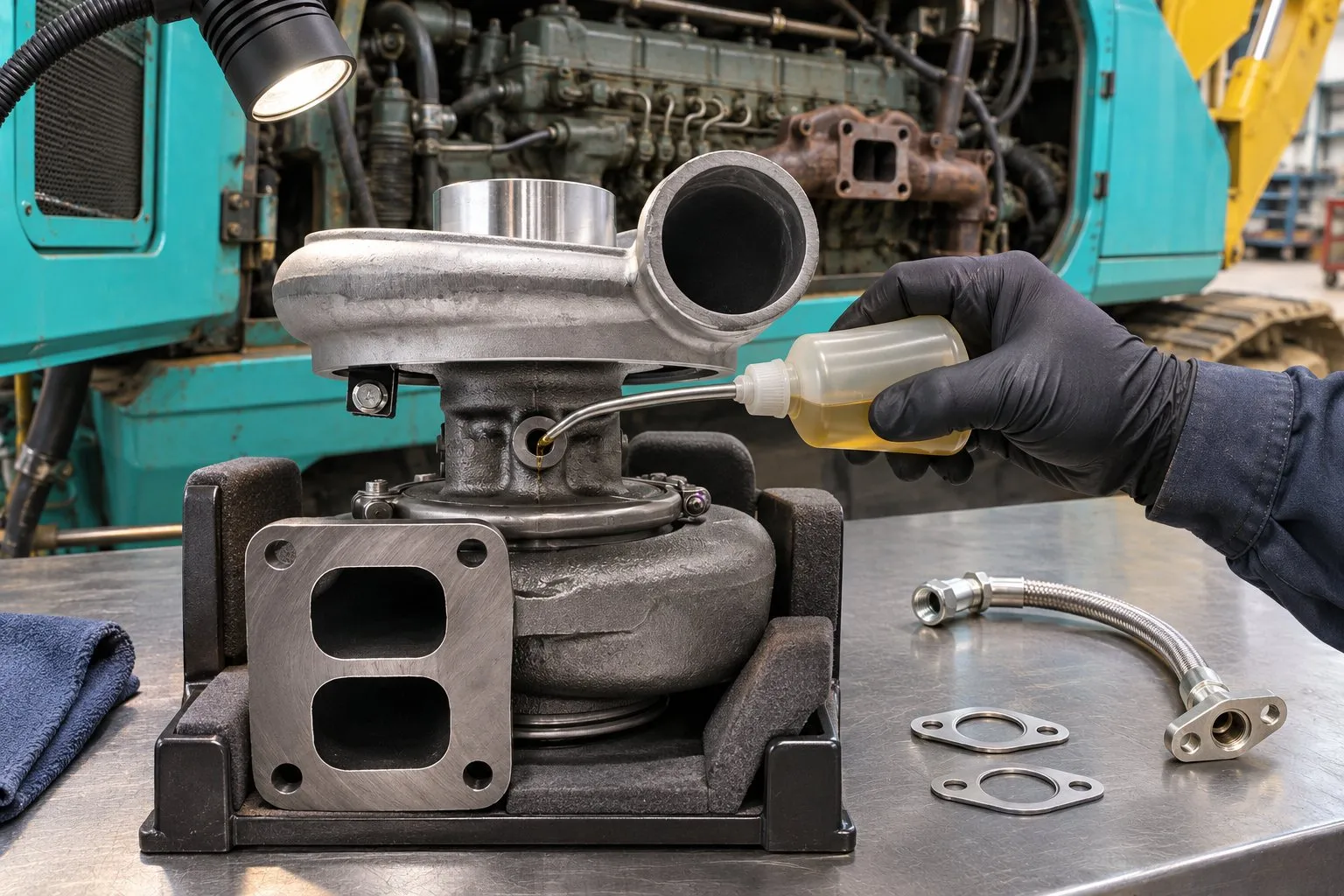
Before the new unit goes on
- Find the cause first. A new turbo fed by the same bad oil or dirty air will fail the same way.
- Fit a new oil feed line after a bearing failure or coked oil, rather than flushing and reusing the old one.
- Check the drain. It is a gravity return that must run downhill, within about 15 to 20 degrees of straight down, and enter the sump above the oil level. A restricted drain backs oil up past the seals.
- Use new gaskets and no sealant on the oil inlet or drain.
- If a compressor wheel failure shed metal and the engine has a charge air cooler or aftercooler, replace the cooler, because metal in the fins cannot be flushed out reliably. Clean or replace the intake ducting too.
First start
Fill the oil inlet with clean engine oil, about 2 oz (50 to 60 cc), and turn the wheel by hand. Crank for 10 to 15 seconds while keeping the engine from firing by the engine maker’s procedure. Then idle 3 to 4 minutes and check for oil, exhaust and air leaks before you put it to work. These are the first-start steps turbo makers publish, and Garrett’s installation guide gives the same sequence.
Rebuild service
PT Turbo has been rebuilding turbochargers since 1978, more than 45 years, through our in-house rebuild service in San Bernardino, California. Every turbo we rebuild in-house is VSR balanced and gets a final quality inspection. That inspection covers a leak test, a visual inspection and, where the turbo has one, an actuator or wastegate function check.
Inspection notes come with the unit, and we confirm the rebuild price after inspection and before any work starts. Most rebuilds ship in 3 days or less and carry a 12-month, unlimited-mileage warranty. See our turbo rebuild service page for how it works, and the turbo rebuild price list for current pricing.
Whether a remanufactured turbocharger is available for a given TD08 number depends on core supply. If your number is not in the table, search our turbo store by the tag number or contact PT Turbo, and we can quote a rebuild of your own unit by phone. Fleet operators can arrange priority or rush turnaround and stocking of common cores the same way.
If you run mixed equipment, our Cummins QSB turbocharger guide and Caterpillar C9 turbocharger guide cover the Holset and BorgWarner units on other marine and machine engines.
Frequently Asked Questions
Will a TD08H from a different engine fit mine?
Not unless the part numbers match. Turbos with the same frame name can differ in compressor wheel, turbine housing and fittings, and each was matched to its engine’s rating. Match the full number on the tag, suffix included. If the tag is missing or unreadable, call (909) 824-1020 with the engine model and serial number.
Can a TD08 be rebuilt instead of replaced?
Often, yes, if the housings are sound. A rebuild replaces the bearings, seal rings and thrust parts, and any wheel with blade damage is replaced, not rebalanced. Every TD08 we rebuild in-house is VSR balanced and inspected before it ships, and the price is confirmed after inspection and before work starts.
How long should a marine or industrial engine idle before shutdown?
Use the cool-down figure your engine maker gives for that engine, especially after a long run at high load. Shutting down hot cooks oil into carbon in the center housing. Long idling has its own side effect: oil can show at the turbine end, which usually clears once the engine is back under load.
Need a Turbocharger?
PT Turbo has rebuilt and sold turbochargers since 1978. We stock remanufactured units for Cummins, Duramax, Power Stroke, Detroit Diesel, and more — backed by a 12-month unlimited mileage warranty. Units in stock at our shop in San Bernardino, CA ship the same day when ordered before 2 PM Pacific, Monday through Friday.
📞 (909) 824-1020 · 346 S I St. #3, San Bernardino, CA 92410 · info@ptturbo.com