Garrett GTB1752VK and GTB1752VKL Turbochargers: Chevy Colorado & GMC Canyon 2.8L Duramax Guide
The Garrett GTB1752VK turbocharger and its close relative the GTB1752VKL are small variable geometry turbos for four-cylinder diesels. In North America the one you are most likely to meet is the GTB1752VKL on the 2.8L Duramax in the Chevrolet Colorado and GMC Canyon. This guide covers what these turbos fit, which part number goes with which truck, how they fail, and what your replacement and rebuild options are.
One correction first, because this number gets attached to the wrong truck: the GTB1752VK is not the Ford 6.0L Power Stroke turbo. The 6.0L uses the much larger Garrett GT3782VA. If you are working on a 6.0L, start with our 6.0L Power Stroke turbocharger guide instead.
What the Garrett GTB1752VK Turbocharger Fits
Garrett’s model names give the size: this is a 17-frame turbo with a 52 mm compressor wheel, and the V marks variable geometry. Several versions share the name, with different housings and part numbers for each engine. These are the ones PT Turbo lists, with the fitment the supplier gives for each.
| Model | Garrett part number | Fits |
|---|---|---|
| GTB1752VKL | 901994-5001S | 2016-2018 Chevrolet Colorado and GMC Canyon, 2.8L Duramax |
| GTB1752VKL | 914155-5001S | 2019-2022 Chevrolet Colorado and GMC Canyon, 2.8L Duramax |
| GTB1752VK | 753546-5023S | 2.2L diesel from Ford and Land Rover (Ford 6G9Q-6K682-CB; Land Rover LR006862, LR024702, LR029637) |
The two Colorado and Canyon numbers are not the same part. GM changed the turbo for the 2019 model year, so order by the number on your turbo’s tag or by model year, not by engine alone. The 2.8L Duramax was also fitted to the Chevrolet Express and GMC Savana vans; confirm the part number on those before ordering.
The 753546 version belongs to a different engine altogether, a 2.2L diesel sold mainly outside North America in vehicles such as the Land Rover Freelander 2. It will not fit a Colorado. If your number is not in the table, the GTB1752VKL model page shows everything currently listed, or send us the tag numbers and we will match it.
The 2.8L Duramax and Its Turbo
The 2.8L Duramax four-cylinder arrived in the Colorado and Canyon for 2016, rated at 181 horsepower and 369 lb-ft of torque. It makes that torque low in the rev range because of the GTB1752VKL: a variable geometry turbo that closes its turbine vanes at low engine speed to build boost quickly and opens them as revs rise so the turbine does not overspeed.
Like every modern diesel, this engine runs exhaust gas recirculation and a diesel particulate filter. Both matter to the turbo. The exhaust that drives the turbine carries soot, the vanes sit in that soot stream, and a truck that spends its life on short trips never gets hot enough for long enough to burn the deposits off. For the operating principle, see the variable-geometry turbocharger overview.
Common GTB1752VK Failure Symptoms
A small variable geometry turbo fails in a small number of ways. The table sorts the usual complaints by what they point to.
| Symptom | Likely cause | What to check first |
|---|---|---|
| Low power, slow boost build, P0299 | Vanes sticking with soot, or a boost leak | Charge pipes and intercooler connections, then vane movement |
| Surging or overboost, P0234 | Vanes sticking closed | Commanded against actual boost on a scan tool |
| Blue or gray smoke, oil in the intake piping | Worn bearings and seals | Shaft play at the compressor wheel |
| Whine, siren or grinding noise | Bearing wear or wheel contact | Compressor wheel for rub marks |
| Repeated failed regenerations | Turbo not controlling exhaust flow, or a restricted filter | Exhaust back pressure and filter loading |
The codes are set by the engine computer, not the turbo, so confirm with live data before you condemn the unit. Our page on a turbo not building boost and the one on variable geometry turbo problems walk through the checks in order.
What Kills These Turbos
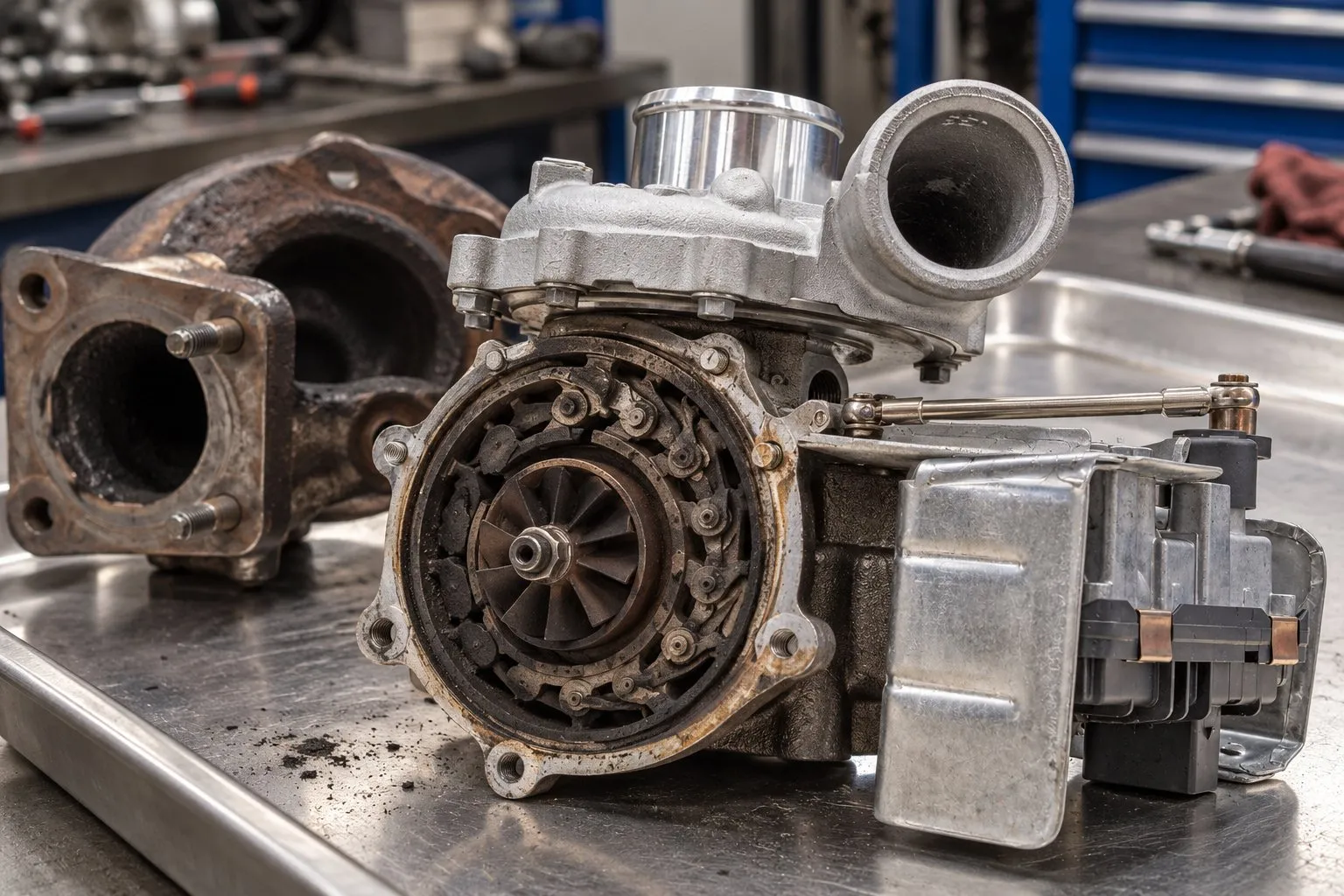
- Soot on the vanes. Short trips and long idling load the turbine housing with carbon until the vanes bind.
- Oil condition. A turbo this small spins very fast on a thin film of oil. Extended oil change intervals, or oil diluted with fuel by repeated regenerations, wear the bearings.
- Hot shutdowns. Shutting off straight after a hard pull or a regeneration bakes oil in the center housing.
- A restricted particulate filter. High back pressure loads the thrust bearing and pushes oil past the turbine seal.
- Debris. Anything that gets past the air filter, or that breaks loose in the exhaust manifold, damages the wheels.
None of this is special to the 2.8L. It is how small variable geometry diesels fail, and the cure is the same: clean oil on time, a regular longer drive at full temperature, and a moment of easy running before shutdown.
Replacement and Rebuild Options
When the turbo has to come off, you have two routes at PT Turbo.
| Option | Price | Best for |
|---|---|---|
| New Garrett GTB1752VKL | $843 to $973 (2 listings) at PT Turbo | A direct replacement by part number, no waiting on a rebuild |
| Rebuild your own turbo | From $575 at PT Turbo (price list) | A unit with sound housings and wheels that needs bearings, seals and cleaning |
Price ranges in this article are general estimates to help with budgeting, not PT Turbo quotes. Our current prices are on each product listing, and our rebuild prices are on the turbo rebuild price list.
Our turbocharger rebuild service is a mail-in service: we inspect the turbo and confirm the price before any work starts, VSR balance every rebuild, and back it with a 12-month unlimited-mileage warranty. Most rebuilds ship in 3 days or less. PT Turbo has been in the turbocharger business since 1978 and stocks both new and remanufactured turbochargers.
Whichever way you go, fix the cause as well as the turbo. Change the oil and filter, check the oil feed line is clean, find any boost leak, and make sure the particulate filter is not restricted. A new turbo on a truck with the old problem lasts about as long as the last one did.
Frequently Asked Questions
What does the Garrett GTB1752VK turbocharger fit?
The GTB1752VKL fits the 2.8L Duramax in the 2016 and later Chevrolet Colorado and GMC Canyon (901994-5001S for 2016-2018, 914155-5001S for 2019-2022). The GTB1752VK 753546 version fits a 2.2L diesel from Ford and Land Rover. It is not the Ford 6.0L Power Stroke turbo.
Are the 2016-2018 and 2019-2022 Colorado turbos the same?
No. They carry different Garrett part numbers, 901994-5001S and 914155-5001S. Order by the number on the turbo’s tag or by model year.
Can a GTB1752VKL be rebuilt?
Yes, when the housings and wheels are sound. A rebuild renews the bearings and seals, cleans and frees the vane mechanism, and balances the rotating assembly. Rebuild prices are on PT Turbo’s price list, and the price is confirmed after inspection, before any work starts.
Further reading: Learn more about Garrett Motion.
Need a Turbocharger?
PT Turbo has rebuilt and sold turbochargers since 1978. We stock remanufactured units for Cummins, Duramax, Power Stroke, Detroit Diesel, and more — backed by a 12-month unlimited mileage warranty. Units in stock at our shop in San Bernardino, CA ship the same day when ordered before 2 PM Pacific, Monday through Friday.
📞 (909) 824-1020 · 346 S I St. #3, San Bernardino, CA 92410 · [email protected]
More From PT Turbo
 BorgWarner Schwitzer S1B Turbocharger: Agricultural & Industrial Applications
- BorgWarner S300 Turbocharger: Complete Application Guide for Cummins, CAT & Detroit
- Holset HE400WG Turbocharger: Wastegate Application Guide for Cummins ISLe, Volvo/Mack & DAF Engines
- IHI RHB5 Turbocharger: Small Diesel & Marine Application Guide