Caterpillar D8 Dozer Turbocharger Guide: C15 Engine Application & Replacement
Use this Caterpillar D8 dozer turbocharger guide to identify the turbo on a C15-powered D8, read the signs that it is failing, and fit a replacement that lasts. A dozer works its engine under steady heavy load for long shifts in dust, so the air side and the oil side of the turbo decide how long it survives.
The sections below cover how the C15’s turbo arrangement differs between versions, how these turbos fail in dirt work, what to check before you condemn one, the first-start steps the turbo makers call for, and your replacement and rebuild options.
Which C15 and Which Turbo Is on Your D8
Not every D8 has a C15. Earlier D8 generations ran other Cat engines. Even among C15-powered machines such as the D8T, the turbo on one dozer is not automatically the turbo on another. Read the engine serial number plate and the turbo’s own tag before you order anything.
Caterpillar does not build its own turbochargers. Garrett and BorgWarner supply them. The tag on a factory-fitted unit carries the turbo maker’s part number and Cat’s part number, and that tag number is what you order by. Housing casting numbers do not identify the turbo, because one casting serves many turbos.
Two facts hold across the C15 family. The C13 and C15 never used variable-vane turbos, so there is no vane actuator to calibrate and no vane position to learn. The C15 also comes in single-turbo and series two-turbo form. Most machine ratings carry a single turbo, while the C15 ACERT truck engines run two turbos in series.
| C15 version | Turbo arrangement | Turbos listed | Variable geometry | What to check |
|---|---|---|---|---|
| C-15, serial prefixes 6NZ and MBN | Single, fixed geometry | Garrett GTA4702 or BorgWarner S410G, by rating | No | Wastegated on many ratings. Go by part number. |
| C15 ACERT, serial prefixes BXS, MXS, NXS, SDP | Two turbos in series | Low-pressure turbo: Garrett GTA5518B | No | The wastegate is on the high-pressure turbo. |
| C15 machine ratings (D8 and other machines) | Single turbo on most ratings | By the tag on your turbo | No | Engine serial plate and turbo tag before ordering. |
The GTA4702 and S410G numbers belong to those engine prefixes. A D8’s machine-rated C15 can carry a different turbo, so treat the table as a map of the family, not a fitment chart for your dozer. For the truck engines in more detail, see our Caterpillar C15 turbocharger guide. If your fleet also runs C13-powered equipment, the C13 turbocharger guide covers that engine.
How the Turbo Fails in Dozer Work
Oil supply and oil quality
Garrett states that more than 90 percent of turbo failures come from oil starvation or oil contamination. Starvation comes from hard acceleration on a cold engine, blocked or leaking oil pipes, or a turbo fitted without priming. Contamination comes from carbon, engine wear debris, dirt let in during servicing, a faulty filter bypass and degraded oil.
Change oil and filters on Cat’s schedule. If the machine works in heavy dust or idles a lot, use the severe-service schedule. Use the oil grade Cat specifies for your engine.
Dust
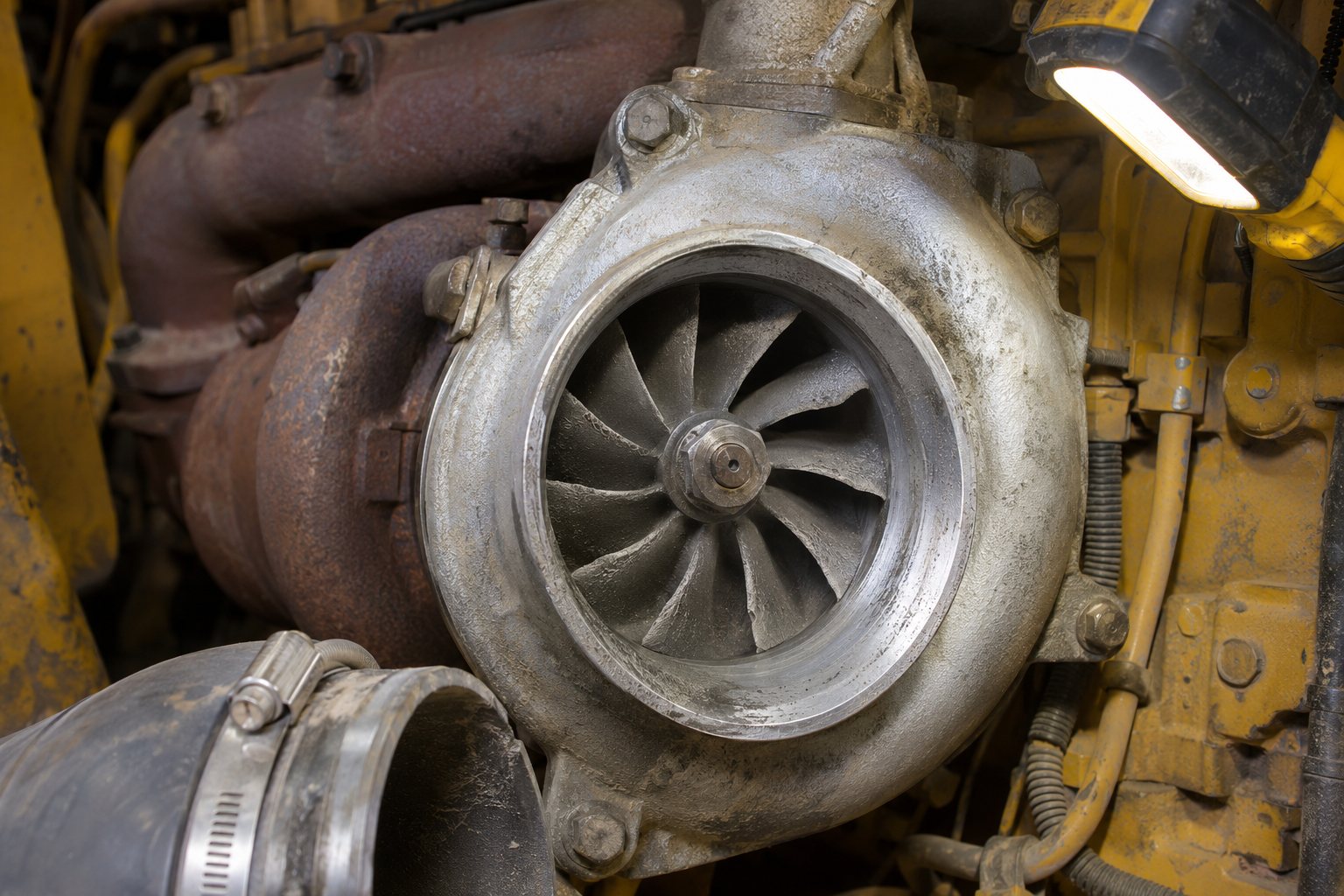
Dust that gets past the filter sandblasts the compressor wheel, leaving pitting on the inlet edges of the blades. It usually gets in through a torn or badly seated filter element, a loose clamp, or a cracked inlet pipe between the filter and the turbo. That pipe is under suction, so a crack there pulls dirt in rather than leaking anything out.
Replace the filter when the restriction indicator calls for it, and inspect every clean-side joint while you are there. Bent or chipped blades are a different failure. That is impact damage from hardware or debris that got into the intake.
Heat and shutdown
Shutting down a hot engine right after heavy pushing leaves oil sitting in a hot bearing housing, where it cokes. That carbon later wears the bearings and fouls the seal rings. Idle the machine down for the time Cat gives in the operation and maintenance manual before you shut it off.
Long idling has its own symptom. Oil can show up at the turbine end first, and it usually clears under load. That alone does not mean a seal has failed.
Leaks and debris
A turbocharger runs on exhaust energy. An exhaust leak before the turbine, at a manifold gasket or a cracked manifold, gives low boost, slow spool and higher exhaust temperature. A charge-air leak after the compressor makes the turbo spin faster to reach target boost and can overspeed it.
Overspeed leaves an orange-peel finish on the back face of the compressor wheel, along with damaged or cracked blades. When something breaks inside the engine, the pieces hit the turbine wheel on its inlet edges. A wheel with blade damage is replaced, never rebalanced and reused.
Turbos we list for the GTA4702
Listings for the turbo models named in this guide that can be ordered online today. Several part numbers can fit one engine by year and rating, so match the number on your turbo’s tag, or call (909) 824-1020 and we will match it for you.
Diagnosing Turbo Trouble on a C15 Dozer
The C15 is electronically controlled, so start with the ECM. Read active and logged codes with Cat ET and look at intake manifold pressure under load. Generic OBD-II P-codes do not apply to these machine engines.
Smoke color narrows it down. Low boost gives black or dark gray smoke, and burning oil gives blue-gray. White smoke points to coolant or, on a cold engine, unburned fuel.
| Symptom | Check first | Points to the turbo when |
|---|---|---|
| Low power, black smoke | Air filter restriction, charge-air leaks, exhaust leaks before the turbine, wastegate not seating (if fitted) | The air and exhaust sides check out and the wheel rubs, the blades are damaged or the shaft binds |
| Blue-gray smoke, pooled oil in the charge pipes | Crankcase breather, oil level, oil drain, air filter restriction | Oil still comes past the compressor seal after those are cleared. A light film is normal crankcase vapor. |
| Oil at both ends of the turbo | Restricted or kinked drain, crankcase pressure against the limit in Cat’s service manual | Rarely. A blocked drain pushes oil out both ends. |
| Whine or siren under load | Exhaust leaks before the turbine, boost leaks at every joint | Inspection shows rub marks or bent blades |
| Overboost (wastegated units) | Seized linkage, a gate that opens late, a leaking diaphragm on a boost-opened actuator | The gate or actuator is worn beyond repair |
| Pitting on compressor inlet blades | Filter element, inlet clamps and pipe | The wheel damage is the result. Fix the dust path before fitting a new turbo. |
Shaft play
Some side-to-side movement is normal on a journal-bearing turbo with no oil pressure. Garrett’s installation guidance also says it is normal to feel some up-and-down movement at the wheels. Condemn the turbo for in-and-out play you can feel, for a wheel that touches its housing when rocked, or for play beyond the maker’s limit.
Axial play on a journal-bearing turbo typically runs 0.001 to 0.004 in. Use the published figure for your unit.
Oil analysis
Turbo journal bearings are bronze, so copper is the bearing wear metal in an oil report. Labs set limits by engine and oil. Compare each sample with your machine’s own baseline and the lab’s limits rather than a generic number.
Replacing the Turbo on a C15-Powered D8
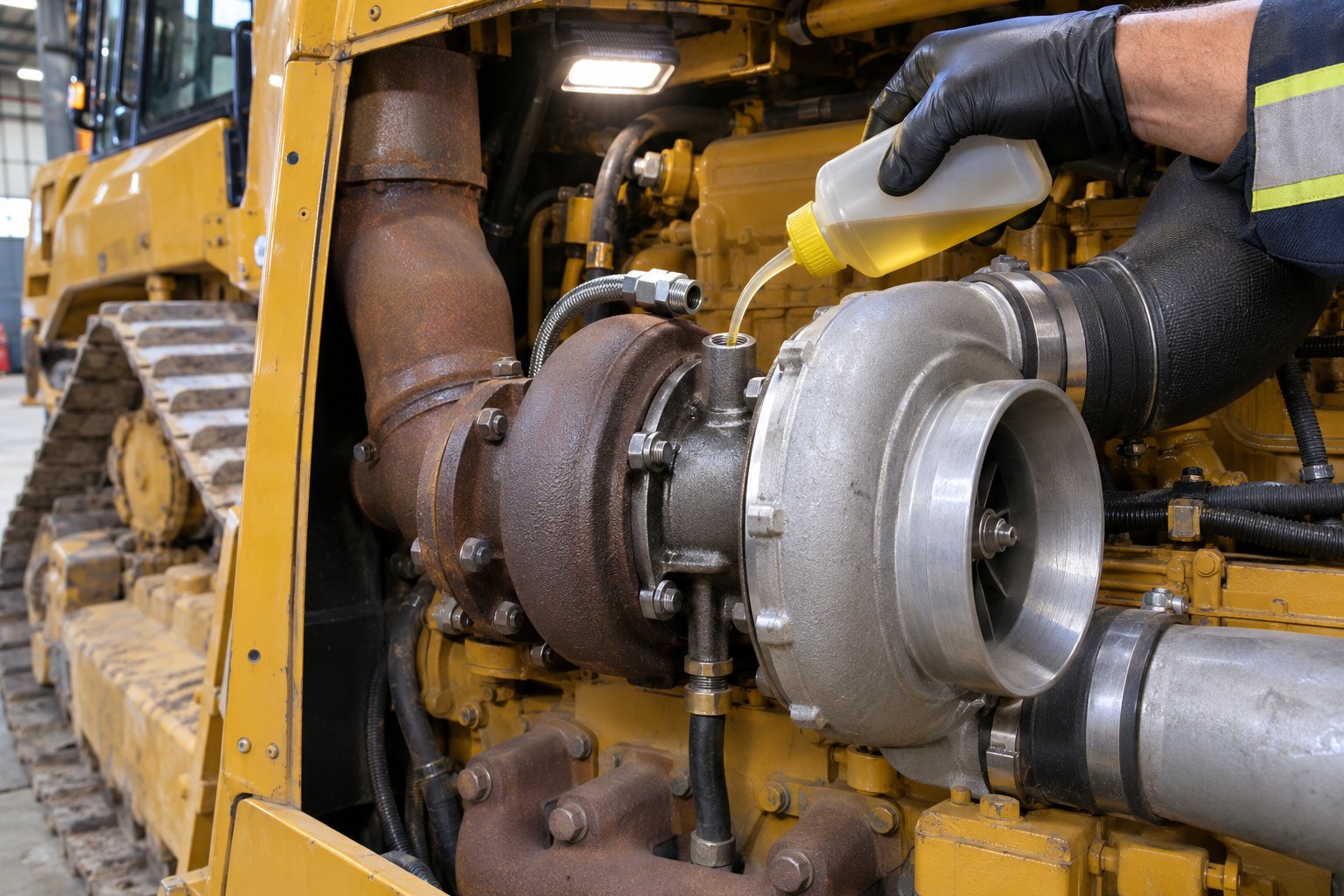
Use Cat’s service manual for the removal procedure and every tightening torque on your machine. The installation points below come from the turbo makers, and they keep the new turbo from failing the same way the old one did.
- Fix the cause first. A new turbo on a restricted oil line, a cracked inlet pipe or a leaking manifold will fail the same way.
- Order by the tag number, not by the engine name or a casting number.
- Replace the charge air cooler after a compressor wheel failure. MAHLE says it should always be replaced, because metal in the fins cannot be flushed out reliably. Anything left in it goes straight into the engine. Inspect the charge piping and clean or replace it.
- Fit a new oil feed line after a bearing failure or coked oil. Do not flush and reuse the old one. Use new gaskets on the oil inlet and drain, with no sealant.
- Check the drain. It is a gravity return. It must run downhill, within about 15 to 20 degrees of straight down, and enter the pan above the oil level.
- Prime the turbo. Fill the oil inlet with clean engine oil and turn the wheel by hand. Never run the engine with a mounted turbo’s oil feed capped.
- First start. Garrett’s procedure is to crank 10 to 15 seconds without starting, then idle 3 to 4 minutes and check for oil, exhaust and air leaks. Keep the engine from firing during cranking by the method in Cat’s service manual. Do all of this before the blade goes into the dirt.
- Check the wastegate if fitted. The linkage should move freely and the gate should seat.
After those first-start steps, run the machine normally. The makers call for no reduced-load period and no early oil change.
New, Remanufactured or Rebuilt for Your D8
PT Turbo is a family-owned shop in San Bernardino, California, and has been rebuilding turbochargers since 1978. With more than 45 years in the business, the starting point is always the same: the number on the tag.
- New: Search our store by the Garrett, BorgWarner or Cat number on your turbo’s tag. If it does not come up, call and we will quote by part number.
- Remanufactured exchange: Availability for C15 machine turbos depends on core supply. Check our remanufactured turbochargers or call. Cores are due back within 30 days, and the customer pays return shipping. If you need longer, call ahead and the shop can usually work with you.
- Rebuild your core: Our turbo rebuild service handles the work in-house. Every rebuild is VSR balanced and gets a final quality inspection: a leak test, a visual inspection and a wastegate or actuator function check. Most rebuilds ship in 3 days or less. The rebuild price is confirmed after inspection and before work starts. See the turbo rebuild price list for current figures. Rebuilds carry a 12-month warranty.
Contractors running several D8s or a mixed Cat fleet can arrange priority and rush turnaround, and we can stock your common cores. Set that up by phone at (909) 824-1020 or through the contact page.
Frequently Asked Questions
Does the C15 in a D8 dozer have a variable geometry turbo?
No. The C13 and C15 never used variable-vane turbos, so there is no vane actuator to calibrate. Many single-turbo C15 ratings have a wastegate, and the series two-turbo C15 ACERT truck engines put the wastegate on the high-pressure turbo. Check your own turbo’s tag to see which you have.
Can I put a C15 truck turbo on my D8?
Not by the engine name alone. Truck and machine versions of the C15 carry different turbo arrangements and part numbers, and even C15-powered dozers can differ. Match the part number on your turbo’s tag, and use the engine serial number to confirm.
How long does a rebuild of a D8 turbo take?
Most rebuilds ship in 3 days or less once the core arrives and the inspection is done. The price is confirmed after inspection and before any work starts. Fleet customers can arrange priority or rush turnaround by phone.
Need a Turbocharger?
PT Turbo has rebuilt and sold turbochargers since 1978. We stock remanufactured units for Cummins, Duramax, Power Stroke, Detroit Diesel, and more — backed by a 12-month unlimited mileage warranty. Units in stock at our shop in San Bernardino, CA ship the same day when ordered before 2 PM Pacific, Monday through Friday.
📞 (909) 824-1020 · 346 S I St. #3, San Bernardino, CA 92410 · info@ptturbo.com
More From PT Turbo
 John Deere 6068 Turbocharger Guide: PowerTech Agricultural & Construction Applications
- Kenworth T680 Turbocharger Guide: PACCAR MX-13 Replacement & Maintenance
- Ford 6.7L Powerstroke Turbocharger: Problems, Symptoms and Replacement Guide
- Caterpillar C13 Turbocharger: Symptoms, Diagnosis & Complete Replacement Guide