Deutz TCD Turbocharger Guide: Agricultural, Construction & Industrial Applications
This Deutz TCD turbocharger guide is for the mechanics and owners who keep Deutz-powered tractors, loaders, telehandlers, compressors and generator sets working. Deutz sells its TCD engines to many equipment builders, so one engine family can sit in a farm tractor, an excavator and a pump set, each with its own turbo specification. The engine name gets you close. The number on the turbo tag gets you the right part.
Below we cover how to read the engine and turbo designations, which turbo types you may find, how each kind of work wears a turbo, how to diagnose boost and oil problems, and the installation steps that keep a replacement alive. PT Turbo is family-owned and has been rebuilding turbochargers in San Bernardino, California since 1978. The same rules apply to a Deutz as to any other diesel.
Reading Deutz TCD Engine Designations and Turbo Tags
Deutz engine names describe the engine. In a designation such as TCD 2013 L06 4V, the T stands for turbocharging, the C for charge air cooling and the D for diesel. The 2013 is the series, L06 means an in-line six and 4V means four valves per cylinder. Newer families drop the series number and carry the displacement in the name instead, as in the TCD 4.1 and TCD 6.1.
None of that tells you which turbo is bolted to the engine. A single engine family is built in many ratings and emissions stages for many machine builders, and the turbo can change with each one. Record the engine model and serial number from the engine data plate, then go to the turbo itself.
What the turbo tag tells you
The data plate on the turbo carries the turbo maker’s part number and a serial number. On factory-fitted units it often carries the engine maker’s part number as well. The formats differ by turbo maker:
- BorgWarner: six or eleven digits. Older KKK units use a 4-3-4 format such as 5331-970-7101. The tag sits on the compressor housing.
- Garrett: six digits, a dash, four digits and a closing letter (765155-5007S style). The first digit after the dash marks the sales channel: 0 for original equipment, 5 for new aftermarket, 9 for remanufactured. Plate position varies by plant.
- Holset: a seven-digit assembly number with a letter suffix, with the engine maker’s number in a separate field.
Casting numbers on the housings are not part numbers. One casting serves many turbos, so a casting number can narrow a search but never confirm a match. If the tag is burned off or missing, send the engine model, serial number and clear photos of the turbo through our contact page.
In our catalog, BorgWarner S200 turbochargers are listed for Deutz engines. Frame size alone does not prove a fit, though. S200 versions differ in wheels, housings and wastegate setup, so match the full number on your tag.
Turbo Types on Off-Road Diesels and How to Tell Them Apart
Look at the turbo before you order parts or run tests, because each type is checked differently. The type on your engine depends on the rating and emissions stage, and the tag number settles it. This table covers what to look for on the unit in front of you.
| Turbo type | How you recognize it | What controls boost | What to check first |
|---|---|---|---|
| Fixed geometry, no wastegate | No actuator on the turbine side | Housing and wheel sizing only | Air filter restriction, charge-air leaks, exhaust leaks before the turbine, shaft play |
| Wastegated | Actuator canister linked to a flapper valve in the turbine housing | The gate bypasses exhaust around the turbine | A flapper that does not seat gives low boost and slow spool. A leaking diaphragm on a boost-opened actuator makes the gate open late, which causes overboost. |
| Variable geometry | An actuator moving a mechanism inside the turbine housing, often with a wiring connector | The turbine nozzle area changes with load | Carbon in the mechanism. Stuck closed gives overboost and high drive pressure. Stuck open gives low boost. |
Actuator tests depend on the actuator. Pneumatic actuators, whether vacuum or pressure operated, are tested with a hand pump and have a rod you can set. Electronic actuators are checked with the service tool and calibrated to their own turbo. Never force an electronic actuator’s arm by hand, because its gears break.
If your engine carries two turbos in series, debris only travels downstream. Pieces of the low-pressure compressor go into the high-pressure compressor, and pieces of the high-pressure turbine go into the low-pressure turbine. Inspect both turbos after either one fails.
Turbos we list for the S200
Listings for the turbo models named in this guide that can be ordered online today. Several part numbers can fit one engine by year and rating, so match the number on your turbo’s tag, or call (909) 824-1020 and we will match it for you.
How Agricultural, Construction and Industrial Work Wears a Turbo
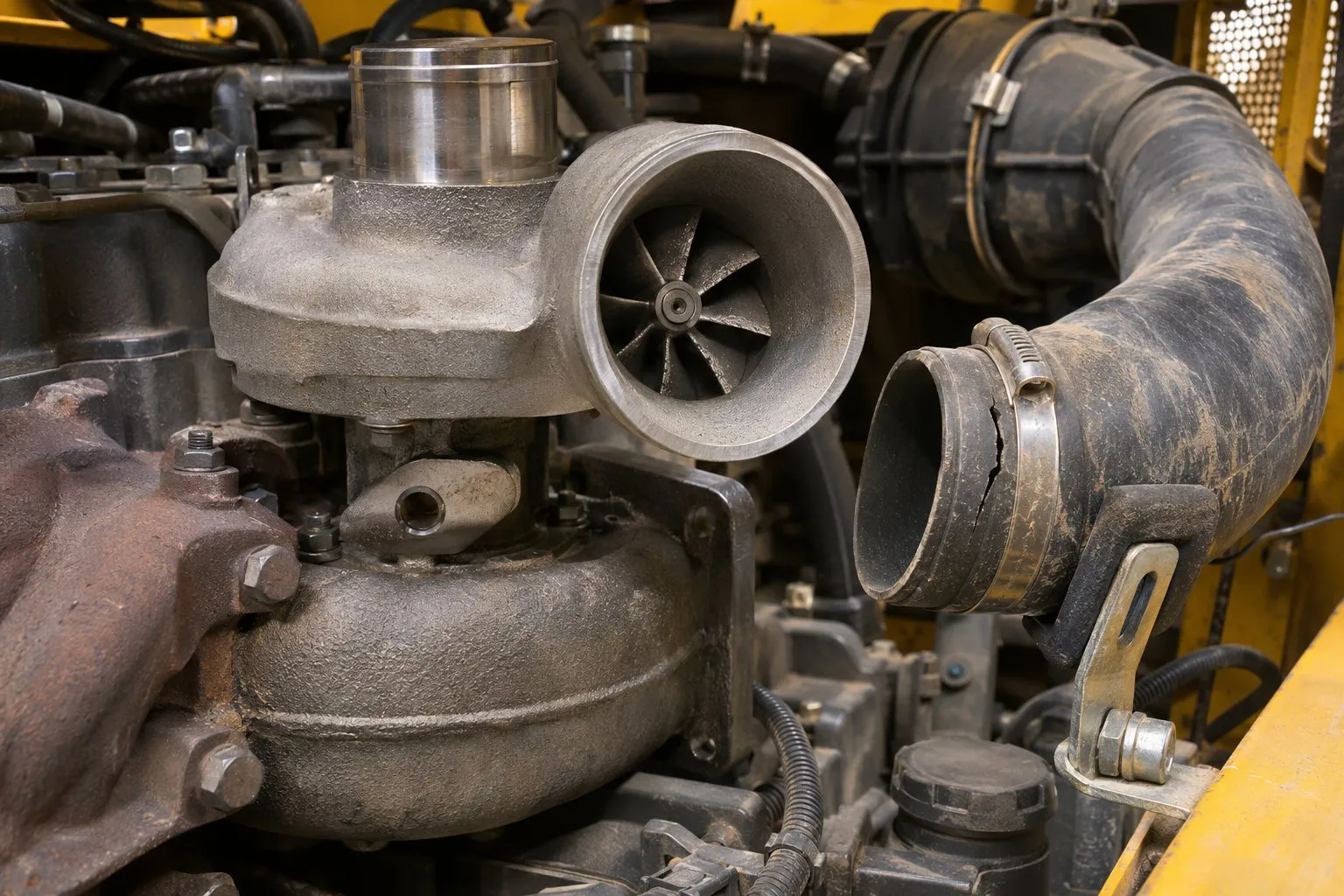
The turbo does not know what machine it is in, but the duty cycle decides how it fails. Garrett states that more than 90 percent of turbo failures come from oil starvation or oil contamination. Each type of work feeds those two causes in its own way.
Agricultural machines
Harvest and tillage mean dust, chaff and long hours at heavy load. Replace the air filter when the restriction indicator calls for it. Follow the maker’s oil schedule, or its severe-service schedule for dusty, high-load work.
After a long pull, idle for the time Deutz gives in the operator manual before shutdown. A hot shutdown bakes oil into carbon inside the center housing. Machines that sit between seasons start with drained bearings, and Garrett lists hard acceleration from cold among the triggers for oil starvation. Bring the engine up gently until oil pressure settles, then work it lightly until it is warm.
Construction equipment
Fine dust is the enemy. The inlet pipe between the air filter and the compressor runs under suction, so a cracked hose or loose clamp there pulls unfiltered dirt straight into the compressor. There is no boost leak to warn you. Dust shows up as pitting on the compressor inlet blades, while bent or chipped blades point to impact from a solid object.
Carbon is the most common oil contaminant, according to Garrett. Dirt let in while changing filters in the field also gets into the oil. Keep fittings and filter mounts clean on service day. Operators who shut down right after heavy digging cause the same coking as on a farm machine.
Generator sets, pumps and compressors
Long running at idle or light load shows up as oil at the turbine end first. That usually clears once the engine runs under load, so it is not proof of a failed seal. Lightly loaded engines also tend to build carbon on the exhaust side, which can stick a variable geometry mechanism.
Standby units that rarely run face the same drained-bearing start as stored farm machines. If your engine has a particulate filter, remember that it sits after the turbo. A loaded filter raises exhaust backpressure, so let an active regeneration finish as the maker advises.
Diagnosing Low Boost, Smoke and Oil Leaks
Electronically controlled TCD engines report faults as J1939 SPN / FMI pairs, not the P-codes of an on-road pickup. Intake manifold pressure is SPN 102, and the FMI describes the kind of fault. Look up the exact pair in the Deutz or machine maker’s documentation. Judge boost by comparing the actual reading with the value in the service data for your rating, not with a number from a forum.
- Black or dark gray smoke: the engine is short of air. Check air filter restriction, charge-air leaks and exhaust leaks before the turbine (these cause low boost, slow spool and higher exhaust temperature). Then check for a wastegate that will not seat, and only then the turbo.
- Blue-gray smoke: oil is burning. Before you blame the turbo seals, check the breather, air filter restriction, oil level and the turbo oil drain.
- White smoke: this comes from coolant, or from unburned fuel on a cold engine. It is not a turbo symptom.
- Whine or siren noise: this often comes from an exhaust leak before the turbine or from a charge-air leak. Check every joint before you condemn the turbo.
- Oil in the charge pipes: a light film is normal where crankcase vapor is routed into the intake, but pooled oil is not. A restricted air inlet pulls oil past the compressor end. A poor drain or high crankcase pressure pushes it out at both ends.
Crankcase pressure has no universal healthy range. Makers test at set speeds with their own adapters, so compare your reading with the Deutz service manual for your engine.
Checking the turbo itself
With the intake and outlet ducts off, some side-to-side rock at the wheel is normal on a journal-bearing turbo with no oil pressure. Condemn the turbo for in-and-out play you can feel, a wheel that touches its housing, or play beyond the maker’s limit. Axial play on journal-bearing turbos typically runs 0.001 to 0.004 in. Copper in an oil report can point toward the bronze journal bearings, so compare it with your own baseline and the lab’s limits.
Replacing or Rebuilding a Deutz TCD Turbo
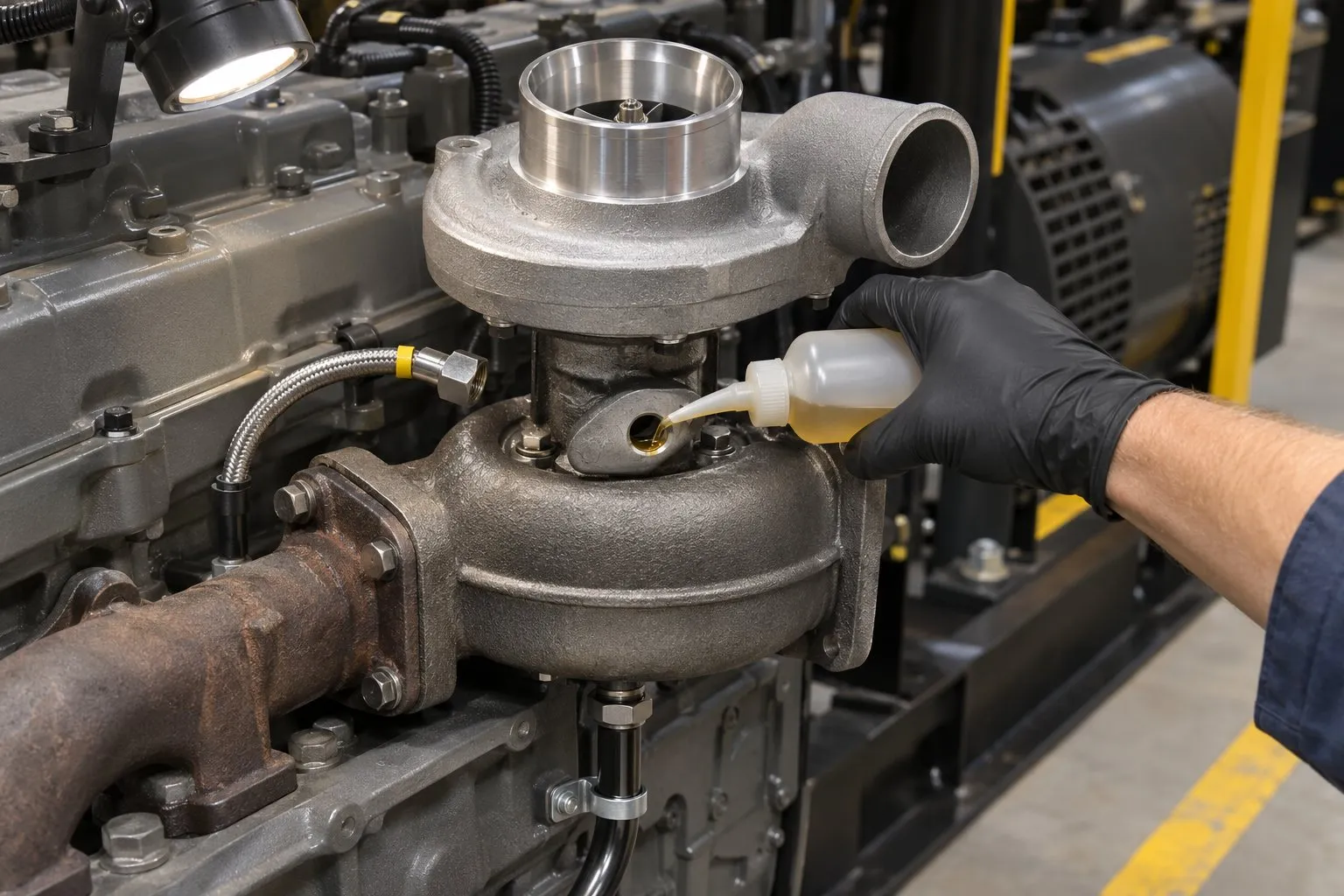
Fix the cause before the new or rebuilt unit goes on, or it will fail the same way. These steps come from the turbo makers’ installation guidance:
- Replace the oil feed line after a bearing failure or coked oil. Do not flush and reuse the old one.
- Check the drain. It is a gravity return that must run downhill, within about 15 to 20 degrees of straight down, with no kinks, and enter the crankcase above the oil level. Use no sealant on the oil inlet or drain gaskets.
- If the compressor wheel shed metal, replace the charge air cooler, because metal in the fins cannot be flushed out reliably. Inspect the charge piping, then clean or replace it.
- Fit a fresh air filter and check every hose and clamp between the filter and the compressor.
- Prime the turbo. Fill the oil inlet with clean engine oil and turn the wheel by hand. Crank for 10 to 15 seconds while the engine is kept from firing by the engine maker’s procedure. Then idle for 3 to 4 minutes and check for oil, exhaust and air leaks before you apply load.
- Calibrate an electronic actuator to its turbo with the service tool if the maker requires it.
There is no break-in period. Once the first-start steps are done, the machine goes back to work.
PT Turbo’s rebuild service for Deutz turbos
When a replacement for your tag number is hard to find, or the lead time does not fit the season, a turbo rebuild of your own core can be the faster route. Most rebuilds ship in 3 days or less. Every turbo we rebuild in-house is balanced on a VSR (Vibration Sorting Rig). It then gets a final quality inspection: leak test, visual inspection and an actuator or wastegate function check.
The rebuild price is confirmed after inspection and before work starts. See the turbo rebuild price list for current figures by turbo. Our warranty is 12 months with unlimited mileage, backed by more than 45 years in the business.
To find a replacement, search the store and the remanufactured turbochargers section by the number on your tag. Stock changes daily, so call (909) 824-1020 to confirm. Fleet operators, rental yards and farms running several machines can arrange priority turnaround and have us hold their common cores by phone.
If the same yard also runs Cummins or Caterpillar power, our Cummins QSB turbocharger guide and Caterpillar C9 turbocharger guide cover those engines.
Frequently Asked Questions
How do I find the right turbo for my Deutz TCD engine?
Go by the part number on the turbo’s data plate, not the engine name. The same TCD engine is built in different ratings and emissions stages for many machine builders, and the turbo can differ between them. If the tag is unreadable, send us the engine model, serial number and photos of the turbo, and we can help identify it.
Can PT Turbo rebuild the turbocharger from a Deutz TCD engine?
Usually, provided repair parts for that turbo are available and the housings and wheels are serviceable. Call (909) 824-1020 with the tag number and we will confirm before you ship the core. Every in-house rebuild is VSR balanced and inspected, most ship in 3 days or less, and the price is confirmed after inspection and before work starts.
Why does my Deutz-powered generator drip oil from the exhaust after long idling?
Oil seen after long idling appears at the turbine end first and usually clears once the engine runs under load, so it does not by itself mean the turbo seals have failed. If it continues under load, check the drain line for kinks or restriction and compare crankcase pressure with the Deutz service manual. Then inspect the turbo for in-and-out shaft play and wheel contact with the housing.
Need a Turbocharger?
PT Turbo has rebuilt and sold turbochargers since 1978. We stock remanufactured units for Cummins, Duramax, Power Stroke, Detroit Diesel, and more — backed by a 12-month unlimited mileage warranty. Units in stock at our shop in San Bernardino, CA ship the same day when ordered before 2 PM Pacific, Monday through Friday.
📞 (909) 824-1020 · 346 S I St. #3, San Bernardino, CA 92410 · info@ptturbo.com
More From PT Turbo
 Toyota 1KD-FTV 3.0L Turbocharger Guide: Hilux, Land Cruiser Prado, Fortuner & HiAce Applications
- BorgWarner S200 Turbocharger: CAT C7, John Deere & Agricultural Applications
- Mitsubishi TD04 Turbocharger: Subaru, Volvo & Light Diesel Applications Guide
- Kubota RTV & SVL Turbocharger Guide: Diesel Utility & Compact Track Loader