John Deere Combine Turbocharger Guide: S-Series, T-Series & X-Series Applications
In this John Deere combine turbocharger guide, we start with the fact that prevents the most wrong orders: the S, T or X on the side of the machine does not tell you which turbo is on the engine. The turbo is matched to the engine model, its version and rating, and its emissions hardware. The number on the turbo’s tag is what identifies it.
PT Turbo is a family-owned shop in San Bernardino, California, and has been rebuilding turbochargers since 1978. This guide covers what our catalog lists for John Deere combines, how to read the tag, how these turbos fail at harvest, and how to fit a replacement so it survives its first start.
Why S, T and X Series Names Do Not Identify the Turbo
A combine series name describes the machine. It is not a reliable guide to the engine. Within one series, models can carry different engines and ratings, and an emissions update can change the turbo while the badge stays the same.
Turbo makers and engine makers catalog parts by engine and part number, and so do we. None of our listings names an S-Series, T-Series or X-Series combine, a combine model number or a model year. Treat any listing that ties a turbo to a combine badge, with no engine model or tag number, as a starting point and not as a match.
Before you call or order, collect these:
- The engine model from the engine serial plate, for example 6068H or 6090H.
- The part number from the turbo’s tag (data plate).
- The engine maker’s part number, if the tag shows one.
- Photos of the turbo, including the actuator, its connector and the oil lines.
Combine Turbos in Our Catalog, Listed by Engine
Six turbos in our catalog have an application row that says “Combine.” Every one of those rows names the engine, not the combine model or year. John Deere PowerTech engines carry mostly BorgWarner turbos, with Garrett units on some versions, and the list reflects that.
| Turbo | Part number | Condition | Engine named in the listing | Type |
|---|---|---|---|---|
| BorgWarner S200S066 | 177268 | New | John Deere 6068H | Fixed geometry |
| BorgWarner S200S066 | 477268 | Remanufactured | John Deere 6068H | Fixed geometry |
| BorgWarner S300BV126 | 178756 | New | John Deere 6068H | Variable geometry, electronic actuator |
| BorgWarner S300BV126 | 478756 | Remanufactured | John Deere 6068H | Variable geometry, electronic actuator |
| BorgWarner S300BV131 | 478742 | Remanufactured | John Deere 6090H (9.0L) | Variable geometry, electronic actuator |
| Garrett T04E48 | 465637-9001S | Remanufactured | None named (“Combine John Deere”) | Garrett T04E compressor family |
Two different turbos for the 6068H show why the tag matters. The BorgWarner S200 unit is fixed geometry. The S300BV126 is variable geometry with an electronic actuator, the type used on the four-valve PowerTech Plus engines. One needs actuator wiring and engine control that the other engine version does not have, so neither substitutes for the other.
The S300BV131 is listed remanufactured only, for the 6090H. The Garrett T04E48 row names no engine, so only the Garrett number on your tag can confirm it. Current pricing for every listing is on its product page, or call (909) 824-1020. Browse the full range of remanufactured turbochargers as well.
Larger PowerTech Engines
Our listings for bigger John Deere engines name only the engine. For the 6090 (9.0L) there are S300BV 12x-series numbers and S410W numbers. For the 6125 there are S400S057, S400S058 and S400S082 units from the BorgWarner S400 family (177285 through 177288). For the 6135 (13.5L) there are S430S 14969880015 and BorgWarner S410W 14969880020. Their rows name tractors, graders, excavators, harvesters or marine use, never a combine.
If your engine plate shows one of these models, compare the tag number with these listings. A match on the engine name alone is not enough, because one engine carries different turbos by rating and emissions level.
Reading the Turbo Tag
BorgWarner’s nameplate is on the compressor housing. It shows the BorgWarner part number and the serial number. On factory-fitted turbos it also shows the engine maker’s part number. BorgWarner part numbers run six or eleven digits. In the listings above, the new and remanufactured numbers differ in the first digit: 177268 is new and 477268 is remanufactured.
Garrett numbers are six digits, a dash and four more digits, usually followed by a letter. The first digit after the dash is the sales channel:
- 0 for original equipment
- 5 for new aftermarket
- 9 for remanufactured
Ignore casting numbers on the housings, since one casting serves many turbos. If the tag is burned off, send the engine serial plate details, the John Deere part number if you have it, and photos.
Turbos we list for the S300BV and S200
Listings for the turbo models named in this guide that can be ordered online today. Several part numbers can fit one engine by year and rating, so match the number on your turbo’s tag, or call (909) 824-1020 and we will match it for you.
How Combine Turbos Fail During Harvest
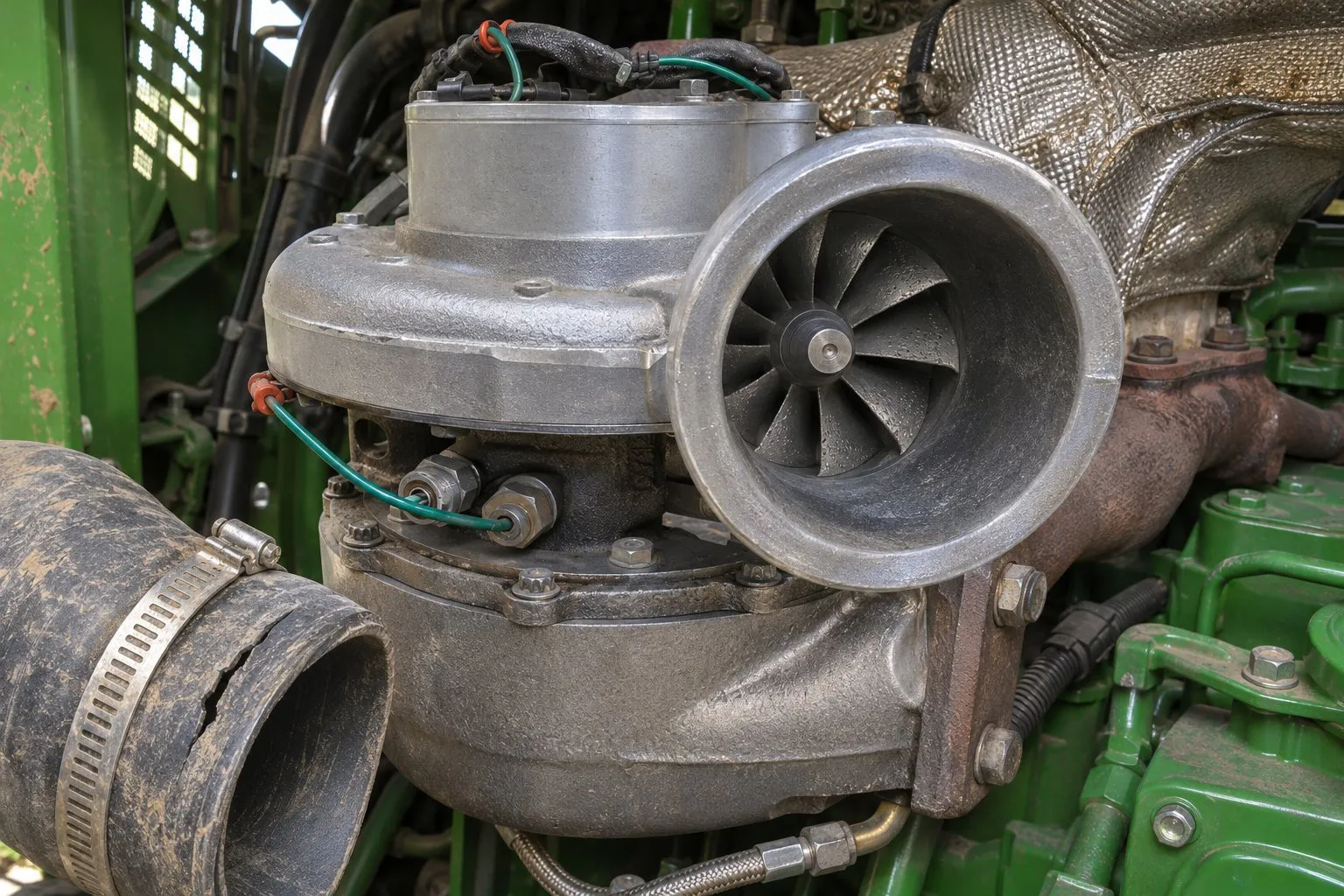
Garrett names oil starvation, oil contamination and foreign objects as the three main causes of turbo failure. It attributes more than 90 percent of failures to the two oil problems. A combine adds dust, chaff and long days under heavy load, so small faults in the air and oil systems turn into turbo failures quickly.
Dust and Chaff
The pipe between the air filter and the turbo is under suction. A crack or loose clamp there cannot leak boost. Instead it pulls unfiltered air straight into the compressor. Dust shows as pitting on the compressor inlet blades, while bent or chipped blades point to a solid object. A damaged wheel is replaced, never rebalanced and reused.
Replace the air filter when the restriction indicator says so. A badly restricted inlet starves the engine of air and can also pull oil past the compressor-end seal.
Oil Supply and Hot Shutdowns
Abrasive bearing wear comes from several sources:
- Carbon
- Engine wear debris
- Dirt let in during service
- A filter in bypass
- Degraded oil
Turbo journal bearings are bronze, so watch copper in oil reports against your own baseline and the lab’s limits. Change oil on John Deere’s schedule, or on its severe-service schedule for dusty, heavy work.
Shutting down hot after a heavy run cokes oil in the center housing. Idle for the cool-down time John Deere gives in the operator’s manual. Starvation is a feed-side fault: low pressure, a blocked or leaking feed line, a hard pull before oil reaches the turbo, or a turbo fitted without priming.
Variable Geometry Units
On a variable geometry turbo like the S300BV, soot from combustion builds up in the mechanism and makes it stick, which shows up as boost faults. The electronic actuator can also fail on its own. Never force the actuator arm by hand, because its gears break. Check it with the service tool, or unbolt the actuator and move the turbo’s lever.
Electronic PowerTech engines log fault codes that you read through John Deere’s diagnostics. The generic OBD-II P-codes used on pickups do not apply to these off-highway engines.
| What you notice | What it points to | Check first |
|---|---|---|
| Low power, black or dark gray smoke | Low boost | Charge-air joints, air filter restriction, exhaust leaks before the turbine, then the turbo |
| Blue-gray smoke, oil pooled in charge pipes | Oil past a seal, or from the engine side | Breather, air filter, oil level and drain before the turbo seals |
| Whine or siren under load | Exhaust or boost leak, or a wheel rubbing | Every joint, then wheel contact with the housing |
| Pitted compressor inlet blades | Dust getting past the filter | Inlet pipe, clamps, filter seal |
| Boost faults on an S300BV | Sticking mechanism or actuator fault | Fault codes, actuator response on the service tool |
A light oil film in the intake is normal crankcase vapor. Pooled oil is not. On the machine, some side-to-side rock at the wheel is normal for a journal-bearing turbo. In-and-out play you can feel, or a wheel that touches its housing, condemns it. Axial play typically runs about 0.001 to 0.004 in, but use the maker’s figure for your unit.
Fitting a Replacement Turbo on a PowerTech Engine
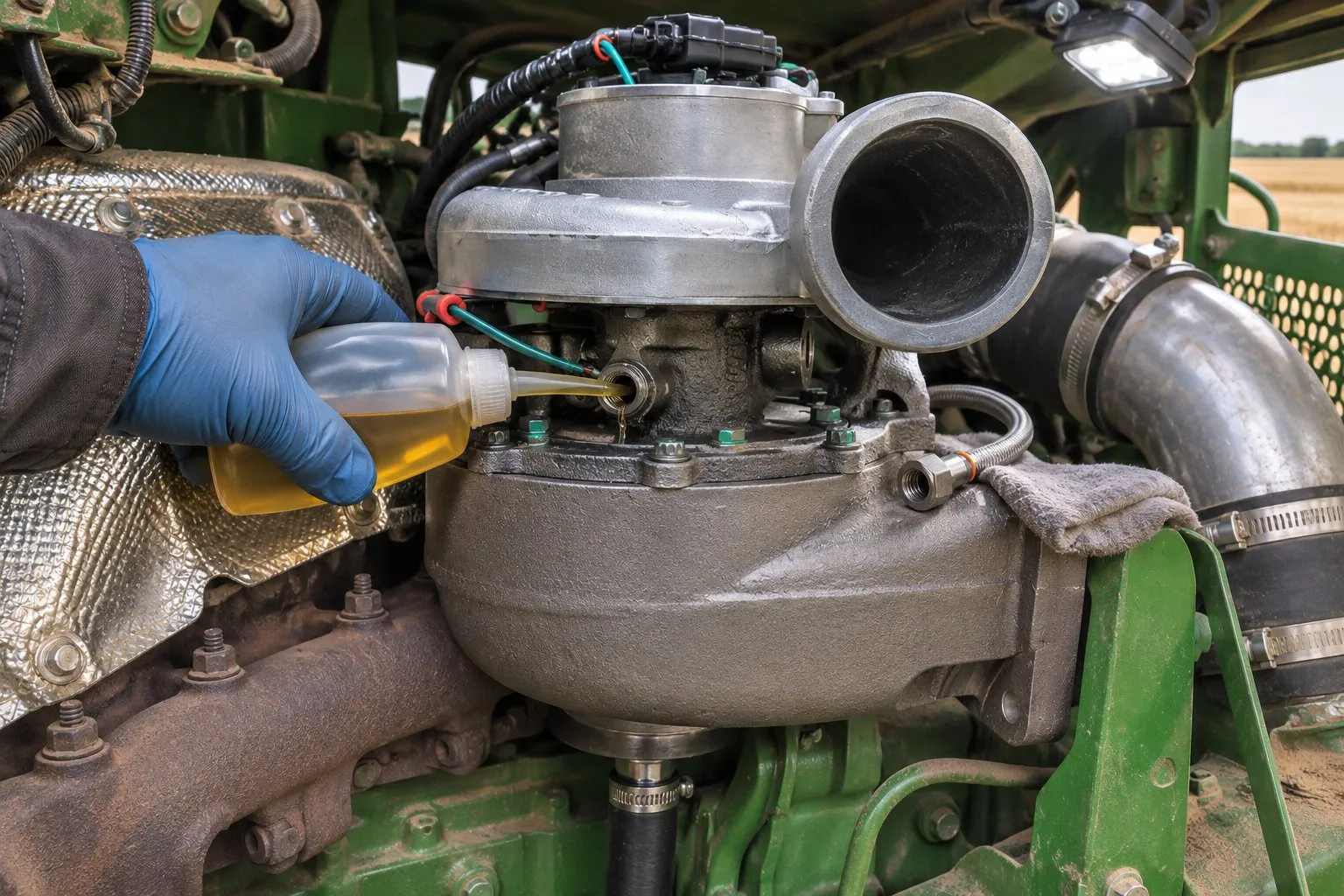
A good turbo bolted onto the same problem fails the same way. Fix the cause first, then follow the makers’ first-start steps.
- Oil feed line: fit a new one after a bearing failure or coked oil, as Garrett recommends.
- Oil drain: the drain is a gravity return. It must run downhill, within about 15 to 20 degrees of straight down, and enter the pan above the oil level. Use new gaskets and no sealant on the inlet or drain.
- Charge air cooler: if the old compressor wheel came apart, replace the cooler. MAHLE says metal in the fins cannot be reliably flushed out, and debris left in the cooler goes into the engine. Clean or replace the charge piping too.
- Prime: fill the oil inlet with clean engine oil and turn the wheel by hand. Crank 10 to 15 seconds without starting, keeping the engine from firing by John Deere’s procedure. Then idle 3 to 4 minutes and check for oil, exhaust and air leaks before you load it.
- Actuator: on S300BV units, run any calibration John Deere’s procedure calls for with the service tool. Calibration matches the actuator to its turbo.
There is no break-in period, and there is no boost limit for the first hours of running.
Rebuild, Remanufactured or New Before the Crop Waits
PT Turbo has more than 45 years in the trade. Our in-house turbo rebuild service inspects your core and confirms the price before work starts. The turbo rebuild price list shows current pricing by turbo. Most rebuilds ship in 3 days or less.
Every turbo we rebuild is VSR (Vibration Sorting Rig) balanced. Each one also gets a final quality inspection: a leak test, a visual inspection, and an actuator or wastegate function check.
The remanufactured units in the table are tested and flow-tested, and their actuators are calibrated before they ship. Our catalog also lists new units for the two 6068H numbers. Core returns are due within 30 days, and the customer pays return shipping. If harvest keeps the old turbo on the machine longer, call ahead and we can usually work with you. The warranty is 12 months with unlimited mileage.
Items in stock at the shop ship the same day when ordered before 2 PM Pacific, Monday through Friday. Most other orders ship within 1 to 2 business days. Stock changes daily, so call (909) 824-1020 to confirm a unit before you plan a repair around it.
Custom harvest crews and farms running several machines can arrange priority turnaround, and stocking of their common cores, through our contact page. For Cummins-powered equipment in a mixed fleet, see our Cummins QSB turbocharger guide. Everything else is in our turbo store.
Frequently Asked Questions
Which turbo fits my John Deere S-Series, T-Series or X-Series combine?
The series name does not decide it. Read the engine model on the engine serial plate and the part number on the turbo’s tag, then match that number. Our combine listings name the engine, such as the 6068H or 6090H. They never name a combine series, model number or year.
Can an S200 replace the S300BV on a 6068H, or the other way around?
Not as a direct replacement. The S300BV is variable geometry with an electronic actuator that the engine controls, while the S200 unit is fixed geometry, so each belongs to a different version of the engine. Order by the number on the tag of the turbo that came off.
Is rebuilding a combine turbo worth it?
It depends on what failed. When the core is repairable, we inspect it and confirm the price before any work starts, and most rebuilds ship in 3 days or less. If the core is beyond repair, a remanufactured or new unit with the same tag number is the route to take.
Need a Turbocharger?
PT Turbo has rebuilt and sold turbochargers since 1978. We stock remanufactured units for Cummins, Duramax, Power Stroke, Detroit Diesel, and more — backed by a 12-month unlimited mileage warranty. Units in stock at our shop in San Bernardino, CA ship the same day when ordered before 2 PM Pacific, Monday through Friday.
📞 (909) 824-1020 · 346 S I St. #3, San Bernardino, CA 92410 · info@ptturbo.com
More From PT Turbo
 Volvo D13 Turbocharger Guide: Holset HE451VE, Symptoms & Replacement Options
- John Deere PowerTech Turbocharger Replacement Guide: 4045, 6068 & 6090 Engines
- Volvo D12 Turbocharger Guide: Holset HX52, HX55 & Garrett GT4594 by Engine Version
- Freightliner Cascadia Turbocharger Guide: DD13, DD15 & DD16 Applications by Year